


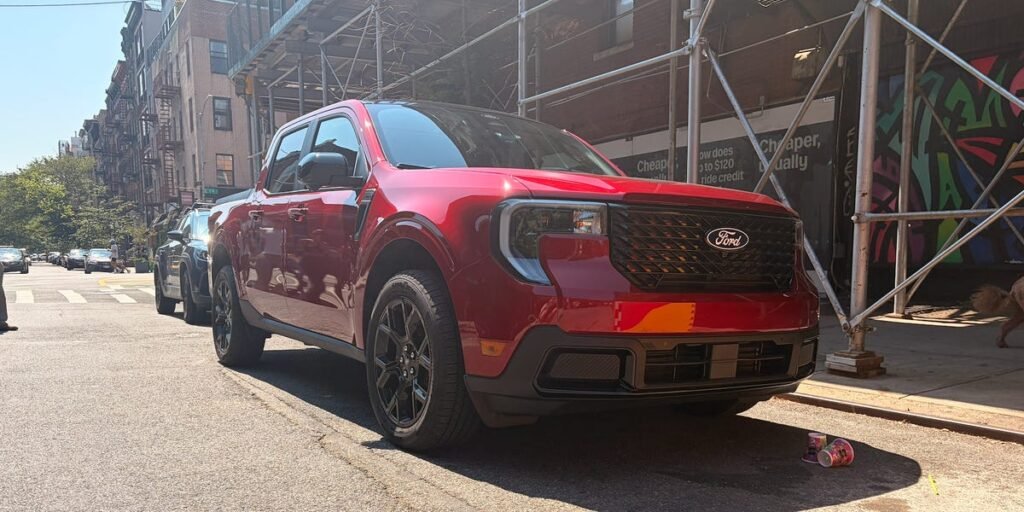
Americans love a big ole, gas-hungry truck.
The full-size Ford F-150 has been America’s bestselling vehicle for more than 40 years. Its closest rivals, the Chevrolet Silverado and Ram 1500, are also top-sellers in the US — and equally gargantuan.
Those trucks are running headfirst into the core issue facing American consumers: gas prices are super high.
Ford has an internal solution. Nestled on their lots between those best-selling F-150s is a smaller, hybrid option, called the Maverick.
The Maverick has a decent-sized bed and an upright truck shape, but occupies about as much mental space behind the wheel as a compact car. It’s pricing starts at $28,145, returns decent fuel economy, and fits inside parking spots without becoming its own geometry problem.
I spent a week with one. I’m convinced it is a practical option for tons of American families.
At least, if they don’t get carried away with options.
My 2026 Maverick Lariat AWD Hybrid cost $46,770 after options, including a moonroof, tonneau cover, tow package, and Ruby Red paint. That is nearly $19,000 more than the base hybrid — and enough to complicate the Maverick’s argument as the affordable antidote to today’s bloated pickups.
The Maverick is upright — in good and bad ways

Ben Shimkus/Business Insider
I drove the Maverick about 150 miles around New York City and on a beach trip to the Jersey Shore with three friends.
It was smooth and nimble at low speeds, with a turning radius that reminds me of a Volkswagen Jetta. Parallel parking was a breeze, and the large, blocky windows provided excellent visibility.
The Maverick’s upright construction shapes nearly everything about it, for better and worse. Its seating position is easy to climb into, and passengers get plenty of headroom. The vertical door panels also leave an unusual amount of storage above the cupholders — you’d be hard-pressed to find a water bottle that was too tall for the Maverick.

Ben Shimkus/Business Insider
The rear seatbacks, however, were so upright that my passengers’ backs hurt after the beach trip. The speakers also sit next to their heads, making it difficult for front- and back-seat occupants to hear each other whenever music is playing.
Hard gray-blue plastic covers much of the cabin. A Redditor who said they owned a Maverick once wrote that those surfaces will scratch if you look at them the wrong way.
Still, the Maverick felt solidly assembled. I noticed no rattles, even through New York City’s harsh roads.
The hybrid returned 33.5 mpg, versus its 36-mpg combined rating. It was smooth around town but slightly whiny on the highway. Ford also supplied a “braking coach” that graded how much regenerative energy I captured whenever I stopped — an amusing feature until it began to feel like an overeager student who loved showing off their homework.
The bed easily swallowed our bags, beach gear, groceries, and sandy shoes. It had more than enough space to haul all the family gear needed for a weekend getaway.
The Maverick’s placement inside Ford

Ben Shimkus/Business Insider
The Maverick could feasibly replace some American SUVs — and that may be exactly what Ford wants.
When I previously asked the automaker about its decision to discontinue the Escape, a representative pointed shoppers toward the Bronco Sport and Maverick.
The Maverick hybrid, they pointed out, was Ford’s cheapest hybrid. Ford also has a pickup that slots in between the Maverick and the F-150 called the Ranger.
There’s another pickup coming to Ford dealerships that could also challenge the Maverick.
The automaker plans to launch a midsize electric truck in 2027 with a target starting price of about $30,000. Ford says it will have more passenger room than a Toyota RAV4, plus a conventional bed and front trunk.
Should Ford hit its target, the EV will offer a proposition remarkably similar to the Maverick’s: manageable dimensions, everyday practicality, and a starting price around $30,000.
That highlights a tension Detroit has yet to resolve during its transition to EVs — its fully electric vehicles are still in direct competition with their gas-powered counterparts.
The Maverick nevertheless makes a convincing case for itself today. It gives buyers the useful parts of a pickup without the bulk or fuel bill of an F-150.
It is best, however, when buyers show restraint. My loaded Lariat was a good truck. A Maverick Hybrid closer to $30,000 may be a great one.