


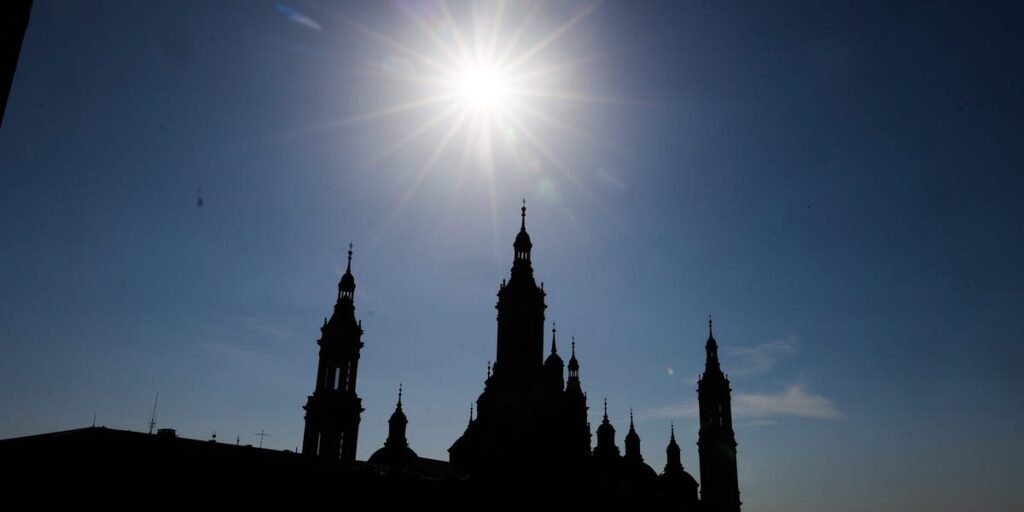
Europeans set their eyes on the sky on Wednesday to witness the only total solar eclipse of the year.
The phenomenon, which occurs when the moon passes in front of the sun, began at 11:34 a.m. ET, with totality lasting up to about 2 minutes and 18 seconds. The lucky few corners of the world with the potential to see the full eclipse were Iceland, Greenland, Spain, the Arctic, and portions of Portugal and Siberia.
In North America, Canada and the northern parts of the US caught a glimpse of a partial eclipse, a far cry from 2024’s eclipse, which swept across the nation and was forecast to drive an extra $1.6 billion to the nation’s economy.
This latest eclipse also brought a tourism boom to Iceland: Data from the UK data firm Lighthouse shows hotel room prices exceeded $1,000 per night in the country’s capital, Reykjavik. That’s 212% above the city’s average rate for 2026.
The next total solar eclipse visible from the US won’t occur until March 2033, but it will only be visible in Alaska. The contiguous US will have to wait until August 2044 to witness the next total eclipse.
In Europe, eclipse events and celebrations varied by region.
Some gathered at Iceland Eclipse, a five-day science and music festival, rubbing shoulders with the likes of artist Imogen Heap, Academy Award-nominated director Darren Aronofsky, American astronaut Sian Proctor, and more.
Others went on multi-thousand-dollar cruises or took a flight. Some airlines allowed travelers the opportunity to see the eclipse unobstructed above the clouds, with people paying up to $1,200 for a seat.
Here are the best photos of the 2026 total solar eclipse.
This was mainland Europe’s first total solar eclipse since 1999.


Sarah Meyssonnier/Reuters
Spectators celebrated at parks, viewpoints, and festivals on the ground, as well as aboard special flights.
Artur Widak/NurPhoto via Getty Images
A photo taken in Caspe, Spain, shows the moon beginning to eclipse the sun.
Aaron Chown/PA Images via Getty Images
A shortage of solar eclipse glasses in UK shops left some scrambling.
Henry NICHOLLS / AFP via Getty Images
Others came up with alternative eye-protection options.
Dan Kitwood/Getty Images
Through the clouds in Stockholm, viewers could see about 83% of the sun obscured.
Fredrik SANDBERG / TT NEWS AGENCY / AFP via Getty Images
Scientists on the ground — and in the sky — studied the eclipse to better understand the sun’s magnetic field.
Ed JONES / AFP via Getty Images
Cloud cover blocked the view in parts of Northern Europe.
Stian Lysberg Solum / NTB / AFP via Getty Images
Greenland saw a boost in tourism for the total solar eclipse. Some cruise ship tours cost upward of $10,000.

Owen Humphreys/PA Images via Getty Images
The sun’s corona, or outer atmosphere, was visible during totality.
Jakub Porzycki/NurPhoto via Getty Images