



Author
Ahmed Barakat


Author


Share



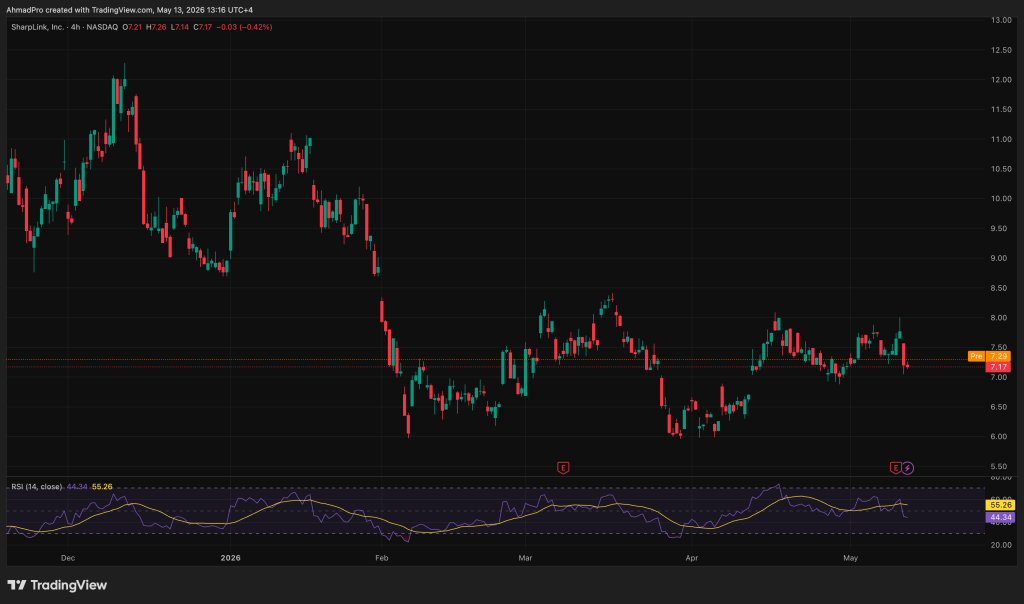
SharpLink posted a Q1 2026 net loss of nearly $686 million, driven almost entirely by $507 million in unrealized losses from its Ethereum treasury, a figure that dwarfs the firm’s less than $1 million loss in the same period last year. Bearish news for ETH treasuries.
The trigger was a 45% peak-to-trough ETH drawdown that turned the company’s aggressive accumulation strategy into a paper catastrophe under GAAP fair-value accounting rules.
The same earnings release announced a $125 million on-chain yield fund with Galaxy Digital, which some analysts are reading as a lifeline in disguise.

The tension at the center of this story is real: does the Galaxy deal signal institutional confidence in ETH staking infrastructure, or does it signal that SharpLink needed a structural backstop to stay credible? Those are not the same thing.
How a 45% ETH Drawdown Produced a $686M Loss, and Why the Math Works That Way
The mechanism here is worth understanding precisely, because it is not a trading loss or an operational failure in the traditional sense.
SharpLink holds approximately 872,984 ETH valued at roughly $2.1 billion at current prices. GAAP fair-value accounting requires the firm to mark those holdings to market at each reporting date, which means a price decline flows directly into the income statement as an unrealized loss – no ETH sold, no cash out the door.
ETH fell from approximately $3,354 on January 15, 2026, to $2,104 by March 31 – a drop of roughly 37% over the quarter alone, contributing the bulk of that $507 million unrealized hit.
Across the broader peak-to-trough cycle, the 45% ETH drawdown compressed the dollar value of SharpLink’s entire treasury position with mechanical precision. The larger the ETH stack, the larger the paper loss on the way down.

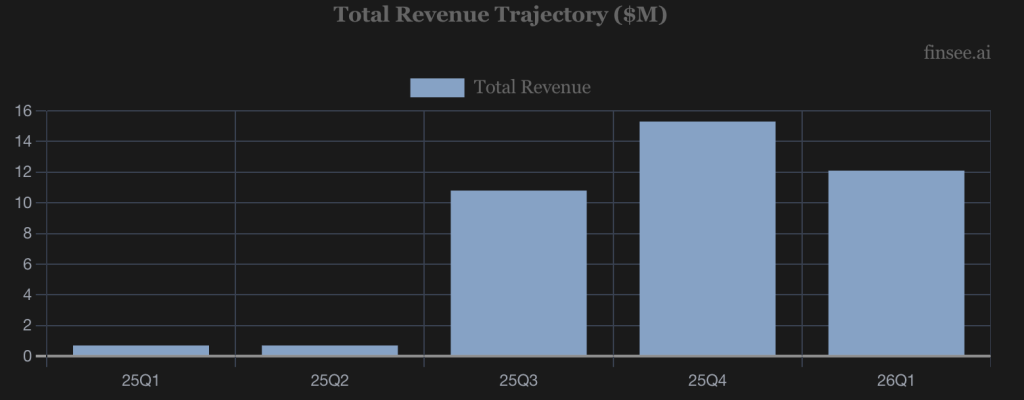
The staking revenue side did not come close to offsetting this. Q1 2026 revenues jumped to more than $12 million from under $1 million a year earlier, a genuine operational improvement powered by the firm’s staked Ethereum treasury.
SharpLink has accumulated 18,800 ETH in staking rewards since launching its treasury strategy in June 2025, running a mix of 66% native staking, 33% liquid staking, and 1% restaking. That is a functioning yield engine. It is just not a $507 million yield engine.
The distinction that matters analytically: this is not a validator economics failure, nor a leverage blowup. It is a concentration risk event, amplified by accounting standards that require mark-to-market recognition of assets that have not been liquidated.
SharpLink ended Q1 with $16.9 million in cash and 872,984 ETH still on its books. The loss is real on paper. The ETH is still there.
That said, the accounting and liquidity risks in institutional Ethereum staking operations are not theoretical. A 45% drawdown does not just create paper losses; it compresses the equity cushion that supports the entire treasury model and raises legitimate questions about what a further leg down would look like on the balance sheet.
Ethereum News: The Galaxy Digital Fund Is a Signal, But Not Necessarily the One Being Advertised
The $125 million on-chain yield fund announced alongside the Q1 results is structured as follows: $100 million comes from SharpLink’s staked ETH treasury, and $25 million from Galaxy Digital. Galaxy is responsible for protocol selection, exposure sizing, and ongoing monitoring of all on-chain deployments.
SharpLink brings the capital. Galaxy brings the operational oversight.
Galaxy Digital CEO Mike Novogratz framed the deal in sector terms: “Institutional capital is moving on-chain, and the infrastructure to support it has matured to a point where allocators can access yield, liquidity, and risk management with the same rigor they expect in traditional markets.”
That is a bullish read on institutional crypto broadly, and Galaxy’s own stock performance supports the narrative. GLXY shares are up 43% in the last month, recently trading at $30.92.
SharpLink CEO Joseph Chalom described the strategic direction as moving “beyond foundational staking into a broader set of on-chain opportunities,” emphasizing a “comprehensive risk-management framework” designed to deliver shareholder value across market cycles.
The language is disciplined. The timing raises a question worth naming: a firm reporting a $686 million quarterly loss is not negotiating from a position of strength.
The conflict of interest embedded in this structure is also worth naming. Galaxy is both a financial contributor to the fund and the entity managing its on-chain deployment decisions.
That does not make the partnership wrong. It does mean the assumption that Galaxy’s protocol selection is purely independent of its own positioning deserves scrutiny from investors and analysts watching this sector.
If ETH price recovers meaningfully through Q2 and Q3, the fund launch will look like a well-timed DeFi pivot that turned a paper-loss narrative into a yield-diversification story.
If ETH continues to grind lower, the $100 million deployed from SharpLink’s treasury into on-chain protocols will be exposed to additional mark-to-market pressure on top of the core holdings. The asymmetry runs in both directions.