


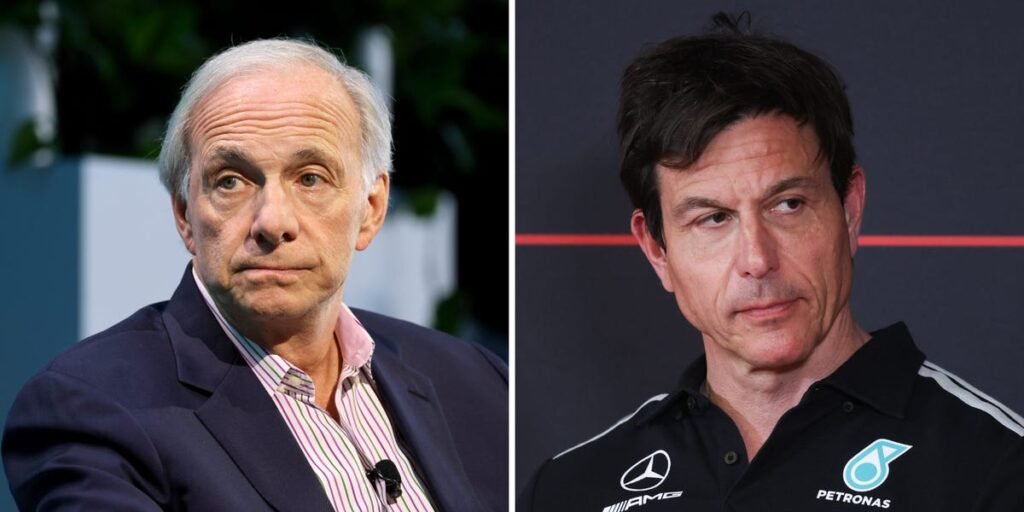
Investing and F1 may not share obvious similarities at first glance, but when it comes to managing people, some lessons cross disciplines.
During a recent conference appearance, Bridgewater Associates founder Ray Dalio and Toto Wolff, the billionaire CEO of Mercedes F1, agreed that demanding leaders need to pair high standards with genuine care for their teams.
As Dalio put it, management needs to implement “tough love.”
“My mantra is meaningful work and meaningful relationships,” Dalio said on a panel at the Milken Institute Asia Summit in Singapore last week.
“When I say tough love, there’s the tough, but there’s also that element of love, that element of mutual caring.”
Dalio, who built Bridgewater into the world’s largest hedge fund, said leaders need a clear mission and have to hold people accountable for delivering on it. But he argued that pressure without a sense of shared purpose can undermine a team.
“You want tough love with your kids; you want tough love with everything because tough makes you stronger,” he said. “And then also when you have a team, you have to make that team successful.”
Wolff offered a case study in how that balance can be difficult to get right. He recalled putting “pressure and pressure” on a senior Mercedes technical leader during a disappointing season, after the team’s run of eight straight constructors’ championships ended.
After Wolff publicly said Mercedes’ car did not deserve to win a race, the executive told him he was considering leaving because he could no longer handle the pressure.
Want more Business Insider in your news feed?
Add BI in Google so our reporting is easier to find when you’re searching for what matters.
Wolff said he ultimately changed course. At a dinner intended to resolve the dispute, he offered the executive a contract allowing him to leave on one month’s notice, far shorter than the usual notice period for senior technical staff, and told him to set his own salary and bonus.
“Fundamentally, I had to change,” Wolff said. “I couldn’t continue what I thought was my modus operandi over 30 years.”
Dalio said that kind of mutual care matters beyond compensation. While money is important, he said, employees and leaders alike are motivated by connection, purpose, and a sense of belonging to a community.
Dalio’s comments echoed an earlier point Wolff made: that workers are not motivated by pay alone. The Mercedes boss said leaders who understand employees’ personal priorities, whether that is recognition, time with family, or room for a hobby, are better placed to keep them.
Dalio took that idea further, arguing that once people have enough money to meet their needs, happiness is no longer closely tied to wealth.
“The greatest determinant of happiness is a sense of community,” he said.