


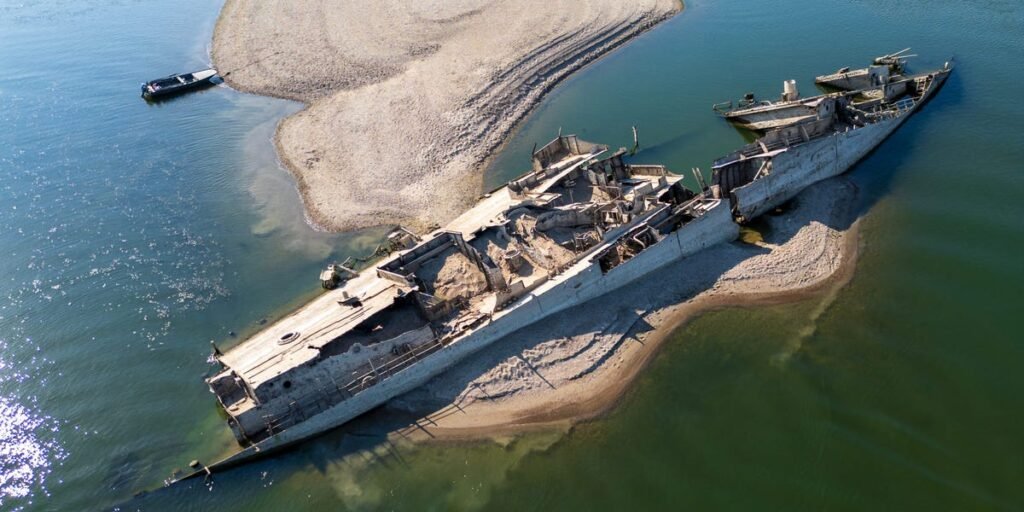
A combination of severe heat and little rain has left many of Europe’s rivers drier than normal this summer, revealing formerly submerged relics and blind spots in the continent’s supply chain.
The two rivers at the center of the crisis are the Danube and the Rhine.
Both serve as major arteries for shipping and freight transport across Europe. In 2025, Germany and the Netherlands accounted for nearly 72% of the EU’s total inland waterway transport, according to the European Statistical Office, or Eurostat.
Beyond freight, they also have long histories dating back to wartime and prehistoric animal migration. This summer, record-low water levels have brought long-submerged relics to the surface.
A local resident in Ryahovo, Bulgaria, stumbled upon woolly mammoth remains and notified both local authorities and the Regional History Museum in the nearby town of Ruse.
Krasimir Kirov, a curator and ecologist at the museum, told Business Insider that this is not the first time mammoth remains have been discovered in the region, with discoveries dating back to the mid 20th century.
The current lower water levels and direct sunlight, however, threaten the preservation of the bones, he said.
“The water plays the role of the conservator of the conditions,” Kirov said. “When the level is down and the bones are in contact with the air, this often leads to irreversible damage. Especially if specialists are not able to discover them in time.”
Elsewhere along the rivers, low water levels have exposed World War II-era shipwrecks and other historical artifacts.
Unearthing lost artifacts is one of the few positives of the European summer heat wave. The low water levels are also disrupting inland waterway freight transportation. EU inland waterway freight was already down 3% in 2025 compared with 2024, according to Eurostat.
Germany, in particular, has felt the economic effects of the low water levels. The country could see a 0.3 percentage-point fall in its GDP growth this year — a loss in the billions — due to low water levels, according to the Dutch banking firm ING.
Richard Lee, a spokesperson for Wetlands International, a wetlands protection advocacy group, cautioned in an August 6 video that climate change and Europe’s dredging and draining have fueled the water-level crisis.
The low water levels could persist, with forecasts indicating warmer and drier-than-average conditions into September, according to the European Commission’s Joint Research Centre.
Here’s what has been discovered along the rivers.
Multiple World War II shipwrecks have re-emerged.


Andrej ISAKOVIC / AFP via Getty Images
Some shipwrecks date back to the 19th century.

Sem van der Wal / ANP / AFP via Getty Images
A local resident in Ryahovo, Bulgaria, found the lower jaw, femur, tusk, and ribs of a young woolly mammoth along the Danube River.

LYUBOSLAV YORDANOV/SLIVO POLE MU/Reuters
Some have taken advantage of the low water levels by hunting for smaller historical artifacts.
Christian Butt/picture alliance via Getty Images
Along the Rhine River in Germany, archaeologists discovered Bronze Age arrowheads.
Christian Butt/picture alliance via Getty Images
20th-century eel ships have re-emerged completely intact along the rivers.
Hesham Elsherif/Anadolu via Getty Images
Previous droughts have unearthed sunken German warships still armed with explosives.
Darko Vojinovic/AP
Artifacts of the recent past have washed up, too.
Sjoerd van der Wal/Getty Images
Archaeologists are under pressure to quickly uncover relics before rising water levels submerge them again.
Fabrice COFFRINI / AFP via Getty Images