


With wars in the Middle East and in Ukraine, a new era of drone warfare has arrived that’s harming more civilians.
Skies are full of large, powerful, and lethal drones that are much cheaper than cruise and ballistic missiles. That means more of them are being launched and need to be stopped.
The United Arab Emirates, for example, said that as of Wednesday, it had intercepted far more drones than missiles: 876, compared to 183 ballistic and cruise missiles.
The process of defeating drones and missiles can cause problems of its own. There are more targets to intercept, and US allies have said that objects hit in flight have killed civilians and damaged homes.
AP Photo/Evgeniy Maloletka, File
“Large-scale drone war is a civilian risk because there are more projectiles in the fight than if it were just missiles, thus inherently creating more debris,” Molly Campbell, a drone and counterdrone warfare expert at the Center for a New American Security, told Business Insider. It’s not that drone debris inherently causes more damage than missile debris, but there can be so much more of it.

Every time Sinéad publishes a story, you’ll get an alert straight to your inbox!
Stay connected to Sinéad and get more of their work as it publishes.
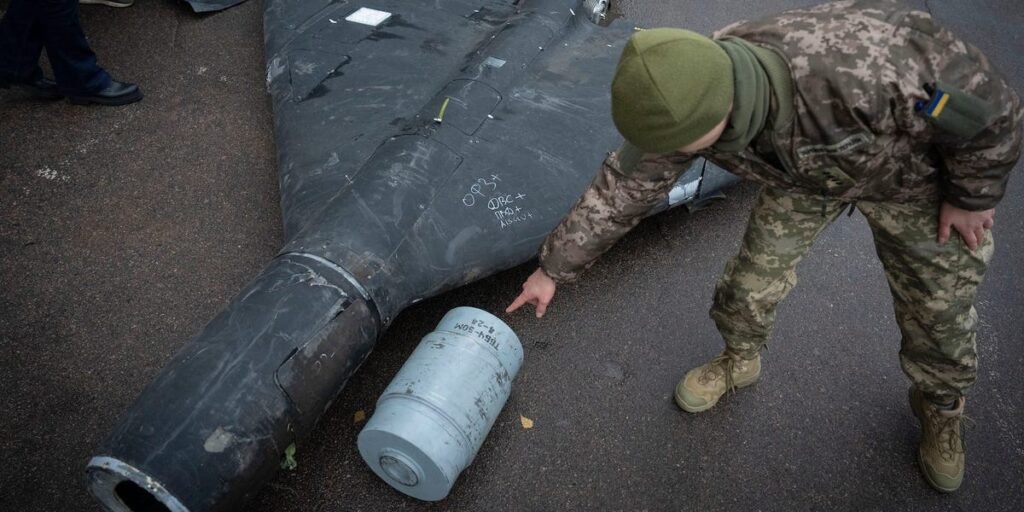
The use of drones in warfare is surging. Ukraine says Russia attacks with about 6,000 Geran drones modeled after Iran’s Shaheds each month. A Shahed drone has a wingspan of roughly 8 feet and can carry a warhead up to 110 pounds.
Militaries want to stop attacks before they reach a military target, and that could be dangerous if they’re flying over populated areas.
The problem is that “what goes up must come down,” Mark Cancian, a senior advisor at the Center for Strategic and International Studies, told BI.
Mahmud HAMS / AFP via Getty Images
A missile that hits its target will typically cause more damage than a drone due to its higher speed and larger warhead.
It’s simply dangerous when “large numbers of drones are being intercepted over populated areas,” as James Patton Rogers, a drone expert at the Cornell Brooks Tech Policy Institute, put it to BI.
Most drone interceptions in the Middle East appear to be kinetic, which involves a projectile launched to hit and destroy them. “Kinetic interceptions create debris, and the risk of collateral damage is real and particularly complex in the urban settings we’re seeing in the Gulf,” said Campbell, the drone expert at the CNAS think tank.
Interception comes with its own risks. It could merely deflect the threat or achieve a partial hit that divides the missile into fragments that leaves its warhead active.
The problem of debris from intercepting an attack isn’t new, and it’s long been a factor in missile defense. In Europe, for example, Douglas Barrie, an air warfare expert at the International Institute for Strategic Studies, told BI that there has always been the knowledge of “if you try to intercept things at extended range, then you might be shooting something down effectively over somebody else’s airspace,” and cause damage to an ally.
Pierre Crom/Getty Images
The problem with drones, Barrie said, is that “there are so many of them that if you intercept them at comparatively short range and it’s a kind of urban or a quasi-built-up environment, then some of them are going to fall in populated areas. It’s inevitable.”
Militaries can and do try to intercept attacks while causing minimal damage. Modern air defense systems track threats like drones and missiles to give air defense crews a sense of what they threaten and whether they should be countered.
Rogers said that civilians can often become better protected over time in a long conflict or war, as “a kind of bunkerisation begins to take place as societies adapt to the risk.” In Ukraine, for example, people receive alerts about bombardment and move to hardened shelters. But that’s also a negative outcome: “In that sense, drones don’t just kill people, they take the life out of a city.”
The low cost of drones enabled so many more of them to be used. Iran’s Shahed one-way attack drones cost an estimated $20,000 to $50,000 each, for example. Missiles cost far more: hundreds of thousands if not millions of dollars each.
The effects of large-scale drone warfare are clear in Ukraine, where drones are being used more than in any other conflict in history. Ukriane’s military relies on them, and Ukrainian President Volodymyr Zelenskyy said in January that Russia had fired more than 57,000 of its Shahed-style drones since the full-scale invasion began in 2022.
Russia’s drones have devastated Ukraine. Many still caused harm even after being intercepted.
Diego Herrera Carcedo/Anadolu via Getty Images
Both the Middle East and Ukraine show that “future conflicts will likely feature high-volume drone and missile attacks designed to saturate air defenses,” meaning more of them flying over and near civilian areas, Campbell said.
Countries will need to stop these attacks, making the debris risk unavoidable, Campbell said.
“Debris from kinetic interceptions compounds this risk — but it remains far preferable to allowing an armed drone or missile to hit its target.”