


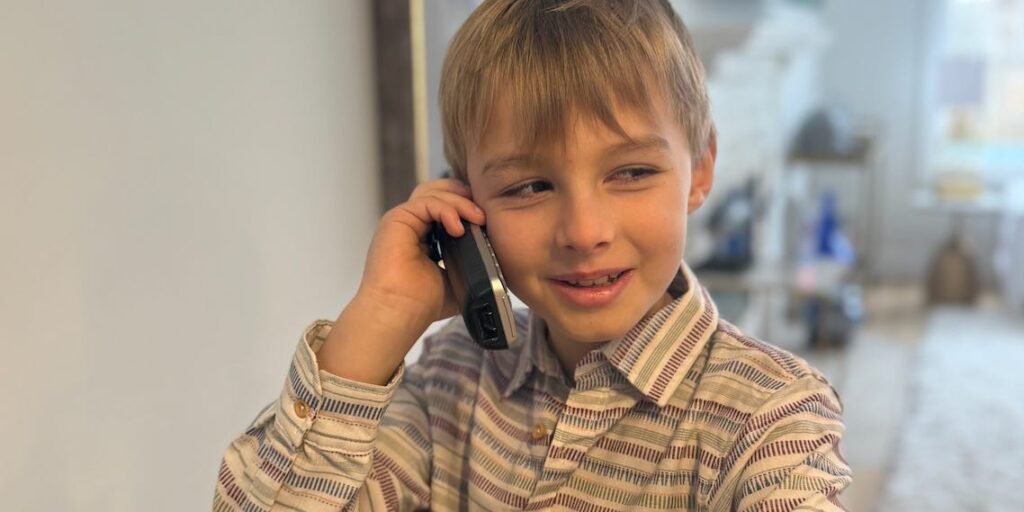
My now 8-year-old son consistently uses our landline to call his friends and classmates and ask for playdates. He has been initiating these telephone calls since he was 6 years old.
He doesn’t wait for me to text their parents first. Oftentimes, I am so busy that I rarely find the time to even do that. He takes the class list, finds the phone number, decides who he wants to invite, and makes the call himself.
My son grabs the friends list, finds who he wants to call, calls, and asks for a playdate. Then I step in to confirm the logistics with the parents. He has no hesitation speaking with anyone, whether it’s their mom, dad, grandparent, or a friend.
Watching him do this in real time has made me realize how rare everyday social independence has become for children.
Parents do so much for kids right now
So much of childhood is now managed by adults. Parents text parents. Parents make the plans. Parents get the birthday reminders, buy the gifts, and manage every social detail from start to finish. We say we want independent kids, but many of us are still operating as their assistants, schedulers, and intermediaries.
Courtesy of the author
My son, Ben, is a self-starter. He is mature in ways people sometimes dismiss because of his age. He chooses his own outfits, hangs up his clothes, helps with the laundry, and empties the dishwasher. He likes responsibility. At home, we leave plenty of room for reading, creativity, and board games. We keep internet exposure very limited. We are outside a lot more. He spends time catching fireflies with his friends, running around, and doing carefree activities that don’t need an overstimulating screen to feel meaningful.
I ask my child hard questions
I am very hands-on with him, mostly through conversation. I ask him hard questions. I push him to think, then think some more. I do not want him to take everything at face value. I let him lead in some ways, even in small things like choosing parts of dinner or helping shape social plans, but not in everything. I am firm when he misbehaves. If I hear he was not on his best behavior at someone else’s house, I take action and address it immediately.
When he initiates playdates with other children, it becomes my responsibility to also strengthen the connection with the parents. I want them to know that the other parents can talk to me openly. For this to work, it has to be open communication, not just between the children, but between the families.
In some ways, I am acting like my son’s personal secretary. From time to time, Ben’s friends call my phone, and I change my tone almost instantly, from speaking like an adult to speaking with a child who is politely asking for Ben, or trying to figure out a playdate, or wanting to get together for tennis or practice. It is so sweet. These children are trying. They are learning to initiate contact rather than waiting for adults to do it for them.
Ben has expanded that instinct beyond playdates. He arranges practice times with his jiu-jitsu buddies. He helps set up tennis games with his fellow young players. In the transcript, I also pointed out that he has picked up practical skills through all of this: learning phone numbers (and understanding area codes), dialing them, memorizing them, even understanding the basics of group calls.
The class list includes names, phone numbers, and email addresses of parents.
Independence also creates its own challenges
Ben gets this burst of energy early in the morning, and with that, immediately wants to call his friends. I have had to teach him phone etiquette because not everyone expects a call at 7 a.m. Not every missed call needs to be followed by four more in a two-hour span. There is social confidence, and then there is social awareness. He needs both.
Ben loves making handwritten birthday cards at home from construction paper. It allows him the freedom to be creative. He wraps his friends’ presents too. And when we shop for them, I will sometimes give him a debit card with a set budget and let him choose.
Courtesy of the author
The first birthday card I really remember was for his best friend, Mark. His mother texted me to tell me Ben had tucked the card into Mark’s desk that morning before school. It was not only a sweet gesture but also self-directed. He thought of his friend and seized the opportunity to surprise him without adult support.
I also think parents underestimate how much children’s social lives affect our own. Ben has helped me grow my friendship circle, too. Through his friendships, I have deepened relationships with other parents. What starts as one playdate or one conversation after an activity can turn into something much more meaningful. Over time, these relationships can begin to feel like extended families — not formal, not forced, but real. There is more overlap, more trust, more openness, and more shared life.
On a practical level, that has helped me professionally too. Stronger community ties have a way of expanding everything. But more importantly, it has made our lives feel richer and less isolated. There is more social time. More time outside. More natural connection. More spontaneity. More people who know one another, look out for one another, and communicate honestly.
He is still very much a child
Too often, parenting swings between overmanagement and total passivity. I am seeking something in the middle: I want to give both my son and my daughter the ability to act while allowing them the space to think and reflect.
One day, these same habits will become adult skills such as taking initiative, building trust, reaching out first, respecting boundaries, and understanding that independence and community are not at opposite ends. They are the pillars for strengthening each other.