


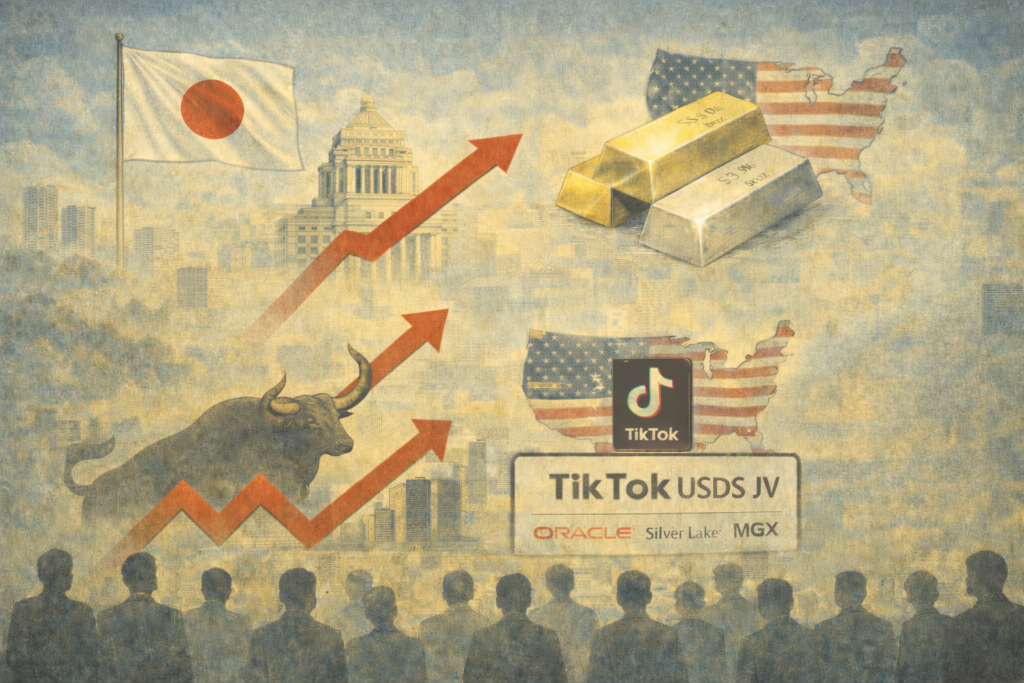
Asian markets advanced on Friday after the Bank of Japan kept interest rates unchanged, while a weaker US dollar pushed gold and silver to fresh records.
The session unfolded against a backdrop of major geopolitical and corporate developments, including a landmark US deal for TikTok, political uncertainty in Japan after a snap election call, and renewed strains in US–Canada relations following comments from President Donald Trump.
Asian markets and central bank signals
Copy link to section
Stocks across Asia moved higher after the BOJ held its benchmark rates steady.
MSCI’s broadest index of Asia-Pacific shares outside Japan rose 0.53%, while Japan’s Nikkei 225 gained 0.2%.
S&P 500 e-mini futures edged up 0.2% after fluctuating between gains and losses.
The yen weakened 0.1% to 158.61 per dollar following the decision.
“The tone appears hawkish,” said David Chao, global market strategist for Asia-Pacific at Invesco in Singapore, in a Reuters report. “The BOJ has raised four of its six inflation projections and indicated that further rate hikes are likely if these forecasts are realised.”
Chao noted that the central bank did not directly address volatility in Japanese government bonds.
“It’s evident that the Takaichi administration is monitoring the bond market closely and is concerned about the recent meltdown,” he said, adding that similar attentiveness from the BOJ would be reassuring.
U.S. markets extended gains overnight after Trump softened his stance on tariffs against Europe.
The S&P 500 rose 0.5%, and the Nasdaq Composite climbed 0.9%.
Analysts at Societe Generale said: “Markets welcomed the shift, with a rebound in risk assets and a flattening of government bond yield curves. Policy uncertainty remains high, however. Further twists and turns are likely.”
The US dollar index hovered near year lows, while gold rose to $4,943.43 an ounce and silver jumped to $98.88.
“The dollar weakness is about a loss of US credibility and prestige,” said Kyle Rodda of Capital.com. “The rise in gold is the inverse of the loss of US credibility.”
TikTok finalises US joint venture
Copy link to section
TikTok’s Chinese parent ByteDance finalised a deal to place the app’s US operations into a new, majority American-owned joint venture, averting a potential nationwide ban.
The TikTok USDS Joint Venture LLC will be owned 80.1% by American and global investors, with ByteDance retaining 19.9%.
Managing investors include Oracle, Silver Lake, and MGX.
A White House official said both the US and Chinese governments had signed off on the deal.
Trump praised the agreement, saying TikTok “will now be owned by a group of Great American Patriots and Investors, the Biggest in the World,” and thanked Chinese President Xi Jinping for approving it.
TikTok said the venture “will operate under defined safeguards that protect national security through comprehensive data protections, algorithm security, content moderation, and software assurances for US users.”
Its recommendation algorithm will be hosted in Oracle’s US cloud and retrained using US user data.
Japan dissolves lower house for snap election
Copy link to section
Japan’s Prime Minister Sanae Takaichi dissolved the lower house of parliament on Friday, calling a snap election for Feb. 8 in a bid to shore up her narrow majority and secure a mandate for expansionary fiscal policies.
Campaigning is set to begin officially on Tuesday, with the interval between the dissolution of the Diet and election day the shortest on record at just 16 days.
The vote will also take place during one of Japan’s coldest months, heightening concerns that snowfall could suppress turnout in affected regions.
Sanae Takaichi appears to be relying on strong personal approval ratings to secure a nationwide mandate to advance expansionary fiscal measures.
She has pledged to introduce a temporary reduction in the consumption tax on food should she win renewed backing for her newly formed coalition.
“I will put my job as prime minister on the line with these election results,” Takaichi said, adding that failure to win a majority could lead to a different premier.
Inflation is expected to be a key issue, with government data showing consumer prices have remained above the BOJ’s 2% target for four years.
Trump withdraws Canada’s ‘Board of Peace’ invitation
Copy link to section
Tensions between Washington and Ottawa intensified after Trump withdrew an invitation for Canada to join his proposed “Board of Peace,” days after Prime Minister Mark Carney warned against economic coercion by major powers at the World Economic Forum in Davos.
US President Donald Trump said in a post on Truth Social on Thursday evening that the Board of Peace had withdrawn its invitation to Canadian Prime Minister Mark Carney to join the body.
Carney said last week that he had planned to accept the invitation, though key details, including the financial terms, had yet to be finalized.
Countries seeking a permanent seat on the board are required to pay $1 billion.
“Great powers have begun using economic integration as weapons,” Carney said, citing tariffs and supply chains as tools of coercion.
Trump responded on social media, saying, “Canada lives because of the United States. Remember that, Mark, the next time you make your statements.”