


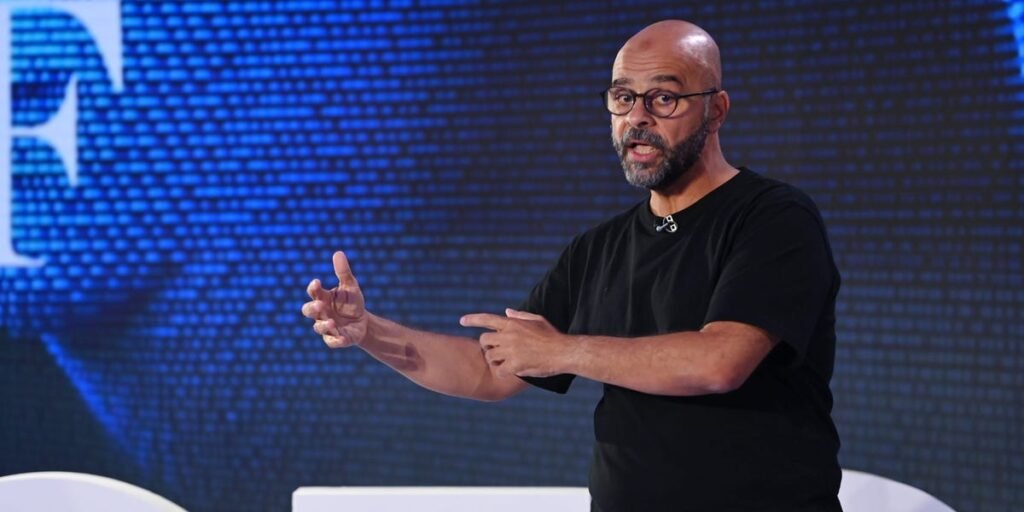
“There’s nothing sci-fi about AI. I think that’s one of the biggest myths in our world today,” Mo Gawdat said.
Gawdat spent decades working across IBM, Microsoft, and Google, and today is a prominent voice and author on AI safety.
In 2020, shortly after leaving his role as Google’s chief business officer, Gawdat made several predictions about artificial intelligence based on patterns he was seeing inside the technology.
In a recent video interview with Business Insider, he said that three of those predictions have come true and described how they are beginning to shape the societal disruption that may come next.
Prediction 1: ‘AI is inevitable’
“AI is inevitable,” he said, adding that there will be “no way to stop it.”
That momentum is already visible in how AI systems shape everyday behavior. “If anyone is watching that video that we’re recording right now, it’s because an AI recommended it to them,” he said.
Once the technology proved useful, competition ensured its expansion. Gawdat described an AI “arms race,” where nations and corporations push forward to avoid falling behind.
He said that dynamic could lead to a world where more decisions are handed over to machines as systems scale faster than humans can manage.
Over time, he suggested, that shift could redefine how power, competition, and coordination work at a global level.
“This is the very first time ever that the episode of history where humanity was the smartest being on the planet ends,” he said.
Prediction 2: AI will become smarter than humans in everything
AI models already outperform humans in many specific tasks, from pattern recognition to strategic gameplay.
Gawdat referenced systems like AlphaGo Zero, which in 2017 learned to play the game Go without human input and surpassed top-performing predecessors within weeks.
Gawdat argued that modern AI can “reason now like humans can,” drawing on vast datasets and neural networks that mirror aspects of the human brain.
The result, he suggested, could accelerate progress in ways that are difficult for humans to track or control. Systems that can learn, share knowledge instantly, and improve their own code may compress years of human work into a microsecond, he said.
Over time, that shift could reshape how expertise is defined.
As machines take over analytical and technical tasks, the remaining advantage for humans may center more on judgment, ethics, and interpersonal connection — areas Gawdat said AI is less likely to replicate in the same way.
Prediction 3: Some things will go wrong
Indeed, things have already taken a turn, with mass tech layoffs and power outages, including one that led to 120,000 lost Amazon orders. But he says this is just the beginning.
Gawdat described a period of instability ahead. He expects disruptions to labor markets, with up to “50% unemployment in certain sectors” as automation expands.
He also warned about the erosion of shared reality. “We’re going to go through an erasure of reality and the ability to recognize what is true and what is fake,” he said.
That breakdown could have ripple effects beyond the technology sector. If people struggle to agree on what is real, it may become harder to maintain trust in institutions, media, and even personal relationships.
At the same time, Gawdat suggested the disruption could force a broader reset.
As economic systems and information networks come under pressure, societies may need to rethink how work, value, and truth are defined in a world where machines can generate both output and influence at scale.
He connected that risk to human behavior rather than the technology itself. The near-term danger, he said, comes from how people use powerful systems — including for misinformation, surveillance, or conflict.
He also warned about the erosion of shared reality, where AI-generated content makes it harder to distinguish what is real from what is not.
Across all three predictions, Gawdat returns to the same theme: the challenge is not intelligence itself, but the context in which it is deployed.
The ultimate outcome, he said, will depend less on the technology and more on the decisions humans make while it evolves.