


University officials and military students say they were blindsided by a Pentagon decision to not only sever ties with Harvard University, but also put dozens of other colleges under review.
Troops pursuing military legal and specialist careers are barred from attending Harvard through certain Defense Department-funded programs, officials say, and recent internal messaging has raised the prospect that other long-standing education partnerships could be affected as well.
After an internal list of schools under review leaked online last week, Business Insider reached out to each institution for their reaction to the news.
A spokesperson for The George Washington University said the school had not “received any direct notification or communication” from the Department of Defense. Northeastern University said the same, sharing that while it was aware of press reports on the matter, it was still working to establish facts.
“I’m a little bit flabbergasted,” said a professor at one listed school. “This is very strange.” Another questioned what the long-term effects of this decision might be. It’s a question military students are asking as well.
“We’ve had no clarification as to what’s going on,” shared a prospective lawyer currently on active duty and enrolled at one of the listed schools. Like the professors, they spoke on the condition of anonymity out of fear of professional repercussions.
‘Have a backup plan’
Last Friday, screenshots of internal US Army emails began circulating online. The emails, which CNN first reported and Business Insider verified, identified Harvard University as “fully off limits” for service members seeking US military tuition assistance while marking 33 other schools as moderate or high risk. Self-paying students were also encouraged to apply elsewhere.
One email said that prospective students who had applied to or had been accepted to schools like American University, Stanford University, or Georgetown University, among others, “should have a backup plan” in case the Pentagon gives those schools the same treatment as Harvard.
Army spokesperson Cynthia Smith said in a statement to Business Insider on Tuesday that only US military ties to Harvard are being halted. Other university programs are under review, she said, but “no further decisions have been made at this time.”
A separate defense official who requested anonymity to discuss sensitive issues also told Business Insider that the list is still “up in the air.”
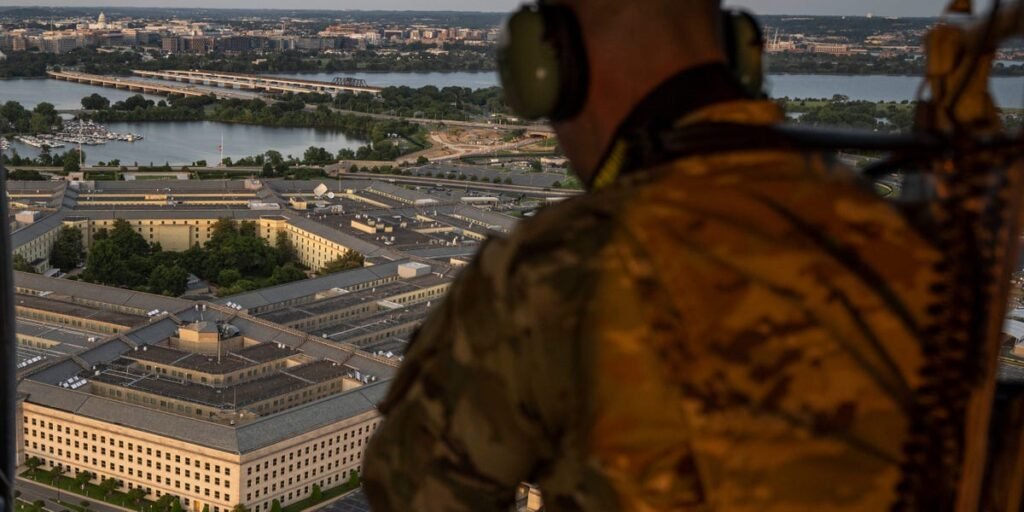
DoD photo by U.S. Air Force Staff Sgt. John Wright
Such considerations signal a potentially significant shift in how the US military interacts with civilian universities — institutions that have long played a central role in educating military lawyers, specialists, and leaders rising to higher ranks — and raise questions about whether political factors are shaping where troops are permitted to study.
The Department of Defense declined to provide any further clarity and referred Business Insider to a social media post by Secretary of Defense Pete Hegseth earlier this month that said the Pentagon intends to sever ties with Harvard for all professional military education programs and fellowships.
Hegseth, who received a master’s degree in public policy from Harvard’s John F. Kennedy School, said Harvard is “one of the red-hot centers of Hate America activism,” adding that “too many faculty members openly loathe our military; they cast our armed forces in a negative light and squelch anyone who challenges their leftist political leanings.” Harvard hasn’t publicly responded.
‘Slippery slope’
The internal Army emails that leaked online were focused on soldiers applying to the Army’s legal education program, a pathway to the Judge Advocate General’s Corps (JAG), the military’s legal branch. Graduate degrees at civilian universities, however, are not limited to prospective JAGs and also include competitive programs for degrees relevant to other military jobs.
The potential blacklisting of universities beyond Harvard has prompted concerns among current and prospective students that coveted spots at their chosen schools may be eliminated.
The active-duty service member preparing for a military legal career at a top law school told Business Insider that they worry that even if they graduate, a degree from a blacklisted university might be viewed unfavorably when future promotion opportunities arise.
Another service member who is set to start school at a top institution in the fall — and is preparing to relocate their family — said they have not received information about how their studies may be affected; however, they fear that if they are barred from attending their chosen university, they might not have time to apply to another school.
“It’s a thing you earn on merit that I would hate to have taken away,” they said of their acceptance at a top institution.
US military officer culture has long prized continued study, particularly for those advancing to senior ranks who are expected to understand the global and strategic implications of American power beyond the boots-on-the-ground level. Civilian graduate programs have historically helped the military build legal, policy, and strategic expertise at senior levels.
Educational priorities are shifting in the Pentagon under the current administration, which has labeled Ivy League schools and other universities as “woke” for some of their policies and programs. In some cases, the admin has also threatened federal funding freezes on several schools, including some on the Army list.
“This is such a slippery slope,” said Rachel VanLandingham, a professor at Southwestern Law School and a retired Air Force JAG. She expressed alarm at the prospect of certain schools being off-limits for troops without transparency about the exact criteria the Pentagon is using to judge them.
“Everyone is just kind of scratching their heads,” she said.