


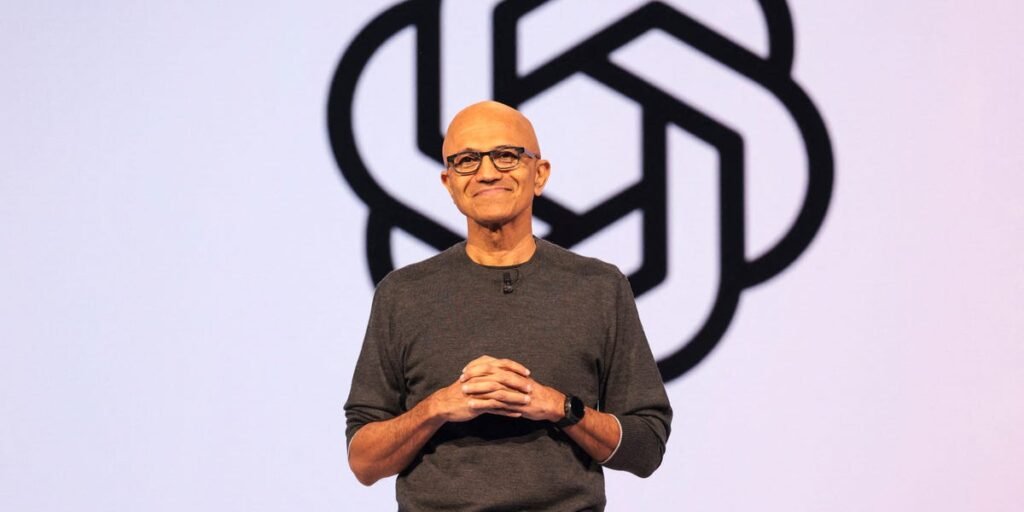
Microsoft is facing capacity constraints, and OpenAI is driving a large portion of the backlog in its cloud computing business.
The company said its backlog in commercial bookings, a metric referred to as remaining performance obligations, ballooned 110% year over year to $625 billion when it reported earnings for the second quarter on Wednesday.
OpenAI accounts for roughly 45% of those commitments, Microsoft revealed. The company did not say how much OpenAI contributed during the previous quarter.
Some Wall Street analysts on the call expressed concerns about Microsoft’s dependency on OpenAI.
CEO Satya Nadella said acquiring more Azure clients is important to the tech giant, but it can’t come at the expense of neglecting its other services.
“If you think about it, acquiring an Azure customer is super important to us, but so is acquiring an M365 or a GitHub or a Dragon Copilot, which are all, by the way, incremental businesses and TAMs for us,” Nadella said during Microsoft’s second-quarter earnings call. “And so we don’t want to maximize just one business of ours.”
Shares of Microsoft fell more than 6% in after-market trading on Wednesday, even as the tech giant posted an overall earnings beat.
Morgan Stanley’s Keith Weiss said during the call that some on Wall Street may be spooked by slower growth in overall Azure revenue and the increase in capex spending. Microsoft’s capital expenditures rose 66% year over year to $37.5 billion in the second quarter, another record for the company and testament to the sheer amount of money tech companies are spending amid the AI race.
CFO Amy Hood said that Microsoft has to look at many different areas when it allocates the GPUs and CPUs that come online as a result of its capex spending, including investing in the growth of first-party apps like Microsoft Copilot, devoting GPUs to research and development, and the talent they’ve acquired.
“You end up with the remainder going towards serving the Azure capacity that continues to grow in terms of demand,” she said.
Microsoft is not alone in facing capacity issues.
Executives at OpenAI, which has pledged to spend $250 billion on Azure services, have repeatedly said the startup is held back by a lack of compute, forcing tough trade-offs between product and research.
Wednesday’s earnings mark the first quarter since OpenAI completed its restructuring, which included a new agreement with Microsoft, the startup’s largest investor. Microsoft owns 27% of the public benefit corporation.
“It’s a great partnership,” Hood said of Microsoft’s relationship with OpenAI. It’s allowed us to remain a leader in terms of what we’re building and being on the cutting edge of app innovation.”