


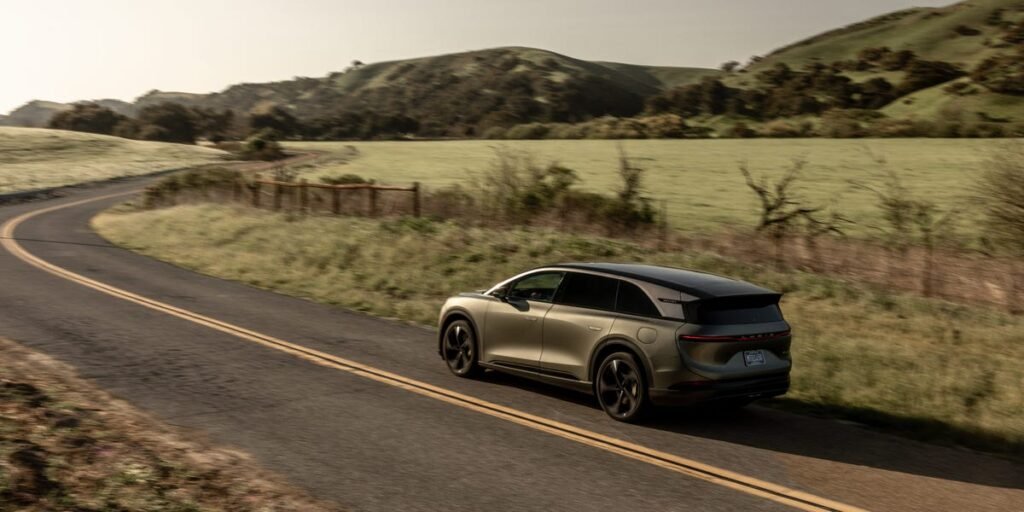
Lucid Motors wants everyone to know it’s not going bankrupt.
On Tuesday, the luxury EV maker filed paperwork with the SEC, forcefully denying two articles from EVs.com that — citing anonymous sources — reported the company was considering bankruptcy or going private. The automaker also sent the publication a cease-and-desist letter demanding that it retract the reports.
Cláudio Afonso, the founder of EVs.com’s parent company, CARBA, told Business Insider that the company had responded to Lucid’s letter but declined to comment further.
“Lucid is not considering bankruptcy or a transaction to take the company private,” Silvio Napoli, the company’s recently-appointed CEO, wrote in a LinkedIn post on Wednesday. “Those reports are false. The Board did not explore either scenario. Period.”
Nick Twork, Lucid’s communications chief, also pushed back in a series of posts on X.
The reports have sent Saudi-backed Lucid’s shares on a wild ride this week. The stock price dropped from an opening of $5.53 on Tuesday to a midday low of around $2.40 following the articles. By Wednesday, the stock had largely recovered, rising more than 18%.
Lucid confirmed that it was working with AlixPartners, an advisory firm known for corporate turnarounds, but said the firm was helping improve its operations and execution — not preparing it for bankruptcy.
“My priority is clear: turn this company around,” Napoli wrote.
This moment is consequential for Lucid Motors. The company is still climbing through the so-called “valley of death,” where startup automakers burn through vast amounts of cash while trying to reach mass-market profitability. Last quarter, Lucid lost more than $1 billion.
During its May earnings call, an investor asked management about concerns that Lucid could eventually face bankruptcy. The company declined to address “market rumors or hypothetical strategic alternatives.”
Lucid said it ended the quarter with $3.2 billion in total liquidity and said subsequent financing would have raised that figure to about $4.7 billion on a pro forma basis — enough, the company now says, to fund operations well into 2027.
Lucid has gone through two major layoff events this year, including a 12% staffing cut in February and an 18% workforce reduction in June.
Napoli, who took over as CEO on June 1, has overseen major C-suite changes, too: The company eliminated the chief operating officer position held by Marc Winterhoff, the recent interim CEO. Chief financial officer Taoufiq Boussaid also left in July.
Lucid has struggled to build sales momentum for its current lineup. Lucid reported 3,953 deliveries, below an analyst estimate of about 5,000. It’s now offering massive incentives on its 2026 Gravity SUVs, including 0% financing for up to six years.
The biggest test is still coming

EUIPO
Right now, both of Lucid’s cars — the Air sedan and Gravity SUV — carry luxury prices.
The long-awaited Cosmos is supposed to change that. The midsize SUV is expected to enter production by the end of 2026 on a new platform that Lucid says will support vehicles starting below $50,000.
That would put Lucid into the heart of the American auto market — and one of its most competitive segments.
Rivian began delivering its R2 in June, while Tesla has continued expanding the Model Y lineup. The Cosmos will also compete against established electric SUVs, including the Toyota bZ, Ford Mustang Mach-E, Hyundai Ioniq 5, and Chevrolet Equinox EV.
Its gas-powered competition may be even tougher. The Honda CR-V was the country’s best-selling SUV during the first half of the year, while Toyota has been ramping production of its redesigned RAV4 amid tight supplies and strong demand.
Lucid plans to follow the Cosmos with a more rugged SUV called the Earth and has previewed a purpose-built robotaxi called the Lunar.