


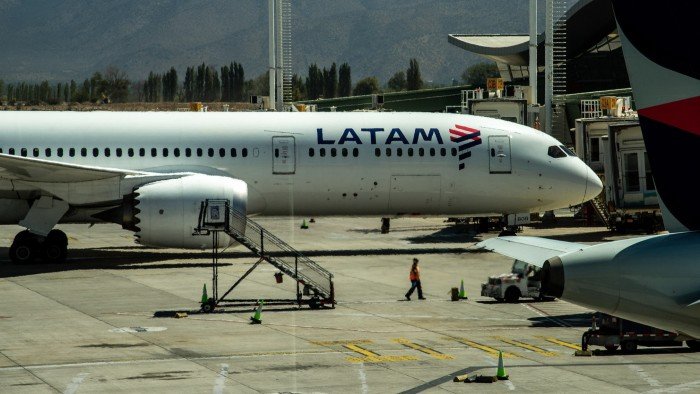
Latin America’s biggest airline is targeting ambitious growth in the coming decades, hoping to profit from expectations that the region will be among the world’s fastest-growing for air travel.
Roberto Alvo, chief executive of Latam Airlines, said Latin America and the Caribbean were “under-developed” in aviation, with a 650mn population that is projected to fly just 480mn times this year.
“That’s 0.6 passengers per inhabitant,” he told the Financial Times, adding that the airline hoped this would rise to “two and a half times, up to three times a year per inhabitant”.
The carrier was one of the pandemic’s earliest corporate victims, filing for Chapter 11 bankruptcy protection in New York in May 2020 and embarking on a restructuring. Now, with the Chapter 11 process and pandemic behind him, Alvo is bullish about the group’s future, especially in Brazil, its biggest market where it has a near-40 per cent market share.
The nation “has big potential, it’s a country which is tremendously little visited for its size”, he said in an interview. “We are very optimistic about Brazil.”
Boeing forecasts that passenger air traffic in Latin America, a region where cities are far apart and often separated by mountain ranges or forests, will grow 5 per cent a year over the next two decades, faster than the Middle East, Europe or North America. It expects Latin America’s commercial aircraft fleet to almost double in size to more than 3,000 planes over the same period.
As well as capitalising on its status as the region’s biggest airline, which already transports four out of 10 passengers in South America, Latam plans to add new international routes, introduce premium economy class on long-haul flights and renew part of its fleet.
Alvo argues that Latam has a much stronger position than other big international carriers on their home turf. “In the United States, American Airlines, which is the biggest, represents for North America less than half of what we represent in South America,” he explained.
The product of a 2012 takeover by Chile’s LAN of Brazilian airline TAM, Latam has a bigger international route network than its next biggest regional competitor, Avianca, offering destinations in Australasia and South Africa as well as Europe. In North America Latam operates a joint venture with Delta Air Lines and Qatar Airways, which each have a 10 per cent stake, and in which San Francisco-based investment firm Sixth Street Partners is the biggest shareholder, with 27.9 per cent.
The international route network and the alliances mean that “we’re the only one-stop-shop in South America for travel”, Alvo said.
He said growth in the south Pacific had been surprisingly strong, with the airline this month adding a third direct route from its Santiago hub to Sydney, complementing existing flights to Melbourne and Auckland. “There is very good demand,” he said.
The airline flies 330 passenger and 22 cargo planes and has rationalised its fleet to use Boeing for long-haul and Airbus for short-haul. It recently announced an order for 10 Boeing 787s, part of an order book with both plane makers that totals 120 aircraft, mostly Airbus A320s, over the next six years.
Latam left the Oneworld alliance after tying up with Delta, which is part of the rival SkyTeam grouping, and Alvo said it was unlikely it would return to a global alliance.
“Bilateral relations are what matters,” he said, adding that existing agreements with Lufthansa and International Airline Group’s Iberia for Europe, Qantas for Australia and Delta for the US “are the ones which we are interested in. Latam today is fine without being in an alliance”.
The company has promised to boost margins by raising profitability faster than capacity. It estimates it will report adjusted earnings before interest, tax, depreciation, amortisation and rent costs of $3.25bn to $3.6bn in 2025, up on an expected $3bn to $3.15bn this year and $2.5bn in 2023.
Analysts forecast $3.4bn next year but while there is agreement about the growth prospects, some point out that the company’s debt is higher and its profitability lower than its smaller regional rival, Panama’s Copa Airlines.
“Latam is leveraged two times versus Copa at 0.5 times,” said Stephen Trent, analyst at Citigroup. “Latam’s ebitda margin is 12 per cent versus 22 per cent for Copa. Some bulls say Latam should be valued at a premium to Copa, which is laughable.”
Latam recently tapped debt markets for $1.4bn to refinance costly borrowing from the Chapter 11 restructuring from which the airline emerged in November 2022, something Alvo said would generate $100mn a year in interest savings. Another $700mn of debt remained from the airline’s 2022 refinancing and Alvo said Latam would “probably” refinance that remaining portion if market conditions were right.
Trent also pointed to another issue for Latam — a lack of liquidity in its American depositary receipts after it relisted in New York in July following a four-year break while it was restructured. “The ADR is trading less than $1mn a day,” he said. “That’s something which needs solving.”
Another issue is increased competition as other regional rivals build capacity following painful Covid-era restructurings of their own.
Avianca of Colombia and Aeroméxico have also emerged from US bankruptcy protection while Brazilian carriers Gol and Azul struck deals with creditors to reduce debts and financial obligations to more manageable levels.
Abra Group, a UK-headquartered holding company, brought Avianca and Gol together under common ownership in 2023 and is one of Latam’s biggest competitors. It announced a refinancing of Gol two months ago, with the hope that the Brazilian airline can exit Chapter 11 in spring 2025.
However, Alvo is confident of Latam’s continuing ascent.
“Latam is one of the few truly global companies in Latin America,” he said. “I’m very optimistic about the future.”