


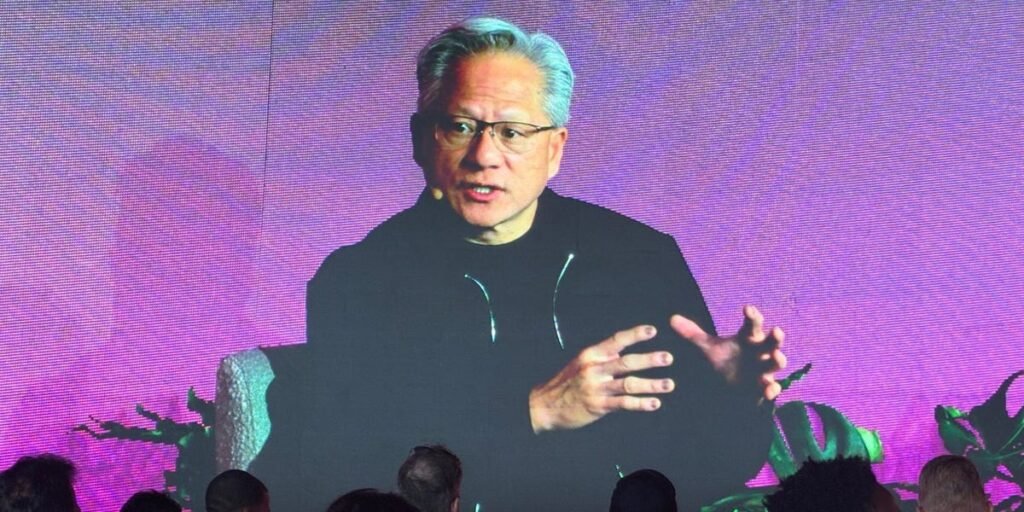
Nine days before Jensen Huang resigned as Nvidia CEO, I sat near the front row at a San Francisco conference and watched him discuss the future of AI.
Two things struck me that day. Both seem more significant now.
First, Huang wasn’t wearing his famous black leather jacket. Instead, as you can see in the photo I took, he wore a dark fabric zip-up. At the time, I thought it was funny. His jacket had become such a recognizable part of his image that seeing him without it was a bit jarring.
Now, with revelations about his extramarital affairs and allegations involving a possible Chinese spy, I wonder whether the wardrobe change meant something. The initial allegations were already public by November 3.
Of course, that’s hindsight talking. Maybe a jacket is just a jacket.
The second thing was more consequential.

Alistair Barr/Business Insider
Near the end of the conversation, Fireworks AI CEO Lin Qiao asked Huang about his unusual management style. He had 60 executives reporting directly to him.
Huang explained that he’d designed this structure more than 30 years ago, when personal computers and email were transforming business. Rather than a traditional hierarchy, he wanted information flowing freely among executives empowered to make decisions.
Then came the obvious question: What should a company’s leadership structure look like in the AI age?
Want more Business Insider in your news feed?
Add BI in Google so our reporting is easier to find when you’re searching for what matters.
“I don’t know the answer to that,” Huang replied.
At the time, I thought that was a bit odd. Nvidia is leading the AI revolution and Jensen leads Nvidia. Wouldn’t he be thinking of how best to run this company in the future?
Today, that exchange seems especially relevant.
With Huang gone, Nvidia faces an extraordinary succession challenge. Sixty direct reports may have worked brilliantly under its founder. But it also means there isn’t an obvious deputy to take the reins.
If he’d had two or three direct reports, those people would have had more experience with more responsibility. But 60 direct reports, by definition, means that each one of those execs only had a small piece of Nvidia to oversee.
Does this mean Nvidia is doomed? I’m not sure. The way Jensen described Nvidia’s structure back on Nov. 3 provides some hope.
Huang said he gave executives considerable freedom to make decisions and work together, rather than taking orders from the top. Instead of a rigid management hierarchy, Nvidia organized itself around projects, with teams forming and changing as needed.
“Irrespective of whatever internal or external threats and opportunities, the company will naturally adapt itself, it should adapt itself to new opportunities,” he said. “That was the organization I created.”
The talk ended on a poignant note. Again, with hindsight, I can’t help thinking he knew something was coming.
“I’m super proud of you,” he told Fireworks’ Qiao. “Don’t forget us little people someday.”
Sign up for the AI Insider newsletter here. Reach out to me via email at abarr@businessinsider.com
The latest on Jensen Huang’s ouster from Nvidia and what it means for the company’s future