


As the US-Israeli war with Iran rages across the Middle East and roils global markets, a small subset of drone makers — ones who build drones to destroy other drones — are seeing an upside to the conflict.
Interceptor drone manufacturers outside the region told Business Insider of a surge in requests for demonstrations and inquiries from potential buyers over the past week, as the US and its allies scramble to counter Iran’s loitering munitions.
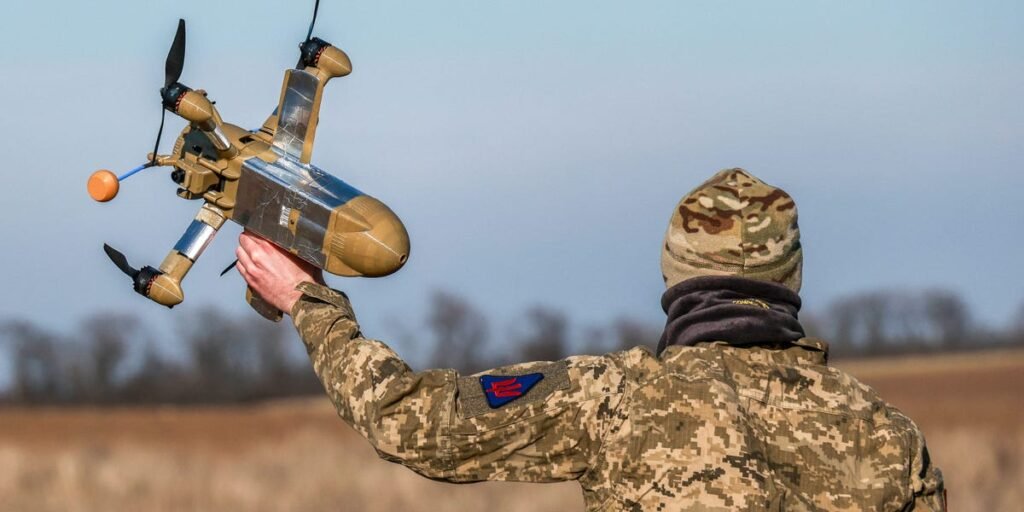
“Since the beginning of the war, we have been receiving daily requests from the Middle East, whereas previously it might have been once or twice a month,” said Jens Holzapfel, business development director for Nordic Air Defense. The Swedish startup is building a propeller-driven interceptor, the Kreuger-100XR, which is being tested in Ukraine.
New interest has overwhelmingly come from Gulf state governments or entities working with their defense ministries, although European countries have also reached out, the companies said.
Misha Lu, a spokesperson for the Taiwanese firm Tron Future, said international inquiries for its counterdrone products, which include a single-use quadcopter interceptor and net-launcher drone, have “effectively doubled” since the war began.
Almost all prospective clients were asking for ways to protect critical infrastructure, such as airports and power grids, he said.
Lu added that potential buyers are also largely shifting their focus from anti-drone jammers to “hard-kill” solutions, which rely on explosives or physical force to destroy drone threats.
Surging interest in Ukrainian drones
Heightened demand for hard-kill counterdrone tech comes as Iran has launched thousands of one-way attack Shaheds against the US and its allies in the Gulf region. Some of the loitering munitions have successfully gotten through air defenses and struck their targets, including US military facilities.
Key concerns in air defense against Shahed threats have been cost and quantity. Traditional air-to-air or surface-to-air missiles are limited in supply and would be too expensive to engage en masse against Shaheds, which cost $20,000 to $50,000 each.
Win McNamee/Getty Images
A cheaper solution, pioneered largely by Ukraine, is to use first-person-view or small drones to catch and ram into Shaheds.
The Wild Hornets, the Ukrainian manufacturer of a popular interceptor drone called the Sting, told Business Insider that the company previously fielded one or two business inquiries daily, but since last week has received “several dozen per day.”
Sting production is still heavily dedicated to helping Ukraine fight off Russia’s locally built versions of the Shahed; Kyiv says Moscow has launched over 57,000 of them so far.
“These are requests, not what we’ve agreed to,” a Wild Hornets spokesperson said of the new inquiries. “Our priority is Ukraine’s defense.”
Another major Ukrainian drone maker, Skyfall, told Reuters last week that it was receiving foreign requests for interceptors and could produce up to 10,000 a month without affecting Ukraine’s needs.
Still, Ukrainian firms may have difficulty closing any such deals for now. A wartime law broadly blocks drone exports from the country, as uncrewed aerial systems remain the pillar of its tactical combat operations.
Alex Nikitenko/Global Images Ukraine via Getty Images
Whether the ban will remain, however, is unclear. Kyiv has been exploring the possibility of controlled exports, seeking to promote its fledgling defense tech market and touting its wartime production expertise and ability to test weapons in combat.
Ukrainian President Volodymyr Zelenskyy has also repeatedly signaled openness to assisting allied countries, including Gulf States, that request support and expertise against Shaheds.
So far, though, Zelenskyy has only confirmed that Kyiv is sending experts to the Middle East, without mentioning export sales.
Too much demand to cope with
For interceptor makers in other countries, the sudden demand is so great that most aren’t sure they can keep up with the influx of business. The technology is also fairly young, meaning some firms have yet to build out their production lines fully.
Agirs Kipurs, CEO of the Latvia-based firm Origin Robotics, told Business Insider that his firm is already working to fulfill existing contracts and may thus only meet a “limited part of the demand.”
“Obviously, we will not be able to meet all requests, as we are still scaling up production and building toward full output capacity,” said Kipurs, whose firm builds drones deployed in Ukraine and an autonomous interceptor used by NATO forces.
Jiří Janoušek, a representative for the Czech firm TRL Drones, said his company recently received multiple requests a day for its fixed-wing interceptors — a short-range drone and a larger jet-powered system that are used in Ukraine.
TRL Drones is increasing production capacity to accommodate new requests, Janoušek said, but has had to “carefully prioritize incoming opportunities,” giving preference to customers who already know their operational requirements and are ready to move quickly.
“Supporting Ukraine remains a core priority that continues to utilize a portion of our capacity,” Janoušek added.
Lu, of Tron Future, said that his firm is “fully engaged” with all the inquiries it’s receiving, but is still working on scaling production.
Tron Future
Demand from Taiwan and East Asia has recently doubled, too, he added, with inquiries from Taiwanese law enforcement and military agencies reaching double digits.
There is concern about China’s own delta-wing drones, Lu said, such as the Loong M9 and Feilong 300D. Both appear highly similar to the Shahed-136.
Chinese industries have long supplied drone components to both sides of the Ukraine war, and Lu said it’s clear that the People’s Liberation Army is learning from the battlefield there.
“So we know that in a conflict scenario across the Taiwan Strait, we will also see similar saturation attacks where cheap drones of various classes mingle with missiles,” Lu said.