


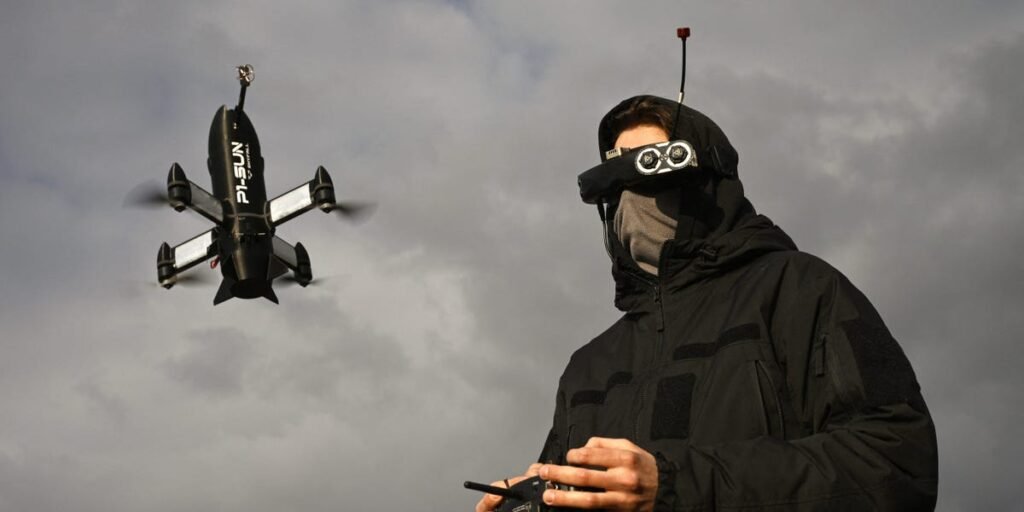
Cheap, lightweight, and built for mass production, interceptor drones may look simple.
They aren’t. And keeping them relevant against evolving threats is anything but easy.
Ukraine is making these inexpensive Shahed-killers at scale — it says up to roughly 2,000 a day — and demand is rising globally as militaries look beyond multimillion-dollar missiles to confront cheap, mass drone attacks.
Drone makers told Business Insider that these systems are deceptively complex, and small tweaks to their designs can make a life-or-death difference.
Morteza Nikoubazl/NurPhoto via Getty Images
To stop a Shahed, an interceptor drone must be stable, fast enough to catch its prey, and maneuverable enough for a human pilot to hit a flying target. It also has to be low-cost and suitable for mass production.
One variant in Kyiv’s arsenal is the Sting, a first-person-view drone developed by the Wild Hornets that costs about $2,000 per unit, a fraction of the cost of the Russian one-way attack drones they chase, estimated to cost at least $20,000 each.
Early 2024 versions of the drone struggled to match the Shahed’s roughly 115 mph speed.
Viktor Lysenko/BI
A ‘constant balancing act’
Upgrading an interceptor to maintain relevance is a “constant balancing act,” a Wild Hornets representative told Business Insider, speaking on the condition of anonymity to discuss sensitive defense projects.
“Building an individual motor, sensor, or frame is relatively straightforward,” they said. “The challenge is making everything work together quickly, accurately, and reliably in a real environment.”
A larger battery allows a drone to fly for longer, but it weighs it down. Larger propellers increase thrust but can make it cumbersome. Stronger motors overheat. More complex software adds lag. Every gain potentially creates a tradeoff.
Wild Hornets
And the threat continues to evolve. Newer, jet-powered versions of Shaheds are increasingly appearing in Russia’s attacks. Some are armed with missiles, while others are equipped with automatic systems to evade interceptor drones.
More recently, Ukraine has warned that Russia is now exploring another Iranian-designed turbojet drone, the Karrar, that reportedly flies at speeds of up to 370 mph.
Kyiv will need new solutions, Serhii “Flash” Beskrestnov, a drone expert advising Ukraine’s defense ministry, warned in a February statement to drone manufacturers.
“All the enemy’s bets will be on speed,” he said.
The iconic ‘bullet’ shape
Most interceptor drones share a similar physical design: a teardrop- or bullet-shaped frame with four propellers at the base.
The same design shows up in civilian speed-record drones.
Screenshot via YouTube/Luke Maximo Bell
South African hobbyist Luke Maximo Bell, maker of the Guinness World Record’s fastest quadcopter to date — it reached 408 mph during a straight flight in December 2025 — has been trying to break drone speed records since at least 2023.
He told Business Insider that the teardrop design is common because it’s the “classic aerodynamic shape” for reducing drag. The cross-section of a commercial airliner’s wings, for example, is shaped like a teardrop.
Instead of the overall design concept, most drone makers obsess over the finer features such as the thickness and length of the quadcopter’s arms, the sharpness of its nose, and the length of its tail.
“It’s very small optimizations,” said Bell.
Changing the gap between the propellers can massively increase thrust output or efficiency, he said, while power imbalances can cause drones to overheat and catch fire.
As hobbyists like Bell push the physical limits of what these systems can do, he said hundreds of Ukrainians have reached out to him and his father, who makes drones with him, about building similar tools for war. Bell said he’s sticking to his YouTube channel.
“I guess it’s a bit scary that we can do all of that just from like, a garage, essentially,” he said.
Building drones for armed conflict
In Ukraine’s military drone industry, civilian models often serve as inspiration for manufacturers, said Egor Tereschenko, the head of sales at the Ukrainian drone motor company Motor-G.
But building drones as interceptors comes with additional requirements.
“For civilian record-breaking, you just optimize the drone for speed and nothing else,” Tereschenko told Business Insider. Ukrainian officials said in December that his firm’s motors allowed an interceptor to reach a major speed milestone of 248.5 mph.
Unlike civilian drones, an interceptor drone has to carry explosives, which increases its weight. And as the quadcopter approaches a target like a Shahed, it needs enough power left over for a final burst of speed to catch its quarry. Many interceptors also require software to help the human pilot lock onto a target.
Ed JONES / AFP via Getty Images
Right now, the typical Ukrainian interceptor drone flies at about 220 mph, he said.
The main issue manufacturers face now is figuring out how to keep pushing these drones without overheating them, Tereschenko added.
“The motor or some wiring or the computer unit — something will give out because you are running insane amounts of power, producing a lot of heat in a very compact, fragile, and sensitive system,” he said.
Beyond a prototype design
While top speed and maneuverability are key, customers ultimately look for reliability in interceptor drones.
“A slightly slower drone that works every time is usually more valuable than a very fast one that fails occasionally,” said Jiri Janousek, a representative for the Czech drone manufacturer TRL Drones. The company makes two fixed-wing interceptor drones being used in Ukraine.
TRL Drones
They also need to be scalable. Countries want to buy interceptor drones in bulk, so they need to be easy to manufacture and upgrade.
Janousek said that while interceptors can be partially built with off-the-shelf parts, core elements such as their structure and control systems must be built from the ground up.
“Making one prototype is relatively easy, but making a system that can be produced repeatedly with the same performance and reliability is much harder,” he said.