


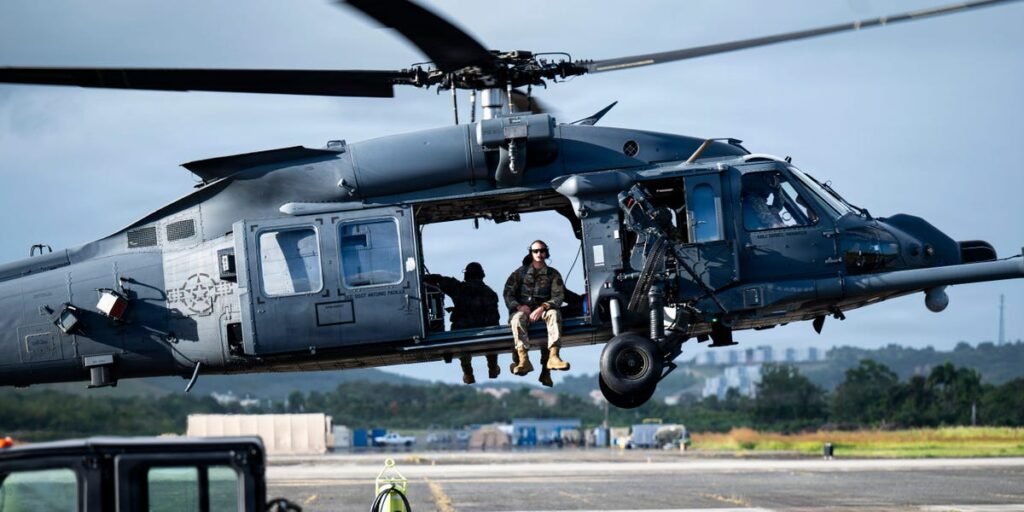
When a US aircraft goes down in combat, rarely used but highly trained airborne search-and-rescue crews spring into action.
Multiple American media outlets, citing anonymous US officials, reported the loss of a US Air Force F-15E fighter jet to enemy fire over Iran and the subsequent search for the downed airmen on Friday. Later reports indicated that two search-and-rescue helicopters were hit during operations, underscoring the risks of these kinds of missions. Both helicopters managed to return to base.
Additionally, an A-10 Thunderbolt II attack aircraft crashed in Kuwait territory after taking hostile fire the same day. The A-10 pilot was safely recovered, reports said.
US Central Command has not commented publicly on these incidents, nor has it shared information in response to Business Insider’s queries concerning them. As of Friday afternoon, one member of the two-person F-15E Strike Eagle crew had been rescued by American forces, according to The Washington Post and other reports.
The status of the second F-15E crew member is unclear.
Master Sgt. Darius Sostre-Miroir/US Air Force
Business Insider spoke with a current Air Force search-and-rescue pilot about the operations they carry out.
He said that the Friday rescue mission, which videos showed being conducted in broad daylight, was extraordinarily bold. Air Force combat search-and-rescue, also known as CSAR, is the military’s force dedicated to rescuing downed aircrew.
Combat search-and-rescue missions are dangerous under the best of conditions, he said, ideally on dark nights with no moonlight.
“Darkest of dark nights, this is still pretty intense and pretty scary. Doing this in full moonlight would still be risky,” he said. More light means increased risk to the crew, more easily spotted by enemy weapons that often lack the advanced night capabilities the US military possesses.
But a rescue mission in broad daylight exposing crews to a variety of threats “is just some complete other level,” the pilot said, noting it reflected the urgency to locate American personnel. “It is sort of terrifying to go like, ‘let’s just go fly in broad daylight into the middle of a country that is at war with us,” he said.
For American troops, rescuing downed comrades is one of the most sacred duties, the pilot told Business Insider. Finding crews before the enemy does is critical and serves both the service members and broader operations, as capture can have serious strategic consequences.
Aircrews, and other service members like special operations personnel, train for the possibility that they might end up stuck behind enemy lines or be captured during their SERE training, short for ‘survive, evade, resist, escape,” which helps troops prepare for potential POW experiences.
Search-and-rescue crews have developed alongside combat aviation. The Vietnam War — when American aircraft were frequently shot down and aircrews were captured as POWs — saw the expansion and refinement of these operations, with coordinated, specialized units sent deep into enemy territory to rescue downed airmen. The helicopters used in these missions now share the name “Jolly Green” with those of the Vietnam era.
So what does the rescue mission look like today?
“The CSAR mission is extremely well resourced in the USAF,” Greg Bagwell, a former British Royal Air Force senior commander and airpower expert, wrote on social media, explaining that these operations rely on units from within Air Combat Command and Air Force Special Operations Command. “It is well practiced by all aircrew and is a key part of any mission brief.”
The mission often involves Pave Hawk helicopters (a derivative of the well-known Black Hawk made for search-and-rescue), HC-130 refuelers, and Pararescue Jumpers, commonly known as PJs, supported by special mission aviators operating guns and hoists on the helicopters.
Helicopters scouring the terrain for downed troops are slow, not well-armed, and need fuel support to keep up the search.
Another aircraft, such as A-10 Warthog ground-attack aircraft, might float nearby and serve as a mission command aircraft, a sort of quarterback that can direct rescue assets, the American CSAR pilot said. Such aircraft may also defend search-and-rescue forces.
Senior Airman Gabriel Jones/US Air Force
The crews in the search-and-rescue helicopters incur serious risk, flying low and slow in their search.
“They’re trying to get in, avoid hostile fire, and somehow locate this individual,” the pilot said. “And the goal is for the PJs to run out, grab the guy who looks American, drag him in the helicopter and go.”
When an aircraft is shot down in combat, the likelihood that the downed airmen are hiding somewhere near the enemy is high, meaning CSAR crews may face an adversarial response.
On top of the concerns about enemy fire, including everything from small arms to shoulder-launched rockets and surface-to-air missiles posing a threat, the helicopter crews also have to be prepared to operate in any kind of environment, from open terrain with high exposure to complicated urban battlespaces with hard-to-see power lines and other obstacles.
“You train a whole lot, and the hope is you never have to do it,” the CSAR pilot said of the missions. “But you certainly train to do it every single day.”