


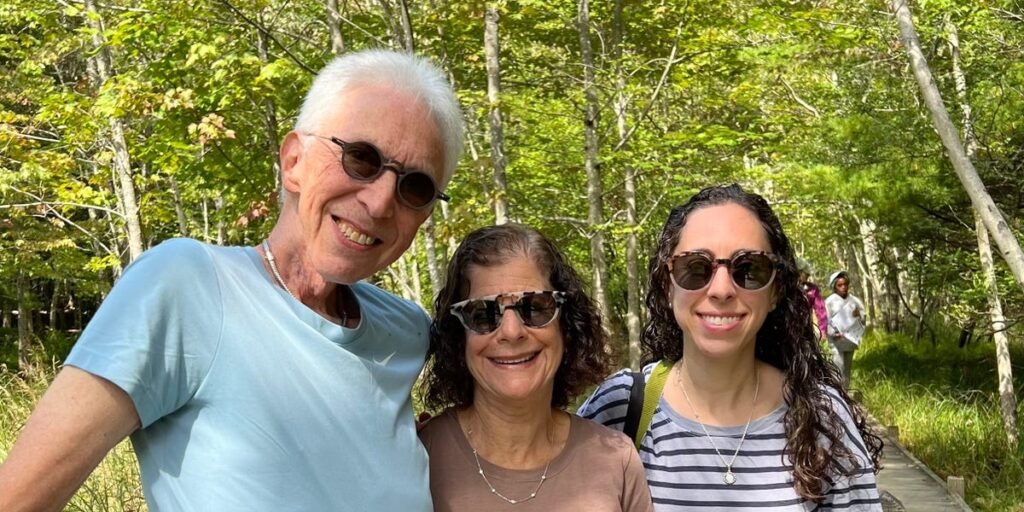
“I’ll try to meet you there,” I told my mother a few months ago, one evening before bed. “I’m not feeling great, but I’ll do my best,” I confirmed before hanging up the phone. The next morning, my 71-year-old mother had surgery to lift her bladder. My 74-year-old father is a stage 4 tongue cancer survivor now dealing with the overwhelming downstream effects of radiation — and I live with multiple sclerosis (MS) — so usually my otherwise healthy mother plays the caregiver role.
She was present at most of my appointments during the 13 years I searched for a diagnosis through early adulthood. She attends every medical visit with my father and often takes me for my immunosuppressive infusion. She was beside me for the birth of my older son in 2011 and later cared for him when my younger son was born in 2014. Lying in the hospital bed that Monday morning, she threw our normal family narrative off kilter.
I’d never seen my mom that vulnerable before
I walked into her hospital room just as she arrived post-recovery, the anesthesia still swirling through her system. “Can you fill this out for me?” she asked, handing me the cafeteria menu for her overnight stay. “I can’t read right now,” she continued, her words ever so slightly slurred. In that moment, it occurred to me that I’d never seen her like this: vulnerable and dependent.
“Pasta alfredo with chicken or mac and cheese for dinner?” I asked, chuckling, knowing a discussion of the absurdity of a hospital offering only pasta options would ensue. “I’ll write-in chicken breast with vegetables and rice,” I suggested, handing her the cranberry juice that had been left just beyond her reach. She asked me to plug in her cellphone charger before reading the remaining menu options. As I moved around the room with purpose, my legs jittered, and my hands shook.
I’ve been living with MS for two decades, and it always flares at the worst possible times; stress makes it worse. As I struggled to stand, I realized this disease that had affected my personal functioning and my ability to parent for decades was now impeding my capacity to care for my mother, something I’d always imagined I’d do without limits.

Courtesy of Lindsay Karp
I’ve always pictured myself caring for my parents as they get older
When I was younger, my paternal grandfather stayed at our home while recovering from surgery. I’d arrive home from school to find him resting in his favorite recliner. My maternal great-grandmother came to live with my grandmom during her final months. I remember watching my grandmother bring a turkey and cheese sandwich to her bedside, tending to her just as I imagine my great-grandmother had done for my grandmom when she was sick as a child. I still recall that scene vividly.
Now, tables have turned, and my mother takes my 94-year-old grandmother to run errands weekly and to doctor’s visits as they arise. She’s been back and forth to the hospital with her as she struggles with lymphedema and infections in her legs.
And one day I, too, will find myself in the caregiver role. Just as I stayed home with my babies, not wanting someone else to raise them, I’ve always aspired to personally care for my parents when the time came, especially after my grandfather, who was living with Alzheimer’s, was involved in an incident at his nursing home that still haunts me and my family 10 years later.
My father is living with severe dysphagia (i.e., swallowing disability), a voice disorder, blood pressure lability, and a smattering of other issues secondary to radiation to the head and neck two decades ago. He now uses a feeding tube, and his voice is permanently hoarse and extremely difficult to understand. “Will you be my voice?” he texted me the day before my parents’ 50th anniversary celebration last November. “I’d like you to read this for me,” he said, of a toast he’d written for my mother.
The day following my mother’s surgery, I checked him into the visitor’s center at the hospital where he’d struggled to be understood the day before. Watching him flounder rattles me, but knowing I can alleviate some of his struggle is reassuring. I was glad I was there beside him to walk the halls to her room that morning because blood pressure instability has left him lightheaded and in need of a seat often. My strong and capable father, who once fixed broken knickknacks, remedied car troubles, and built a kitchen closet from scratch, now relies on me in ways I never imagined he would.
My diagnosis has made my vision for the future feel more difficult
Slowly, the time of need I’ve envisioned since childhood is creeping toward me, but I’m not the strong adult of my youthful imagination. I’m realizing I can’t be the boundless caregiver I always thought I’d be. I can’t drive endless miles with a foot that often struggles to hold the pedal. I can’t walk the perimeter of a hospital and back again with legs that weaken from simply existing. And last-minute visits to the store aren’t as simple for someone living with chronic weakness and fatigue.
Despite my father’s medical battles, he continues to work full time as a civil engineer and president of his firm because he maintains the vivacious spirit I’ve never known him without. My mother has fully recovered from her procedure and continues to be the caregiver I’ve always known her to be. They don’t need me just yet, but watching her in the hospital and moving slowly against pain in the following weeks at home gave me a glimpse of how they may need me one day soon — and the reality of my own limitations.
As a child, I promised myself I’d care for them just as they always did for me. My caregiving won’t be perfect, but I’m going to give them everything my body will allow; my voice, a turkey and cheese sandwich, and all.