


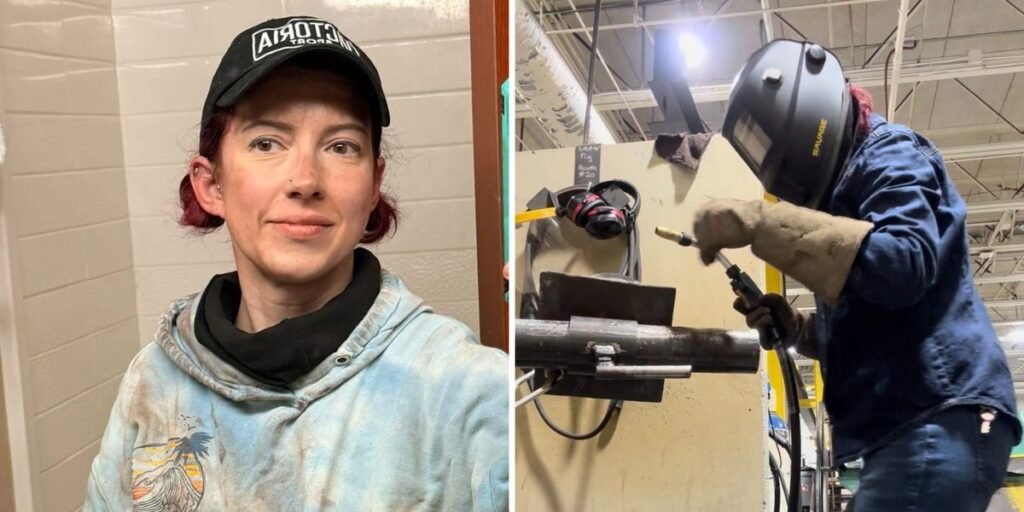
This as-told-to essay is based on a conversation with Tabby Toney, a 38-year-old welder and former software engineer in Oklahoma. It’s been edited for length and clarity.
After I was laid off from my software engineering role last May, I was so angry at the tech industry.
I loved tech because of the intellectual stimulation and creative problem-solving it provided, and I felt like that was being taken away as AI started reshaping the industry and job market. I decided to take a month off before looking for my next role.
During my break, I borrowed some of my family’s welding equipment. I remember running around as a kid in my grandpa’s garage, where he and my dad did it a bunch. I was surprised by how much I liked it. I didn’t want to start over in a new industry, but with the constant tech layoffs, I didn’t feel like I was leaving something stable and steady.
I’m now a full-time welder. I don’t have that constant fear about my job security anymore, and that’s been the most peaceful aspect of this industry change.
I went from a layoff to a new career faster than I expected
Once I decided to pivot, I started working on some welding side projects for friends and began looking for a welding course to enroll in.
I applied to multiple trade programs. Some were on a first-come, first-served basis; the school I ended up attending required an essay explaining why we wanted to pursue welding, which was used to determine admission.
In August, I got a spot in a fast-tracked adult welding program. It was 40 hours a week for five months, which is not long at all to learn everything, but it was designed to get us into the workforce quickly. The other welding program at my school wasn’t a fast-track program and lasted two years.
The cost was surprisingly low. It was originally around $3,000 for the entire program, but some companies donate for non-traditional path students, and I had scholarships.
My school helped me land a job after I graduated
My school worked with local companies to help prepare us for the job market, and sometimes those companies would hire directly from our school, which is how I got my current job. We had mock interviews with them and spoke with them about what it’s like to work there.
After I met with my current company during my course, they reached out, and I went through an official interview process and was hired.
I finished my program in mid-December, and I started working the first week of January. I was surprised how fast that happened because I was preparing to have to job hunt.
My day-to-day as a welder is nothing like tech — and I love it
My job is adding attachments, like ladder clips, to utility poles. I work 12 hours a day, three days a week, then I get four days off.
At the start of my shift, I get blueprints and my assigned pole, and I work on it until I’m done. Sometimes an assignment only takes one day, but it depends — if a pole has over 100 attachments, that can take multiple days.
It’s been a huge learning curve, and I didn’t think I’d hate it, but the most surprising thing for me has been how much I really like the work and how fast the day goes by. All of the older welders have been so nice and helpful.
There are some days I miss tech. Mostly because the shop isn’t climate-controlled. So when it’s really cold or really hot, I miss heating and air conditioning. Besides small things like that, I’m so glad I got out of the industry when I did.
The hardest part has been starting over with my salary
I live in Oklahoma City, which has a low cost of living. In my last software engineering job, I worked remotely and made $130,000 a year, and tech jobs in the area typically pay less than that. Welding jobs are usually hourly; mine is $25 an hour, so I think that’s a $52,000-or-so starting salary, which is rough.
Thankfully, when I had a six-figure salary, I paid off everything I could. I know not everyone can do that, but I could kind of see the writing on the wall with the direction tech was going in.
It also felt like a smaller pay decrease because I was in school and unemployed for almost a year while I went through this pivot, and I had severance that I stretched out for a long time.
I don’t feel the same anxiety about my job security that I did in tech
In every job I had after my first tech layoff, all I could think about was how well the company was doing and whether it would perform layoffs. Even when the company was doing well, it was such a source of anxiety.
I had to stop looking at the news about tech layoffs. I know people with 20-plus years of experience who are now unemployed, and my husband, who’s also a software engineer, hasn’t had a job since January. It’s crazy.
I like that now, at the start of my shifts, I can physically see how much work we have coming in. I feel really lucky that everything has worked out the way it did.
Do you have a story to share about leaving the tech industry? Contact this reporter, Agnes Applegate, at aapplegate@businessinsider.com.