


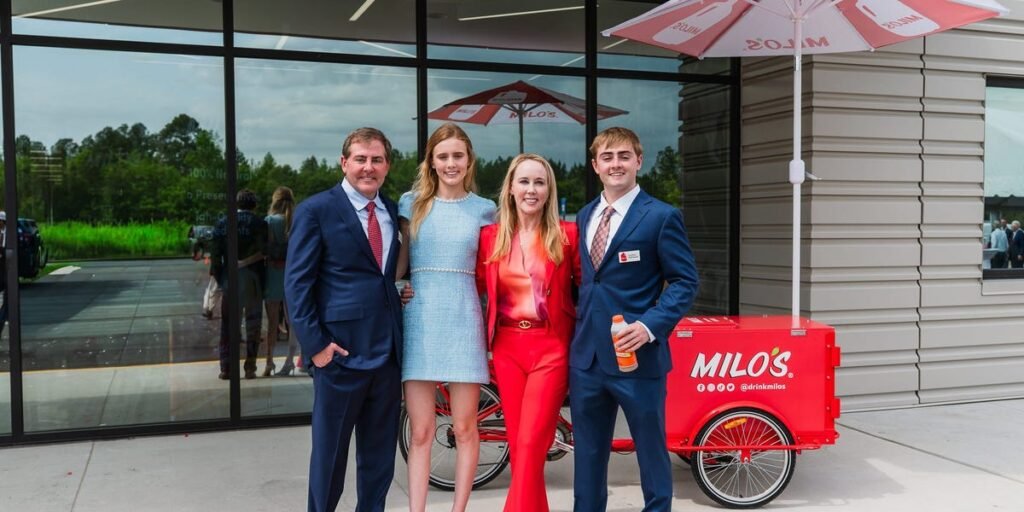
This as-told-to essay is based on a conversation with Tricia Wallwork, CEO and Chair of the Board at Milo’s Tea. It has been edited for length and clarity.
When my grandad Milo returned from World War II, he married my grandma, Bea, the very next week. He likes to say he only had $20 and a footlocker, but he also had a vision: for a hamburger stand serving burgers, fries, pies, and sweet tea to Atlanta’s steelworkers.
That was the beginning of Milo’s Tea. Since then, the business has had three distinct iterations: the initial burger stand, franchise restaurants that my dad and stepmother ran, and now the tea company that I operate.

Courtesy of Tricia Wallwork
Through them all, we’ve been guided by my grandparents’ founding values: listening to customers, using real ingredients, and treating people well.
I became a lawyer, then joined the family business
I never wanted to work at the family business, so I became a lawyer. I thought I would save the world, but really, I was just writing letters and representing companies. It wasn’t what I had envisioned, so I traded my high heels for steel-toed boots and started working at Milo’s.
My dad and stepmom had noticed a trend: people would drive through their restaurants just to order sweet tea. Running a hamburger joint is difficult, so they decided to sell the franchise company and use the proceeds to start the first version of our tea plant.
I saw them constantly figuring things out on the fly — like using pantyhose to filter tea. Things are much more sophisticated today, but I still have that entrepreneurial spirit.
I’ve grown the company drastically over 14 years
I became CEO of Milo’s Tea in 2012, and since then, our growth has been like a hockey stick. In 2012, we did about $30 million in retail sales. In September, we surpassed $1 billion in retail sales, ahead of our projections.
It’s a very unusual situation to be in as a third-generation business owner. I’ve tried to find mentors to help me get ahead of things and manage this rocket ship.
Want more Business Insider in your news feed?
Add BI in Google so our reporting is easier to find when you’re searching for what matters.
I’ve surrounded myself with great advisors, who have helped me and the rest of the board (including my dad, stepmother, and stepsister) be very intentional about family governance. We’ve created a family mission statement and set a goal of remaining 100% family-owned. That allows us to take a long-term view of how we invest in the company.
We have protocols for the next generation
While I hope my children own the company one day, I don’t pressure them to work here. I don’t want them to feel a duty to work at Milo’s Tea, because that becomes a burden. I would rather them see it as an opportunity to do something remarkable.
We have regular family meetings for the next generation to learn about Milo’s and a framework for getting involved. After they’ve attended college, they can attend shareholder meetings. After two shareholder meetings, they can attend a board meeting. There’s no pressure to engage, just opportunity. So far, both my kids have taken advantage.
We’ve also created an internship program, where our kids can learn about Milo’s by working an hourly job. If they want to get hired here, they need to work somewhere else for at least three years and get promoted before they can apply. I like to say merit, not inheritance.
Sometimes, in family business, you see the older generation hanging on until the end. My parents and grandparents weren’t like that. They’ve done a good job of supporting the next generation while also getting out of the way so management and the board can really drive growth. That combination of honoring legacy while driving forward has made Milo’s what it is today.