


Author
Ahmed Barakat


Author


Share


Fact Checked by
CryptoNews Editorial Team
Author


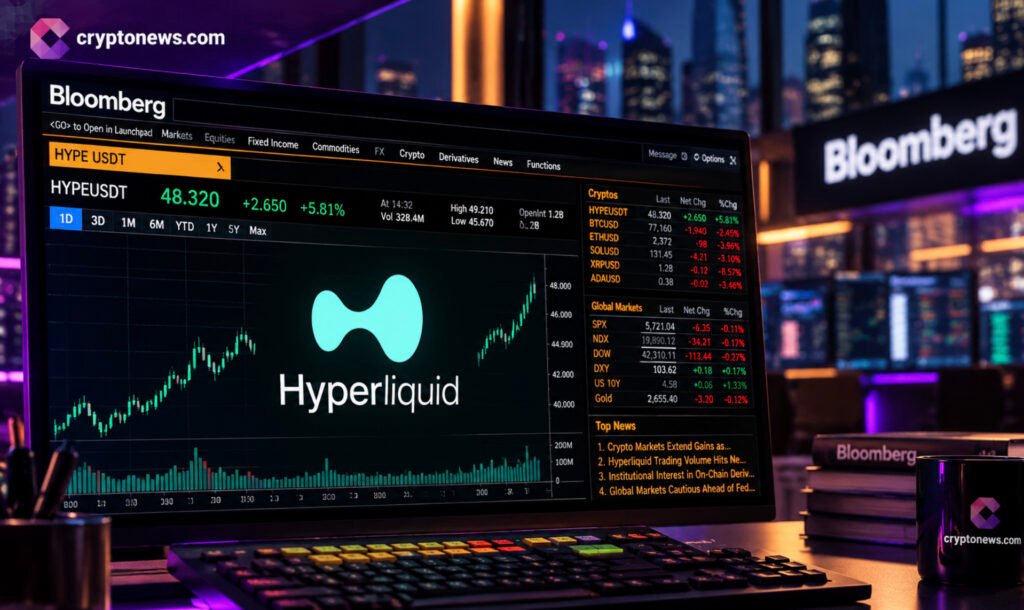
Hyperliquid perpetual contracts are now available through the Bloomberg Terminal, bringing data from the decentralized exchange into a widely used professional market-data workflow. Just a few hours ago, the contracts had become available on the terminal.
Market-data availability can make Hyperliquid easier for professional users to discover, monitor, and compare against other venues, potentially supporting more analyst attention and institutional crypto research.
Institutional investors typically need controls for key management, execution, and custody beyond access to pricing data, as outlined in discussions of institutional custody and execution infrastructure. Likewise, clearing and regulatory registration are distinct from the visibility provided by a market-data platform.
Hyperliquid runs on its own layer-1 blockchain and supports more than 100 assets through HyperCore. However, Bloomberg access does not, on the available evidence, confirm real-time data, direct exchange connectivity, institutional participation, or regulatory approval.
Earn $50 and Enter $300K Prize Draw on EdgeX
Hyperliquid Perpetuals Rely on Hourly Funding
Hyperliquid’s documentation describes perpetuals as derivatives without an expiry date. Funding payments occur hourly and are intended to help keep contract prices aligned with the underlying spot market, so there is no scheduled settlement date forcing positions to close.
The documented margin structure uses USDC collateral for generally USDT-denominated linear contracts. The documentation identifies PURR-USD and HYPE-USD as the USDC-denominated exceptions. This market structure helps explain what terminal users may be monitoring, but it says nothing by itself about who is accessing the data or whether that access converts into trading.
Trade Crypto on Bybit and Get a Chance to Win Our $1,000 USDT Airdrop
Hyperliquid Demand and Bloomberg Terminal Listing
The report presents the Bloomberg inclusion as a potential sign of rising traditional-finance interest in decentralized platforms. The more useful test is whether it leads to observable changes: sustained institutional attention, further Bloomberg coverage, strategic partnerships, or increased activity on the exchange.
Polymarket pricing put the likelihood of Hyperliquid reaching $100 by December 31 at 71.5%, up from 68% in the preceding 24-hour reading. That is a prediction-market probability, not a verified forecast, and not evidence that Bloomberg access caused a repricing.


Established benchmarks and institutional products package exposure through defined market structures; comparisons with crypto index concentration underline why data visibility alone is not equivalent to a product investors can access under familiar trading and risk controls.
For Hyperliquid, the evidence that would change the assessment is concrete: confirmed institutional participation, additional market infrastructure, or a measurable shift in exchange activity.
If the terminal listing increases monitoring and coverage, it could broaden Hyperliquid’s reach among professional market participants. If it remains a data-only reference without confirmed execution, custody, or clearing access, its significance will remain primarily informational.
Regulatory developments and market sentiment also remain relevant to HYPE’s price outlook.
Discover: The Best Token Presales