


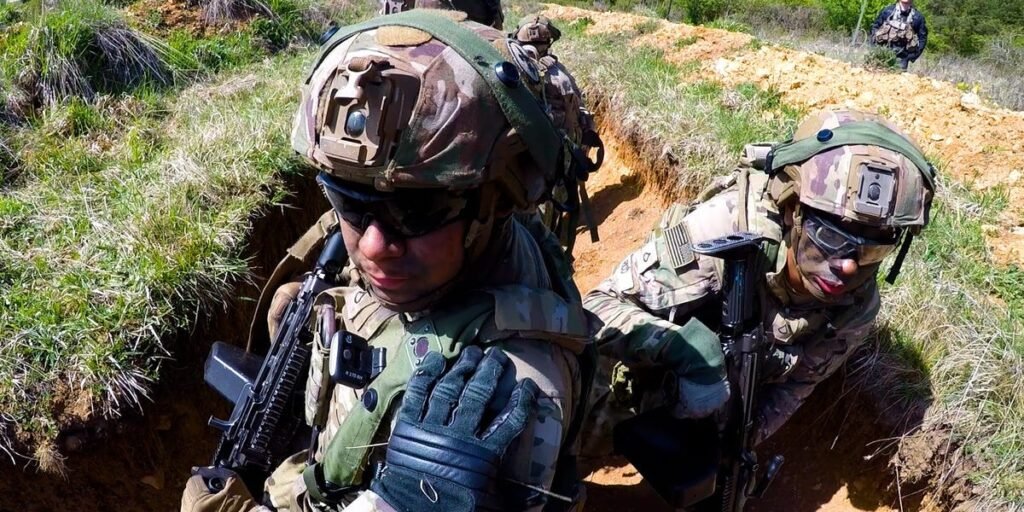
Just a couple of hours north of Munich, the US Army runs its largest training site outside the United States. Once a Nazi artillery training ground, the sprawling base is now home to more than 16,000 troops kept ready to fight at a moment’s notice.
Soldiers train in trenches and with armored Stryker combat vehicles to maintain constant combat readiness “so they can answer America’s call in an instant,” said Hermes Acevedo, who was the command sergeant major and senior enlisted advisor to the garrison commander at US Army Garrison Bavaria when Business Insider’s Graham Flanagan visited last April.
That readiness serves as deterrence. From Bavaria, troops can reach the Czech Republic within about an hour and Ukraine’s capital, Kyiv, in roughly 18 hours by road. “By us being ready, by us being here in this location, [it] kind of sends a signal,” Acevedo said.
Business Insider
He didn’t name a specific adversary, but soldiers in the trenches know who they’re preparing for.
As Russia’s war in Ukraine continues, the US Army’s presence in Germany is crucial. These soldiers could be the first ones in the fight, defending NATO’s eastern flank.
From Nazi training ground to NATO backbone
Business Insider
US Army Garrison Bavaria’s origins date back to pre-World War I, when the Royal Bavarian Army developed a training area for its own artillery forces.
That role expanded under Adolf Hitler, when the Third Reich used the same grounds as a major training hub for the German Wehrmacht — Nazi’s unified armed forces.
At the end of World War II, US forces took control of the area. Today, it anchors US and NATO operations in Europe.
Business Insider
The installation spans four main areas, including Tower Barracks and Rose Barracks. It houses the 7th Army Training Command — which sets standards for US Army Europe and Africa — and the 2nd Cavalry Regiment, a forward-positioned ground force.
“We’re not going to deploy to an incident in Europe,” Acevedo said. “We are already here.”
Training for a potential war with Russia
Business Insider
Troops can leave their barracks and reach live training ranges in less than two minutes, Acevedo said. Once there, they train in all conditions — snow, rain, heat, and cold — to build what he described as instinctive responses.
“It’s all about readiness,” Acevedo said.
The base also runs an opposing force, or OPFOR, that mimics enemy tactics. “We’re basically supposed to act like Russians,” Spc. Aaron Jude said, noting they study the war in Ukraine sometimes through open-source material like social media.
Business Insider
OPFOR units use AK-style rifles and train in trench warfare, reflecting the realities of the conflict.
“That’s what’s so awesome about this unit,” said Staff Sgt. Daniel Johnson, an OPFOR soldier. “Not only are we being able to train to our standards, but we’re also training to Russia’s standards. Honestly, to me, that’s like a really good way to understand our adversaries.”
Sensors across the training area collect data, allowing commanders to analyze performance and refine strategy. That constant feedback loop is central to the base’s role, allowing it to test equipment and decision-making under pressure.
A self-contained military ecosystem
Business Insider
The installation is designed to support both troops and their families. It includes more than 3,400 housing units, K—12 schools, childcare centers, and recreational facilities. Many families live both on and off base, integrated into nearby communities.
Acevedo said that these support systems help ease one of the biggest challenges for troops arriving from the US: uncertainty.
That environment is part of what keeps the base functioning at scale. Soldiers can focus on training and missions, while families have access to services designed to mirror life in the US.
The result is a well-oiled rapid-response war machine that turns a historically significant site into a modern military hub, readying troops for a hard fight.