


Unlock the Editor’s Digest for free
Roula Khalaf, Editor of the FT, selects her favourite stories in this weekly newsletter.
The writer is senior lecturer in marketing at King’s Business School, London
Over its 90-year history, Jaguar has reinvented itself repeatedly. But since the start of the decade, the British car manufacturer has been forced to undertake a radical makeover that has sparked sharp division.
The company, which originally made motorcycle sidecars, launched its first automobile in 1935. Success on the racetracks in the 1950s and the introduction of the legendary E-type in 1961 attracted customers, including the British government and the royal family, alongside fictional drivers such as TV detective Inspector Morse and a number of James Bond villains.
But while the brand’s prestige grew, quality concerns meant that some customers considered buying two cars: one to drive, and one for spare parts. None of Jaguar’s four owners in the past half-century succeeded in turning it around financially.
Successive models such as the XF and the F-type celebrated connections to Britishness, aristocracy, adventure, traditional gender roles or speed. Yet for many years, the business kept accumulating losses.
Test yourself
This is part of a series of regular business school-style teaching case studies devoted to business dilemmas. Read the text and the articles from the FT and elsewhere suggested at the end (and linked to within the piece) before considering the questions raised. The series forms part of a wide-ranging collection of FT ‘instant teaching case studies’ that explore business challenges.
“Project Roar” was its most recent response. Launched in 2024 after several years in the making, the overhaul plan committed Jaguar — part of the larger Jaguar Land Rover group, owned by India’s Tata Motors — to an all-electric future from 2026. It pledged to invest £18bn to transform a manufacturing site and retrain employees.
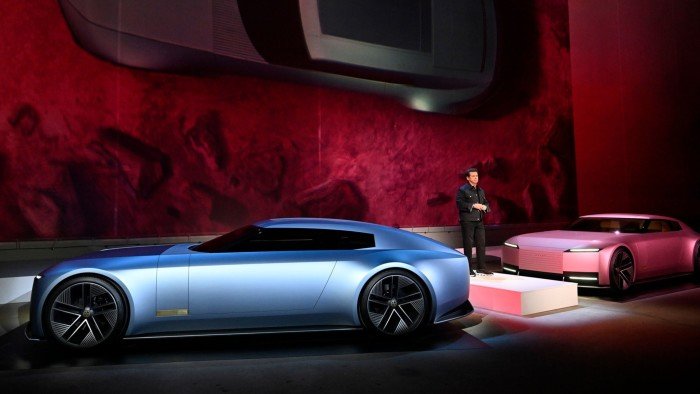
Its first and only venture so far into electric cars, the SUV I-Pace model, is now on sale. Jaguar’s top management is focused on the Type 00 concept car, a £100,000-plus vehicle with a range of up to 478 miles. It features a novel brand logo with a minimal monogram instead of the iconic cat, and received mixed reviews when it was unveiled at Miami Art Week in December 2024.
Gerry McGovern, Jaguar’s chief creative officer, argues that the brand does not need to be loved by everybody. He views the new model as a collectable that, like some art and architecture, is designed with what he calls “fearless creativity” and so can attract a mix of criticism and enthusiasm.
The company estimates that it will need to sell only about 30,000 new cars a year — half as many as in the recent past — to break even. Plans to sell the car by invitation-only via pop-up stores in upscale city districts may attract a new set of young, wealthy and international customers looking to add to their existing car collections. Jaguar might seek out early adopters who are receptive to radically new products such as the Apple Watch or the Tesla Cybertruck.
However, its length of 5.1 metres may make it difficult to sell in the UK and most of continental Europe. And critics see Jaguar as a late follower in the electric car business, its Type 00 design merely an extension of a prior approach. In any case, some see the weakening of emissions targets as posing a threat to continued momentum in sales of electric vehicles.
Meanwhile, the campaign surrounding the car’s launch has divided opinion among brand executives and car enthusiasts. A 30-second ad released in November — ahead of the unveiling of the Type 00 in Miami — featured no cars, sparking fierce discussions on social media. Featuring fashion models, a moonscape and abstract phrases such as “create exuberant”, “live vivid”, “break moulds” and “copy nothing”, the teaser strongly deviated from mainstream car ads.
Critics have challenged the campaign and denounced the rebranding as a significant gamble. While drawing more than 160mn views, the campaign did not resonate well with many brand executives, who expressed disbelief that Jaguar was throwing away a heritage that took a lifetime to build for a new image that tampers with its core brand DNA. Angered car enthusiasts have denounced the campaign as “woke” and unnecessarily alienating loyal customers.
Jaguar’s chief executive defended the ad, which was produced in-house, as “bold”. And while the design is polarising, observers seem to agree it is unique. Pragmatists have acknowledged the buzz created. The point, said Jaguar managing director Rawdon Glover, was that this was making Jaguar “socially relevant”. Perhaps — like savoury spread Marmite’s famous “love it or hate it” slogan — the ability to divide opinion is itself a powerful marketing tool.
Further reading and questions for discussion
Further reading:
AB InBev should defy the Bud Light culture war
BP goes back to petroleum
How Apple’s ‘tone deaf’ iPad ad signals a turning point
Thought the petrol Jaguar was dead? Think again
Consider these questions:
• Given declining demand for fully electric cars in key markets, should Jaguar continue pivoting away from petrol-fuelled cars — and if not, what would be the alternatives?
• To what extent does changing the brand’s logo support or hinder the brand’s repositioning — or should Jaguar stay authentic?
• What are the strengths and weaknesses of the “copy nothing” teaser ad?
• Is the perceived controversy in the ad likely to differ across markets?
• How successful has been Jaguar’s response to the backlash to the ad? Could it have been addressed better — and if so, how?