


Spoilers ahead for “A Knight of the Seven Kingdoms” season one, episode three, “The Squire,” and the book “The World of Ice & Fire.”
So far, “A Knight of the Seven Kingdoms” has been presented as a cozier, humbler snapshot of Westeros, the fantasy world where “Game of Thrones” is set a century later. But with Sunday’s episode, HBO’s new spinoff show abruptly raises the stakes.
The third episode of season one, titled “The Squire,” ends in a sudden flash of fiery violence when Prince Aerion Targaryen (Finn Bennett) attacks the kindly puppeteer Tanselle (Tanzyn Crawford). In an act of dim-witted chivalry, Dunk (Peter Claffey) rushes to her rescue, punching and kicking the prince in the process.
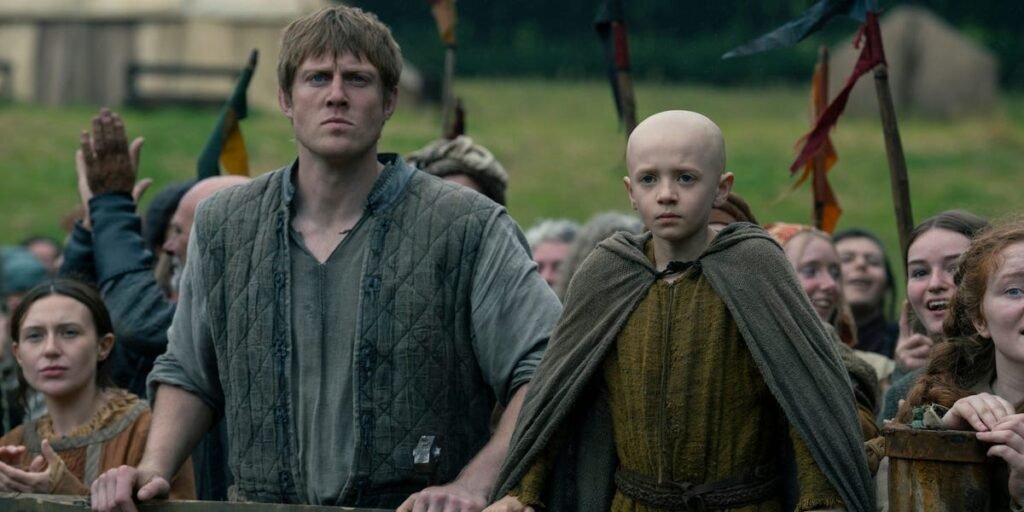
In the medieval monarchy of Westeros, hurting a member of the royal family is a serious crime. Aerion commands his sworn knights to break out all of Dunk’s teeth as punishment, but an unlikely hero swoops in to save him: Egg (Dexter Sol Ansell), his young and conspicuously bald squire, whom, until that point, Dunk had mistaken for a low-born orphan.
“You impudent little wretch,” Aerion spits. “What’s happened to your hair?”

Every time Callie publishes a story, you’ll get an alert straight to your inbox!
Stay connected to Callie and get more of their work as it publishes.
“I cut it off, brother,” Egg replies. “I didn’t want to look like you.”
The reveal that Egg is actually a clean-shaven Prince Aegon Targaryen in disguise is the show’s first big twist, signaling that Dunk and Egg have a much larger role to play in Westerosi history than an ordinary hedge knight and his squire wandering around the countryside, sleeping under the stars, jousting, and drinking ale.
The episode also includes an Easter egg about the duo’s future, which sounds equal parts promising and tragic.
If you can’t wait for Egg to grow up, keep reading to learn his canonical fate and how it might play out in “A Knight of the Seven Kingdoms.”
Egg eventually becomes the king of Westeros, and is known as Aegon the Unlikely
Steffan Hill/HBO
Earlier in “The Squire,” before Egg’s true identity is revealed, Dunk and Egg come across a fortune teller at Ashford Meadow. She tells Dunk that he’s destined for great success and that he’ll become “richer than a Lannister.” She gives Egg a much bleaker prognosis.
“You shall be king,” she tells Egg, “and die in a hot fire, and worms shall feed upon your ashes, and all who know you shall rejoice in your dying.”
Although Dunk brushes it off as a frivolous carnival trick, the boy is visibly shaken by her words.
Book readers will know that Egg has good reason to fret. Although at this age, he’s way down in the line of succession — all three of his uncles, plus his father, his male cousins, and his older brothers need to die for Egg to become king — a series of unlikely tragedies do, in fact, unfold to eventually seat Egg on the Iron Throne.
The second part of the prophecy is also, tragically, book-accurate. Near the end of Aegon’s reign, he becomes obsessed with restoring dragons to the Seven Kingdoms. He ultimately dies in a mysterious fire at Summerhall, one of House Targaryen’s royal residences, during a presumed failed attempt to hatch dragon eggs. Among the dead is also Egg’s eldest son, Duncan Targaryen, and Dunk himself, who had risen through the ranks to become Lord Commander of the Kingsguard.
This snippet of dialogue about a prophecy doesn’t appear in George R. R. Martin’s original “The Hedge Knight,” but rather was invented for the onscreen adaptation. It serves as a wink to fans who are familiar with Targaryen lore and are scouring the show for clues about the dynasty’s downfall.
“Certainly George was consulted, and the histories,” showrunner Ira Parker told Business Insider about his decision to add the prophecy scene. “I don’t think anyone knows the histories better than me surrounding these characters.”
In “Game of Thrones” and HBO’s other prequel series, “House of the Dragon,” it’s clear that Targaryens are deeply influenced by magic and prophecy. Some even have “dragon dreams” — abstract visions that almost always come true, but usually not in the way the dreamers expect. Egg’s eldest brother, Prince Daeron Targaryen (Henry Ashton), is one such example.
Still, “A Knight of the Seven Kingdoms” drastically scales back on the fantastical features of Westeros. After all, at this point in the story’s timeline, the Targaryen family’s dragons have gone extinct, and the common folk are generally wary of magic.
“I think it’s fun to add light, little touches [of magic] as long as it doesn’t influence the story or the characters in a significant way. Because we’re here to tell small, contained little adventure stories,” Parker said. “We’re not a prophecy show.”
Asked how the peek into Egg’s future will affect the cheeky, bald-headed boy we meet in “A Knight of the Seven Kingdoms,” Parker said that ideally, it won’t. Egg has no way of knowing that a random peasant in a backwater town would be able to predict his destiny, and his onscreen portrayal should reflect that innocence.
“We are trying to be as honest as we possibly can with these characters at this point in time,” Parker explained. “He ends up becoming ‘Aegon the Unlikely.’ Nobody is thinking that the fourth son of a fourth son is going to get anywhere near that throne.”
In terms of how the fiery-death, wormy-corpse forecast might factor into “A Knight of the Seven Kingdoms” season two and beyond, Parker kept his cards close to his chest.
“Look, I have a plan for that that I’m not going to reveal to anybody,” Parker said. “You can ask me about it in 10 years if we manage to do a few of these.”