


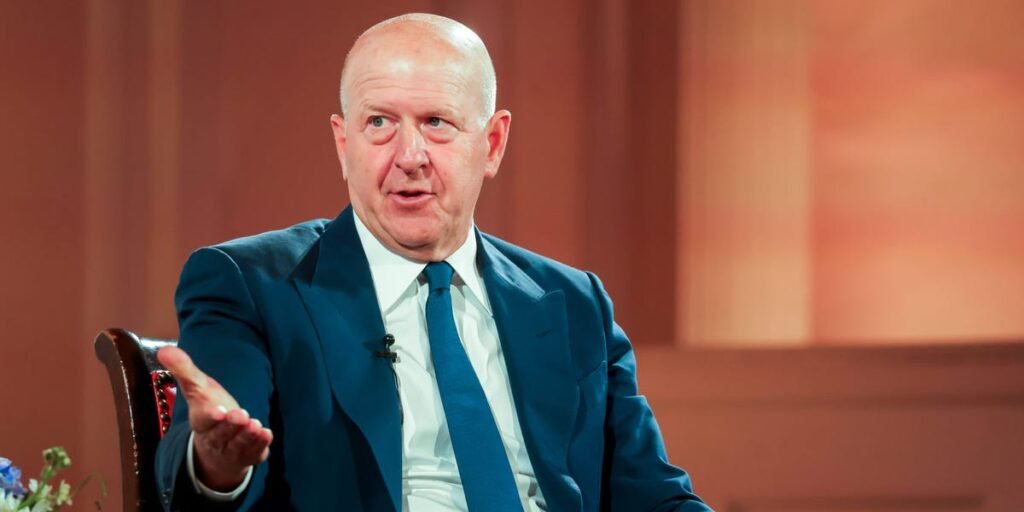
Goldman Sachs CEO David Solomon says the bank may bring in fewer fresh-faced employees over the next few years as AI reshapes their work.
But don’t call it a hiring apocalypse.
During an interview with Bloomberg’s “Odd Lots” podcast, released on Thursday, Solomon said Goldman’s out-of-school hiring could “contract a little” over the next three years. Still, he predicts the firm will continue to hire thousands of interns and recent graduates.
“You’re going to see nuanced changes that probably to some degree reduce the number of people that we start with over the next few years, but probably not what you and I would call dramatically,” he said. “We’re still going to hire a lot of people out of school.”
This year, Goldman is bringing on an estimated 2,400 to 2,500 interns, Solomon said. He added that the firm has a similar number of permanent new hires starting in July — roughly in line with pre-COVID levels, but below the more than 3,000 it was bringing in during 2021.
Asked how Goldman’s new-hire mix has changed since the pre-ChatGPT era, Solomon said the firm had seen “subtle, subtle changes.” He said the firm had shifted more heavily toward engineering talent over the past decade, and that the mix would likely shift again “given the power of these tools and our ability to code.”
The comments come as concerns about AI’s impact on jobs spark mixed responses across industries.
In Silicon Valley, top AI bosses, like Anthropic CEO Dario Amodei, have warned of potential wipe-outs for entry-level workers. Meanwhile, leaders in other industries think there’s more nuance to the existential warnings — Apollo’s chief economist Torsten Sløk wrote that there’s “zero evidence” that AI is driving layoffs, and Uber’s COO, Andrew Macdonald, said it’s getting harder to justify the amount of spending it takes to automate tasks with AI.
Solomon, who argued in a late-May New York Times op-ed that the AI jobs apocalypse is overblown, falls firmly in the latter camp.
The bigger challenge, Solomon said during the podcast, is figuring out how to train young workers when AI can instantly produce answers that once required hours of grunt work.
He recalled starting his banking career in an age without minute-by-minute digital trackers for stock prices. To compare stock performance, he said, he dug through microfiche, pulled prices from The Wall Street Journal, plotted them on graph paper, and did the math by hand.
It was slow, but it taught him useful critical thinking skills, he said.
“Now, if you ask for it, you get it instantaneously,” he said. “Has your brain really absorbed what’s actually happening?”
Operating in a world with answers at his entry-level intern’s fingertips means Goldman has to rethink skill training, Solomon said.
Still, his advice to young bankers in the AI age was decidedly old-school: pick up the phone and talk to people.
“A telephone call to someone is 10 times more valuable than a text or an email,” Solomon said. “My daughter says that’s an unverified statistic. I know that’s true.”
Goldman didn’t immediately respond to a request for comment from Business Insider.