


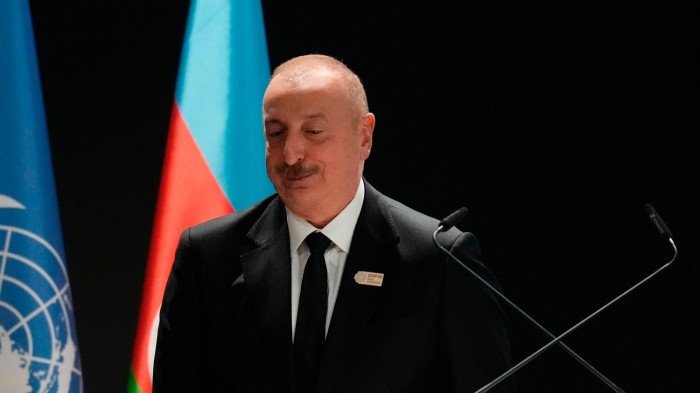
France and Argentina have withdrawn their top negotiators from the COP29 summit in Azerbaijan, deepening the divisions at a climate summit already shaken by Donald Trump’s election.
The move by France, a champion of the UN’s strategy to fight climate change, came after the host country’s President Ilham Aliyev used a speech at the event to accuse the “regime of President [Emmanuel] Macron” of “brutally” killing citizens during recent protests in New Caledonia.
The Azerbaijan president also described France’s Pacific island territories as “colonies”, citing nuclear tests in French Polynesia and Algeria.
France has historically supported Armenia, which for decades has been locked in a deadly conflict with Azerbaijan.
Agnès Pannier-Runacher, France’s environment minister, described Aliyev’s comments as “unworthy of a COP presidency”. Her decision not to attend the summit means Paris will not be represented by a senior political official, since Macron had already chosen not to travel to Baku. Instead, France’s climate ambassador has attended ministerial meetings.
A person close to the French delegation said that Pannier-Runacher was still piloting negotiations from Paris, adding that, because of the gravity of the climate crisis, France was not playing “empty chair politics”.
Other previously announced absences from COP29 include US President Joe Biden, European Commission president Ursula von der Leyen, Indian Prime Minister Narendra Modi and China’s President Xi Jinping.
Trump’s impending return to office has plunged the UN’s climate change agenda into further doubt, with the president-elect having vowed to withdraw from the landmark 2015 Paris accord.
COP29 is taking place just days after the EU’s Copernicus Climate Service said that 2024 was “virtually certain” to be the hottest year on record, with global average temperatures for the year likely to be more than 1.5C above pre-industrial levels.
Argentina also withdrew its climate negotiators from the conference on Wednesday, on orders from the government of President Javier Milei, who portrays himself as Trump’s strongest Latin American ally and spoke to the president-elect on Tuesday.
The country has the world’s fourth-largest shale oil and second-largest shale gas reserves.
A spokesperson for the COP29 presidency did not comment on the withdrawals.
EU climate chief Wopke Hoekstra defended France on social media. “Regardless of any bilateral disagreements, the COP should be a place where all parties feel at liberty to come and negotiate on climate action” he posted on X.
The conference guest lists show that eastern European and central Asian neighbours were registered in far larger numbers for COP29.
While the conference has fewer attendees overall than at COP28 in the United Arab Emirates, where the oil and gas industry was out in force, the fossil fuel industry and consultants are dominant among the Azerbaijan guests, while the ranks of G7 delegates, finance and industry have markedly thinned.
The contingent of fossil fuel executives invited to Baku, where they operate or are represented, include ExxonMobil’s Darren Woods, BP boss Murray Auchincloss, TotalEnergies’ chief Patrick Pouyanné, Eni’s Claudio Descalzi, Saudi Aramco’s Amin Nasser and Sinopec chair Ma Yongsheng.
Among the few industrial sector leaders was Andreas Schierenbeck, chief executive of Hitachi Energy, the world’s largest producer of transformers. This was a contrast to the COP28 gathering in Dubai where bankers and industry turned out in droves.
The UN lists of delegates and parties also identifies dozens of consultants, led by Teneo, the main public relations adviser to the COP29 presidency. Its global strategy executive Geoff Morrell is a former executive at BP, a major foreign investor in Azerbaijan. Also prominent was the Tony Blair Institute, led by the former UK prime minister, as well as BCG, McKinsey, EY and Deloitte.
Green energy groups from the solar and wind sector, such as UAE renewable energy group Masdar, were also represented, though in smaller proportion than their hydrocarbon counterparts.
President Aliyev has been strident about the nation relying on its oil and gas wealth, which generates about 90 per cent of exports and which he has repeatedly described as a “gift from god.” He lashed out at western critics in his opening address to the world’s most important climate negotiations.
“Unfortunately double standards, a habit to lecture other countries and political hypocrisy became kind of modus operandi for some politicians, state-controlled NGOs and fake news media in some western countries,” Aliyev said on Tuesday.
Azerbaijan registered about twice as many guests compared with those invited by the UAE as host of the COP28 summit in Dubai last year, though its own delegation size is half as big as the one the UAE boasted.
The total attendance in Baku is expected to top 65,000, compared with more than 80,000 in Dubai, but this figure includes support and technical staff, which generally make up about a fifth. The core participants are typically reduced further as more register than collect their badges.
Next year’s COP host country, Brazil, also had a sizeable contingent, according to delegate lists released by the UN. Neighbouring Turkey registered the third-largest list of attendees, and President Recep Tayyip Erdoğan was warmly welcomed as one of the more prominent world leaders.
China sent almost 1,000 people for the fifth-largest national presence, while Russia and Kazakhstan, key allies, listed more representatives than the UK, Italy, the US, Canada or Germany. The delegates list for Uzbekistan and Kyrgyzstan was larger than the European Union.
The poor showing of leaders and shrunken delegations from G7 countries did not bode well for a strong new global finance goal, which was critical to helping to limit climate change, said Ruth Townend, a senior research fellow at Chatham House.


Eurasian academic Gevorg Avetikyan said that as well as “doing a personal favour to Ilham Aliyev by being there on the highest level”, Azerbaijan’s neighbouring nations were also facing the threat of global warming.
Any impact on the Caspian Sea would affect the nearby landlocked central Asian states, including Uzbekistan and Kyrgyzstan, giving them a commonly shared interest in preventing further environmental degeneration in the region. The Aral Sea, between Kazakhstan and Uzbekistan, once one of the largest inland bodies of water in the world, is “nearly extinct”, he noted.
The conference also gives these nations the opportunity to express what Avetikyan called “anti-colonial” rhetoric. For Russia, he said, COP is one of the few remaining global events it can attend and not be excluded from processes as a rogue state following the war on Ukraine.
Data visualisation by Steve Bernard
Climate Capital

Where climate change meets business, markets and politics. Explore the FT’s coverage here.
Are you curious about the FT’s environmental sustainability commitments? Find out more about our science-based targets here