


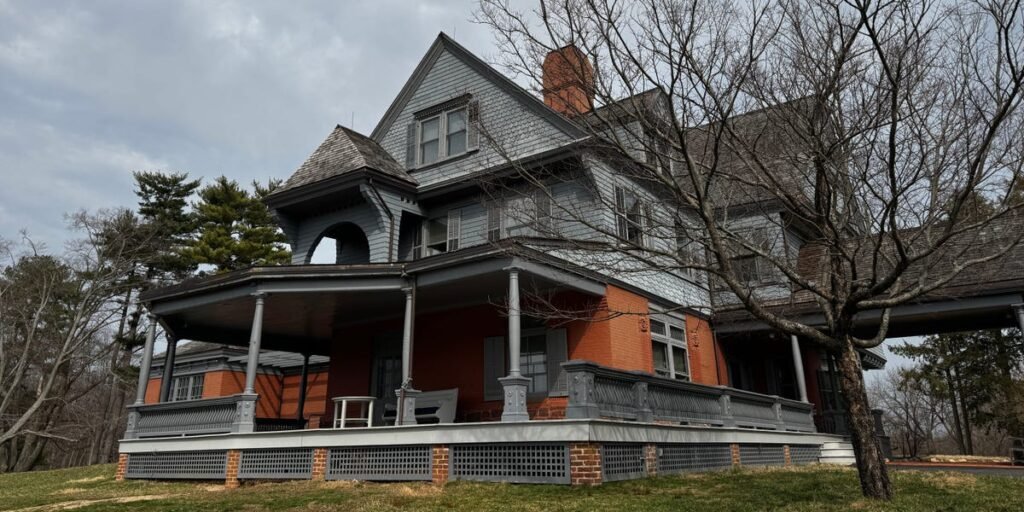
Have you ever wondered what, exactly, brought about the end of the Gilded Age?
Look no further than our 26th president, Theodore Roosevelt, who was inaugurated in 1901 after the assassination of William McKinley, and pivoted the US away from its laissez-faire business traditions and toward the Progressive Era.
However, Roosevelt’s home, Sagamore Hill — nicknamed the Summer White House during his presidency — was built in 1884, smack in the middle of the Gilded Age.
The Sagamore Hill National Historic Site in Oyster Bay, New York, encompasses Roosevelt’s home, his son’s house (now a museum), a nature trail, a pet cemetery, and acres of land.
The park is free to enter, though you can pay $15 for a guided tour of Roosevelt’s home. During my visit, I roamed the property, its museum, and its nearby beach, but I’ll be back when the weather is warmer, giving me a glimpse of the home and its surroundings in their full glory.
Here’s what it’s like to visit the Summer White House and its expansive surrounding estate.
I drove out to Oyster Bay, a town on Long Island, to visit the Sagamore Hill National Historic Site, the home of President Theodore Roosevelt.


Google Maps
It’s free to visit Sagamore Hill, which contains the Roosevelt Museum, a nature trail, Roosevelt’s home, beach access, and more.

Gabbi Shaw/Business Insider
During Roosevelt’s presidency, he spent his summers at Sagamore Hill, which was nicknamed the Summer White House.
Gabbi Shaw/Business Insider
Now, it’s a historic site open to the public.
Gabbi Shaw/Business Insider
The museum is located in the Old Orchard House, which was built on the estate in 1938.
Gabbi Shaw/Business Insider
It was the home of Theodore Roosevelt Jr., the president’s eldest son. He died in 1944, shortly after becoming the oldest general to storm the beaches on D-Day.
Gabbi Shaw/Business Insider
Theodore Jr. and his wife, Eleanor, purchased the land for Old Orchard from his family after they “tired” of living in rented homes.
Gabbi Shaw/Business Insider
It has 12 rooms, making it smaller than his childhood home atop the hill but more than enough for their four children.
Gabbi Shaw/Business Insider
The home has since been turned into a museum for Roosevelt.
Gabbi Shaw/Business Insider
The upstairs is closed to the public, but the first floor is filled with Roosevelt facts and memorabilia.
Gabbi Shaw/Business Insider
The museum goes through Roosevelt’s entire life.
Gabbi Shaw/Business Insider
One of Roosevelt’s famed Rough Riders uniforms, custom-designed by Brooks Brothers, is on display.
Gabbi Shaw/Business Insider
The hat and pin Roosevelt wore to President McKinley’s funeral are there, too. McKinley’s death led to Roosevelt, his vice president, becoming the youngest president ever at 42.
Gabbi Shaw/Business Insider
Part of Roosevelt’s legacy was his dedication to preserving land. A display of junior park ranger badges from across the US honors his love of nature.
Gabbi Shaw/Business Insider
Of course, the museum also has a gift shop.
Gabbi Shaw/Business Insider
Behind the museum is the entrance to a 0.7-mile loop trail that leads to the beach.
Gabbi Shaw/Business Insider
The surrounding forest is filled with oak and hickory trees.
Gabbi Shaw/Business Insider
The trail leads to a boardwalk across a salt marsh to Cold Spring Harbor. A boardwalk in some form has been here since 1888, when Roosevelt built one for his family.
Gabbi Shaw/Business Insider
During their time here, there were bath houses, a floating dock, and rowboats.
Gabbi Shaw/Business Insider
Now, it’s just a peaceful beach.
Gabbi Shaw/Business Insider
I hiked back to check out more of the grounds. These structures are from when Sagamore Hill was a functioning farm, from 1885 to 1948.
Gabbi Shaw/Business Insider
Inside the former chicken coop, there’s information about the farm’s history, including images from the Roosevelt family’s personal archive.
Gabbi Shaw/Business Insider
I walked toward Roosevelt’s house. I passed what was once a working windmill — Roosevelt once cut open his head while trying to repair it.
Gabbi Shaw/Business Insider
Finally, I came to Sagamore Hill. It was built in 1884 for Roosevelt and his first wife, Alice, but she died the same year, and Roosevelt left New York for years to grieve.
Gabbi Shaw/Business Insider
He returned for good after he remarried in 1886. Roosevelt and his second wife, Edith, remained married until his death in 1919.
Gabbi Shaw/Business Insider
The Latin phrase “Qui plantavit curabit” is etched over the front door. It means “He who planted will sustain.”
Gabbi Shaw/Business Insider
The house was designed by architects Lamb & Rich.
Gabbi Shaw/Business Insider
A 22-year-old Roosevelt purchased the land on which Sagamore sits in 1880. He paid $30,000 for 155 acres, or roughly $1 million today.
Gabbi Shaw/Business Insider
He lived here with his family until his death. During the seven years of his presidency, it became known as the Summer White House.
Gabbi Shaw/Business Insider
Peace talks during the Russo-Japanese War were held here. Roosevelt would later win the Nobel Peace Prize for his role in ending the conflict.
Gabbi Shaw/Business Insider
A memorial for Roosevelt’s youngest son, Quentin, is on the property. A pilot, he was shot down during World War I, making him the only child of a US president to die during combat.
Gabbi Shaw/Business Insider
The day before Roosevelt died in 1919, he told his wife, “I wonder if you will ever know how much I loved Sagamore Hill.”
Gabbi Shaw/Business Insider
After visiting, I understood why. It must’ve been a peaceful respite for Roosevelt, a true outdoorsman. I’ll be coming back when the trees are green and flowers are blooming.
Gabbi Shaw/Business Insider