


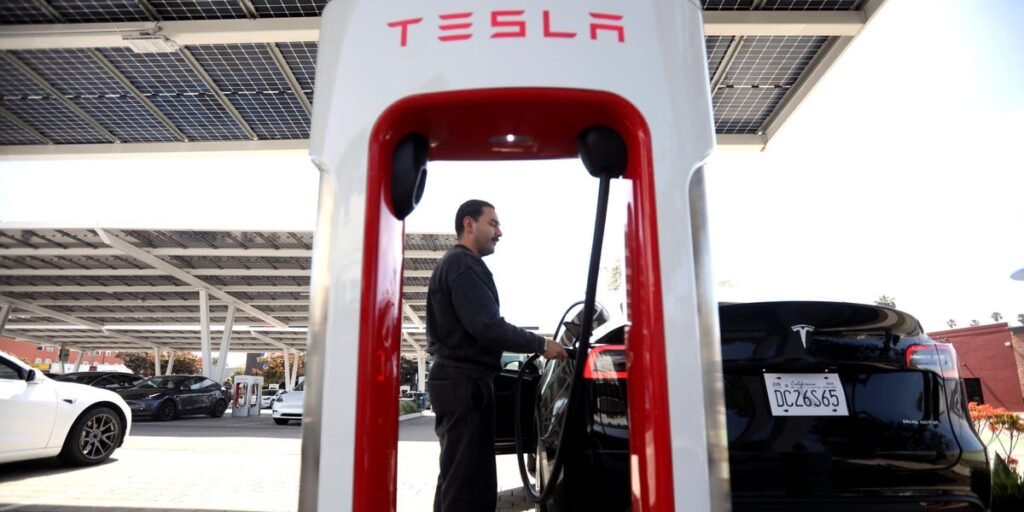
Tickers above American gas stations are flashing higher prices.
EV owners, meanwhile, are plugging in — and laughing about it online.
Across social media, electric-vehicle drivers are touting their savings as fuel costs climb during the US and Israel’s military interventions in Iran.
Many have posted meme-filled victory laps about the price of “filling up.”
One shared a compilation of a mustached Tom Selleck turning toward the camera with a smug grin in “Magnum P.I.” Others are posting screenshots of their cheap charging sessions. Some are sharing gleeful TikToks while plugging their EVs into a home charger.
Juicy J — the cofounder of Three 6 Mafia and a producer of the Academy Award-winning song “It’s Hard out Here for a Pimp” — also weighed in, saying it was “time to go full electric.”
Gas prices have surged as military strikes in the Middle East disrupted oil production and heightened fears about tanker traffic through the Strait of Hormuz — a key artery for an estimated 20% of global oil and liquified natural gas shipments.
Brent crude climbed over $100 a barrel Sunday night as traders reacted to the instability. By Monday afternoon, the price had dropped back to the low $80s.
American drivers are paying more at the gas station. On February 21 — before tensions escalated — the average price of a gallon of regular gas in the US was $2.93, according to AAA.
By Monday, it had risen to $3.48, an 18.7% jump in 15 days.
In some areas, the increases have been even steeper. A Los Angeles gas station advertised prices above $8 a gallon, according to local ABC affiliate KABC.
Public EV charging rates, by contrast, have risen far less.
Over the same period, the national average price per kilowatt-hour at public charging stations increased from $0.39 to $0.42 — a 7.6% bump, according to AAA data.
And most EV owners charge at home, where electricity rates are typically lower and less directly tied to crude oil prices than gasoline.
“I had no idea,” one driver wrote on X about oil prices. “I drive a Tesla.”
Some users on X pointed out that charging costs vary widely by state and utility provider.
In regions where electricity generation relies heavily on natural gas, power prices could rise if energy markets remain volatile.
For example, in Kansas, EV charging costs about $0.30 per kilowatt-hour, according to AAA. In Louisiana — where charging stations are more sparse — the average is $0.47.
The online gloating comes at a complicated moment for the EV market. Even as gas prices heat up, sales of electric vehicles have cooled.
In January 2026, sales of EVs at American dealerships fell by 53.5% compared to the same month last year, per CarGurus’ data shared with Business Insider.
Even as EV sales shrink, Americans who have traded in the gas tank for the battery are taking this time to bask in their money-saving glory.
“Who’s glad to have an EV during this time of high gas prices?” one person wrote on Reddit. “I guess not having to deal with the ups and downs of gas prices is one of the benefits of owning an EV.”
Are gas prices affecting your daily travel? We want to hear from you. Contact Ben Shimkus at bshimkus@insider.com or Signal at bshimkus.41. Use a personal email address and a nonwork device; here’s our guide to sharing information securely.