



Crypto Journalist
Anas Hassan


Crypto Journalist


Share



When Bitcoin plunged below $78,000 on January 30, 2026, it wasn’t alone. Copper, gold, silver, and platinum all tumbled in unison, with the base metal dropping nearly 4% from its record high above $14,500 per ton just hours earlier.
The synchronized selloff reinforced what many have suspected that Bitcoin is increasingly behaving like a macro risk asset, moving with traditional economic barometers during periods of heightened uncertainty.
Copper (often called “Dr. Copper” for its diagnostic ability to predict economic health) has spent the past few days on a volatile tear.

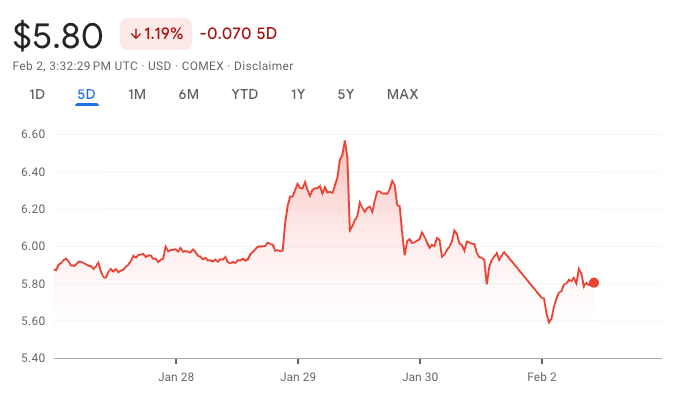
After surging to record highs near $6.50 per pound in late January 2026, the metal retreated sharply to around $5.92 per pound on January 31.
Bitcoin’s trajectory has been similarly turbulent, falling from October 2025’s all-time high of $126,173 to current levels around $77,000-$78,000, a decline of roughly 40%.
Both assets face the same macro headwinds.
Understanding Dr. Copper’s Economic Signal
Copper’s reputation as an economic indicator stems from its ubiquity in industrial activity.
From construction and infrastructure to electric vehicles and AI data centers, the metal’s demand is the perfect mirror of real economic growth.
JPMorgan estimates that data center demand for copper alone could reach 475,000 tons in 2026, up from 110,000 tons in 2025, driven by AI infrastructure buildouts.
Yet even with these long-term tailwinds, copper’s recent volatility shows how quickly macro fears can overwhelm fundamental demand.
Speaking with Cryptonews, Vasily Shilov, CBDO at crypto exchange aggregator SwapSpace, identifies geopolitical tensions as a primary driver.
“Concerns surrounding the situation with Iran were the main news factor weighing on the market,” Shilov explains, adding that “political factors are adding pressure: trade threats against Canada, South Korea, and Cuba, harsh rhetoric toward Iran, and the Federal Reserve’s decision to keep rates unchanged, with no sign of imminent easing.“
Bitcoin’s Shifting Correlation
Bitcoin’s relationship with copper has evolved considerably.
During the pandemic, research from Poland’s Institute of Nuclear Physics documented emerging correlations between cryptocurrencies and commodities, including copper, relationships that hadn’t existed before COVID-19.
Bitcoin’s correlation with copper spiked to 0.84 in December 2022, suggesting the digital asset traded more like a risk-on commodity than a safe haven.
Analysts have tracked the copper-gold ratio as a leading indicator for Bitcoin price movements.
Crypto analyst Lark Davis has previously observed that Bitcoin rallies have historically occurred when the copper-gold ratio’s relative strength index retests its bottom range.
However, late 2025 demonstrated the relationship’s instability.
During what analysts dubbed “metal season,” copper gained over 40% while Bitcoin fell approximately 6%, showing the correlation can break down entirely.
Current Market Dynamics
The January 30 synchronized selloff shows how both assets now respond to common triggers.
For copper, volatility reflects speculative positioning around potential U.S. tariffs on refined copper imports, Chinese demand weakness (down 8% year-over-year in Q4 2025), and front-loaded US inventory accumulation.
Bitcoin faces parallel pressures. “The influx of new capital into BTC has virtually stopped,” Shilov observes, adding that market participants increasingly expect “a protracted sideways trend rather than a rapid V-shaped rebound.“
According to SwapSpace data, on-chain data shows Bitcoin transfer volumes to exchanges have fallen to around $10 billion per month, compared to $50-80 billion during previous price peaks, suggesting the decline stems from weak demand rather than panic selling.
The weakness extends to institutional investors. Research from Galaxy shows the average Bitcoin ETF investor is now underwater, with the collective cost basis of U.S. spot Bitcoin ETFs at approximately $87,830, well above Bitcoin’s current price of around $76,000-$78,000.
U.S.-listed Bitcoin ETFs recorded roughly $2.8 billion in net redemptions over the past two weeks, marking their second and third-largest weekly outflows on record.
The tokenized metals market provided stark evidence of interconnection. On January 30, crypto venues saw approximately $120 million in liquidations across tokenized copper, gold, and silver products as leveraged positions faced margin calls.
In fact, crypto, excluding metal, saw way more, with over $2.5 billion in liquidations of leveraged long positions.
The Critical Caveat
Despite correlations, treating copper as a Bitcoin prediction tool would be a mistake.
Copper moves on idiosyncratic factors (mining disruptions at Indonesia’s Grasberg mine, Chilean production challenges, Chinese smelter utilization rates) that have no direct bearing on crypto demand.
A 2024 study modeling Bitcoin versus commodity futures found that these relationships are regime-dependent, changing with market conditions.
What It Means Now
The current environment shows Bitcoin trading less like “digital gold” and more like what one Goldman Sachs analyst in 2021 called “digital copper,” a pro-risk, growth-sensitive asset that thrives during economic expansion but suffers during uncertainty.
As Shilov notes, prevailing sentiment resembles fear of a 2022-style collapse, though he points out that “the market often goes against the expectations of the majority.“
Historical patterns, like July 2021’s near-50% Bitcoin decline before reversing to new all-time highs, suggest corrections can set up future rallies.
For now, both copper and Bitcoin face the same question, which is whether current prices reflect genuine demand destruction or temporary positioning ahead of clearer macro signs.
Copper at least has structural tailwinds from electrification and AI infrastructure. Bitcoin’s path forward depends on whether risk appetite returns and whether, this time, Dr. Copper’s diagnosis proves accurate.