


Unlock the Editor’s Digest for free
Roula Khalaf, Editor of the FT, selects her favourite stories in this weekly newsletter.
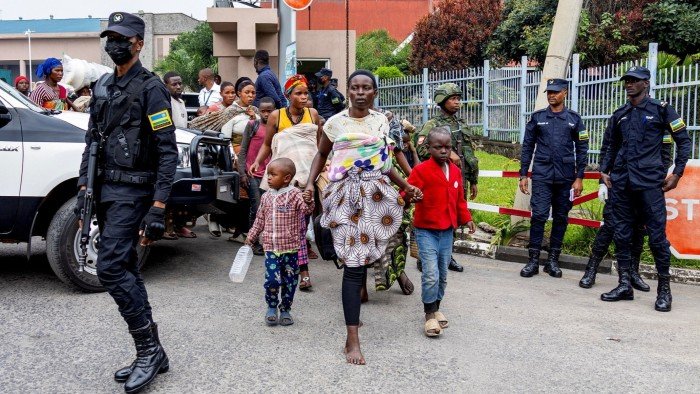
Rwandan-backed rebels moved to tighten their grip on the strategic city of Goma in the east of the Democratic Republic of Congo on Monday in what Kinshasa described as “a declaration of war” by its neighbour.
Lawrence Kanyuka, a spokesperson for the Rwandan-backed M23 militia, said in a post on X that Goma “had been liberated” and called for calm after rebel fighters on Sunday moved into the city of 1.5mn people, many of them displaced by other conflicts.
Years of war in mineral-rich eastern DR Congo, involving dozens of competing militias, have displaced about 6mn people and plunged the region into a permanent state of insecurity.
Goma, which is close to the Rwandan border, is the capital of North Kivu, an important mining region and a big supplier of metals that are used in smartphones and other electronic devices. If its takeover by M23, which briefly occupied the city in 2012, is confirmed, it would be the group’s biggest military victory in years.
France’s foreign minister Jean-Noël Barrot said in Brussels on Monday that Paris “strongly condemns the offensive led by the M23, backed by the Rwandan armed forces, which has led to the death of six peacekeepers and the displacement of several thousand people. Fighting must stop and dialogue resume”.
Rwanda has consistently denied backing M23 rebels, with Rwanda’s president Paul Kagame only this month denying that Kigali backed the fighters. In December, talks — mediated by Angola — to end the fighting between Rwanda and DR Congo broke down.
UN experts say Rwanda has deployed up to 4,000 soldiers to support M23 rebels, providing them with heavy military equipment including surface-to-air missiles and armoured vehicles, as well as snipers, to back their campaign.


“The UN warned of a regional conflict last week and there is a real danger it could become this,” said Alex Vines, head of the Africa programme at think-tank Chatham House.
At an emergency UN security council meeting on Sunday, France, the UK and the US called on Rwanda to withdraw its forces, although China merely urged an end to hostilities without naming Kigali.
DR Congo’s foreign minister Thérèse Kayikwamba Wagner called the Rwandan-backed offensive “a declaration of war that no longer hides itself behind diplomatic manoeuvres”.
Stéphane Dujarric, spokesperson for António Guterres, said: “The secretary-general is deeply concerned by the escalating violence [and] calls on the Rwanda Defence Forces to cease support to the M23 and withdraw from DRC territory.”
The UN has begun to evacuate non-essential staff after at least six were killed in what Guterres said might amount to war crimes.
A UN group of experts’ report on DR Congo published this month said the M23 had expanded its grip on eastern Congo and had gained control of several of the most important mines, which supply tin, tungsten and tantalum to the world’s biggest electronic companies.
The report accused M23 of shipping minerals to Rwanda and disguising them as Rwandan production in what it called “the largest contamination of mineral supply chains in the Great Lakes region recorded to date”.
The DR Congo has filed a criminal complaint against Apple, accusing it of knowingly purchasing metals fuelling war. Apple has vigorously denied the claims and said that, as the security situation worsened, it instructed suppliers in June last year to cease sourcing metals from either DR Congo or Rwanda.
In an op-ed in the Financial Times on Sunday, Jason Stearns, author of The War That Doesn’t Say Its Name: The Unending Conflict in the Congo, accused the west of soft-peddling on Rwanda, which he called “the main instigator of the M23 conflict”.
While the US, EU and UK had all condemned Kigali, he said, they backed it with generous aid and treated it as an ally in regional security issues, including an insurgency threatening a $20bn investment by French company Total in northern Mozambique.
“Talk is cheap. Often criticisms of Rwanda are contradicted by other actions,” he wrote.