


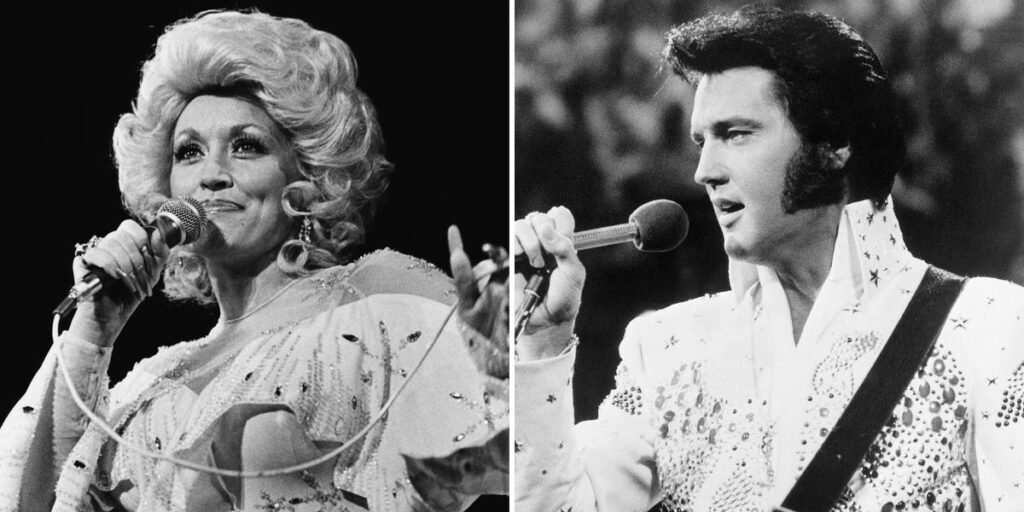
In what world does a young, sequined country singer with just a handful of chart-toppers to her name turn down a special request from the King of Rock?
In Dollywood, of course.
Dolly Parton, who died on Tuesday, was less than a decade into her career when she released the twangy torch song “I Will Always Love You” in 1974. It topped Billboard’s Hot Country Songs chart for one week, becoming her third No. 1 after “Joshua” in 1971 and “Jolene” earlier that year.
Elvis Presley, meanwhile, was already a musical legend and commercial titan when he took a liking to Parton’s tune.
Over the years, Parton has recounted the story several times, saying she was ecstatic when she got the call that Presley wanted to cover “I Will Always Love You.” It was the kind of headline-making endorsement that could make a musician’s career: If Presley’s version became a hit, it could be a major financial windfall for Parton as the sole songwriter.
However, Parton’s excitement dissipated when she got another call from Colonel Tom Parker, Presley’s manager at the time.
“He said, ‘You know that we don’t record anything with Elvis unless we have the publishing,'” Parton recently recalled to Howard Stern. “And I said, ‘Well, that’s not possible, because that is my most important copyright. I’ve got my own publishing company.”
“He said, ‘Well, at least you’ve got to give us half,'” she continued. “I said, ‘I can’t do that.'”
Parton stood her ground on not giving up or splitting the publishing rights — meaning the legal ownership and control of Parton’s composition, and a good chunk of the song’s royalties, too — even though it was personally devastating.

Every time Callie publishes a story, you’ll get an alert straight to your inbox!
Stay connected to Callie and get more of their work as it publishes.
Want more Business Insider in your news feed?
Add BI in Google so our reporting is easier to find when you’re searching for what matters.
“I wanted to hear Elvis sing it, and it broke my heart — I cried all night,” Parton said in 2021. “But I had to keep that copyright in my pocket. You have to take care of your business! Everybody’s going to use you if they can. These are my songs — they’re like my children. And I expect them to support me when I’m old.”
‘I Will Always Love You’ still became a money-maker without Presley

Williams/Mirrorpix via Getty Images
While “I Will Always Love You” was already a modest hit on the country charts, Parton knew she was taking a risk by passing up Presley’s offer.
“I already told everybody Elvis was doing my song. But I thought, you know, I can’t do it. And I didn’t,” Parton told CNBC. “It was just one of those first really hard business decisions I had to make.”
That decision paid off handsomely nearly two decades later, when Whitney Houston recorded her own version of “I Will Always Love You” for the soundtrack of her 1992 blockbuster, “The Bodyguard.”
Houston’s version topped the Billboard Hot 100 chart for a record-breaking 14 weeks and was later certified diamond by the Recording Industry Association of America, meaning it sold at least 10 million copies in the US. It’s become known as one of the most celebrated love songs of all time.
Parton remained the sole songwriter credited on the track and retained the publishing rights. She once quipped that Houston’s version made her “enough money to buy Graceland.”
Parton later revealed that she invested the song’s royalties in a Black community in her home state of Tennessee, calling it “the house that Whitney built.”
“A lot of people say that’s Whitney’s song,” Parton told Katie Couric in 2016, “and I always say, ‘That’s fine, she can have the credit, I just want my cash.'”
Parton’s business savvy is reflected in today’s pop stars

Andreas Rentz/TAS24/Getty Images for TAS Rights Management
Parton’s big payoff illustrates the importance of publishing rights as one of a musician’s most valuable assets.
Some of the savviest businesswomen in the music industry today have followed in Parton’s footsteps, chief among them Taylor Swift.
Swift’s $2 billion fortune is largely thanks to the value of her catalog; she is the sole or lead songwriter on every song she’s ever released, earning her a significant chunk of royalties.
After Swift signed with a new record label in 2018 and left her old masters behind, she launched the “Taylor’s Version” project, in which she re-recorded new versions of her past albums in order to own them outright. The project served to devalue the original recordings that Swift didn’t own, which likely won her leverage in negotiations to purchase her life’s work, which she did in 2025.
Younger songwriters have also made a point to retain ownership of their masters, including Olivia Rodrigo, who cited Swift as an inspiration. Indeed, it’s become increasingly popular for rising stars to forgo the traditional label system and stay independent — a riskier path with a smaller safety net, but one with the prospect of more control and a bigger cut of the profits.
In all likelihood, that’s just as Parton would have liked it.
“Dolly gave us someone to look up to while encouraging us to be who we are as individuals,” Swift told The Hollywood Reporter in a statement after Parton’s death. “She possessed the softest heart when it came to the struggles of others, and a backbone of steel to defend her own self worth as an artist.”