



Author
Ahmed Balaha


Author


Share



Researcher Avihu Levy published a working implementation of Quantum Safe Bitcoin on April 9, 2026 – no protocol change required.
The scheme operates entirely within Bitcoin’s existing script constraints, making it available to any user willing to absorb the compute cost today.
Bitcoin’s governance culture makes a Bitcoin soft fork extraordinarily difficult to coordinate. BIP-360, which Levy co-authored and which was merged into Bitcoin’s official repository in February 2026, laid out a quantum-resistant address standard, but it requires protocol-level consensus that could take years to materialize.
Quantum Safe Bitcoin sidesteps that bottleneck entirely. It’s not a theoretical workaround; Levy shipped GPU-accelerated CUDA code, Python pipelines, and complete Bitcoin scripts alongside the academic paper.
How QSB Actually Works – Hash Puzzles, Not Elliptic Curves
Standard Bitcoin transactions rely on ECDSA signatures over the secp256k1 curve. Shor’s algorithm can compute discrete logarithms efficiently, meaning a sufficiently powerful quantum computer could forge those signatures and drain any wallet with an exposed public key.
Post-quantum cryptography addresses this – but every known implementation requires larger signatures and new opcodes, which means a soft fork.
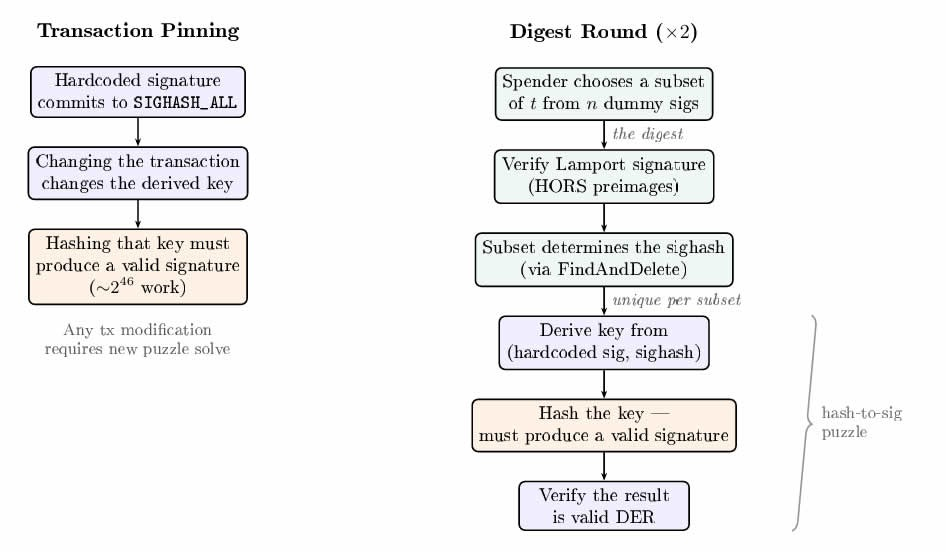
Levy’s approach cuts the elliptic curve dependency at the root. The scheme, built on Binohash (Robin Linus, 2026), replaces the standard signature verification with a hash-to-signature puzzle. The Bitcoin script hashes a transaction-bound public key via OP_RIPEMD160 and interprets the resulting 20-byte output as a DER-encoded ECDSA signature.
A random 20-byte string satisfies DER structural constraints with probability roughly 2−46 – that’s approximately one in 70 trillion attempts – which defines the proof-of-work target.
The critical distinction: this puzzle’s security rests entirely on RIPEMD-160’s preimage resistance, not on any elliptic curve assumption.

Shor’s algorithm attacks discrete logarithms. It does not break hash functions. That single architectural decision is what makes Quantum-Safe Bitcoin resistant to the quantum threat without touching the protocol.
The construction works in three phases. First, transaction pinning: the prover searches over (sequence, locktime) parameter pairs until the recovered public key’s RIPEMD-160 hash produces a valid DER signature – approximately 246 work.
Second, two digest rounds: for the pinned transaction, the prover searches over subsets of dummy signatures; each subset alters the scriptCode via FindAndDelete, producing a different sighash and a different recovered key.
Find a subset whose recovered key hashes to a valid DER signature (~246 candidates per round). The total computational cost is $75–$150 per transaction on cloud GPUs.
Zero-Knowledge Proofs and Dashlink enter the picture as an efficiency layer for proof verification. The QSB construction leverages post-quantum cryptography principles by anchoring security to hash-based assumptions – the same foundation underpinning ZK-friendly hash functions used in modern Zero-Knowledge Proofs.
Dashlink’s role is to compress the verification burden so that proof validation stays within Bitcoin’s existing 10,000-byte script limit and 201-opcode ceiling. No new opcodes. No consensus change. The scheme is consensus-valid under rules Bitcoin already enforces.
Bitcoin Hyper Targets Early Mover Upside


Bitcoin Hyper (HYPER) is currently in presale, targeting early-mover upside in the Bitcoin yield infrastructure layer – a sector drawing serious institutional attention as US spot Bitcoin ETFs pulled in $471.3 million in a single week.
The presale has raised $32 million to date, with the current token price at $0.0093 and staking APY running at 86% annualized for early participants.

The core technical differentiator: Bitcoin Hyper operates as a Bitcoin-native Layer 2 executing smart contracts with BTC as the settlement asset – bypassing the wrapped-token credit risk that plagues existing BTC DeFi infrastructure.
That’s a specific, verifiable architecture claim in a space full of vague interoperability promises.
Research Bitcoin Hyper here before the presale window closes.