



Author
David Pokima


Author


Share


Fact Checked by
CryptoNews Editorial Team
Author


Bitcoin price is doing something it hasn’t done in months by moving on its own terms, breaking the recent bearish prediction. Trading near $68,500 and dropping by 2% today, BTC is quietly separating from the tech equity complex that dragged it lower through most of early 2026.
The catalyst isn’t a halving narrative or ETF inflow. It’s war, and the AI valuation crisis that is hitting software stocks. The full implications for price haven’t been priced in yet.
Since the outbreak of the U.S.-Iran conflict on Feb. 28, Bitcoin’s correlation with the iShares Expanded Tech-Software Sector ETF (IGV) collapsed from near-perfect alignment at close to 1.0 to just 0.13, a level signaling near-total decoupling, before partially recovering to around 0.7.
Over that same period, Bitcoin has risen more than 5% while IGV has dropped more than 2%. The gap is widening. Investors appear to be rotating out of software equities, where AI-driven margin compression is hammering SaaS multiples, and treating Bitcoin as a macro hedge instead, a role gold has occupied for decades. Geopolitical shock has a way of accelerating these thesis shifts.
The 1 year chart still shows both assets deeply underwater, Bitcoin down 10%, IGV off 15%, but the divergence since late February suggests the relationship is fundamentally changing.
Discover: The best crypto to diversify your portfolio with
Bitcoin Price Prediction: Reclaim $75K as the Tech Decoupling Deepens?
At current levels, Bitcoin is trading roughly 30% below its October all-time high after a peak-to-trough decline of approximately 50%. IGV peaked slightly earlier and fell about 35% from its own top, a shallower drawdown, but one now accelerating as AI disruption fears mount across enterprise software. The divergence in recovery trajectories is stark.
The key technical level to watch is the $67,000 range. The level has flipped from resistance to support following this week’s move. A hold above that level keeps the bull case intact. The next meaningful resistance cluster sits near $74,000–$75,000, where prior consolidation and moving average confluence converge.

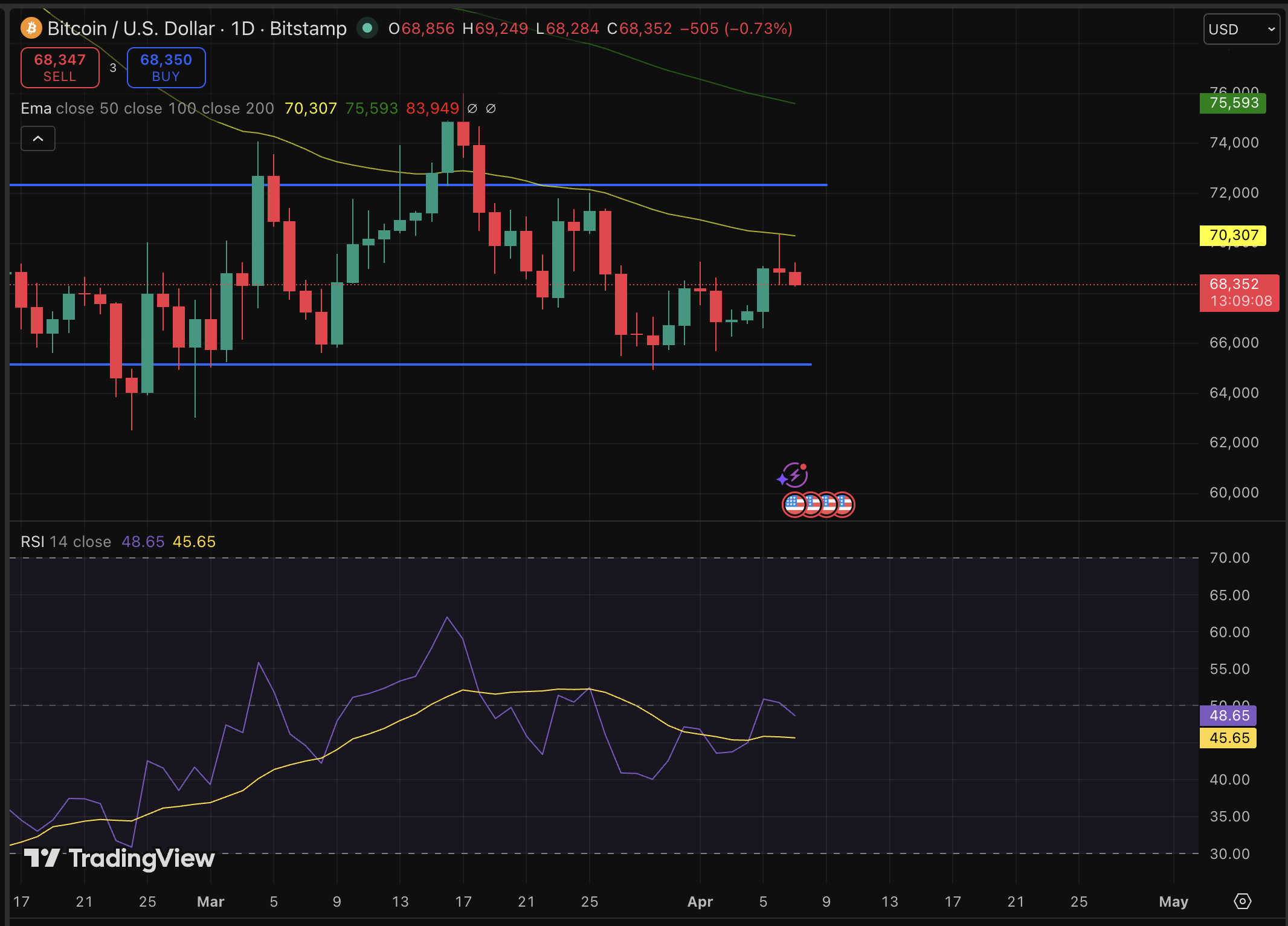
For the bulls, geopolitical tension that sustains macro-hedge demand will keep IGV’s correlation suppressed near 0.3–0.5, and BTC breaks toward $75,000–$78,000 over the next 2–4 weeks.
But, correlation can drift back toward 0.7 as markets stabilize; BTC consolidates between $67,000 and $72,000 while macro catalysts remain ambiguous. A breakdown below $67,000, or a re-coupling with equities if risk-off sentiment deepens, reopens a path toward the $54,000 level flagged by more bearish technicals.
Year-to-date, Bitcoin remains down roughly 10%, matching IGV’s losses almost exactly. That symmetry is now breaking. Whether this week’s move is a structural shift or a head-fake is the only question that matters right now.
Discover: The best pre-launch token sales
Bitcoin Hyper Targets Early Mover Upside as Bitcoin Tests Key Levels
Bitcoin at $68,500 is recovering, but a spot BTC position from here still means waiting on macro catalysts, regulatory timelines, and a 30%-plus move just to return to all-time highs. Early-stage infrastructure in the Bitcoin ecosystem offers a different risk profile entirely.
Bitcoin Hyper ($HYPER) is positioning itself at the intersection of two converging trends: Bitcoin’s resurgence as a macro asset and the explosive demand for scalable smart contract infrastructure. The project claims to be the first Bitcoin Layer 2 integrating the Solana Virtual Machine (SVM), delivering sub-second finality and low-cost smart contract execution while anchoring security to Bitcoin’s base layer.

The presale has raised $32 million at a current price of $0.0136, with 36% APY staking rewards live for early participants. The Decentralized Canonical Bridge enables native BTC transfers into the ecosystem without custodial risk.
For traders who believe Bitcoin’s decoupling thesis has legs, research Bitcoin Hyper as a higher-beta way to express that conviction at the infrastructure layer.