


Author
Ahmed Barakat


Author


Share


Fact Checked by
CryptoNews Editorial Team
Author


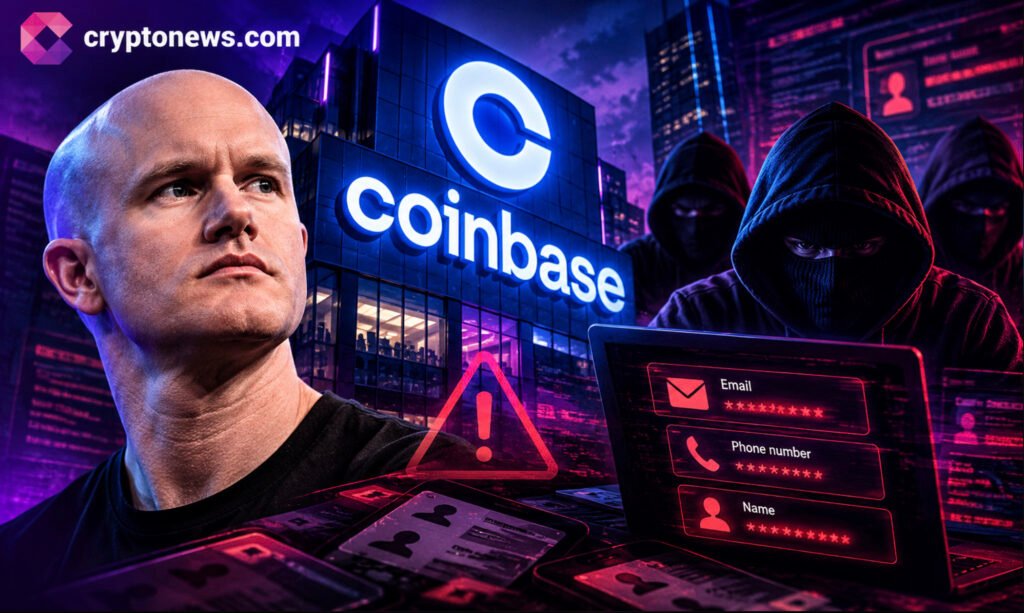
The Coinbase data breach has reignited questions about crypto security, but the incident raises a bigger question than whether users should trust centralized exchanges. An incident at analytics provider Amplitude exposed contact information belonging to a small subset of Coinbase customers.
Coinbase described the affected group as a “small subset” of customers, but has not publicly confirmed an exact victim count. Yet, the exposure could still create opportunities for targeted phishing and social engineering. Criminals may use genuine customer details to make fraudulent security alerts, support calls, and account-verification requests appear legitimate.
Coinbase also suffered a separate security incident in May 2025, when criminals bribed overseas support personnel to obtain customer information. The company estimated potential reimbursement and remediation costs at up to $400 million.
The incidents involved different reported methods, but both highlight the importance of restricting access to customer data and scrutinizing third-party relationships.
The incident comes as hardware wallet maker Ledger faces scrutiny following a customer-data exposure and a separate hardware-implant attack. Together, these cases show how crypto users face risks even when private keys remain protected.
Ledger Shows Why Hardware Wallets Cannot Eliminate Every Risk
Ledger provides another example of how security threats extend beyond private-key storage. In January 2026, a breach involving payment processor Global-e exposed names and contact information associated with Ledger customers. We covered the incident in Ledger Hit by Another Data Breach, Customer Names and Contact Details Exposed.
The incident did not show that Ledger wallets or private keys had been compromised. However, exposed customer details can help criminals identify hardware wallet owners and tailor convincing phishing campaigns.
More recently, Ledger confirmed that devices sold through Southeast Asian reseller CryptoBilis contained unauthorized hardware implants. Ledger’s security team said the implants captured recovery phrases displayed during device setup and transmitted them over LTE.
The company has not verified the total losses or number of affected users. Its investigation also found no indication that Ledger’s own infrastructure had been compromised.
These incidents illustrate two risks: customer-data exposure and supply-chain tampering. A hardware wallet can protect private keys against remote attacks, but that protection depends on the integrity of the device and its distribution channel.
Discover: The Best Token Presales
Should You Not Trust Crypto After The Coinbase Data Breach? Have Banks Face Similar Security Risks?
Crypto is not alone in dealing with data leaks and third-party vulnerabilities. Traditional banks have suffered data breach incidents that closely resemble Coinbase, yet those failures do not automatically invalidate the banking system.
In April 2025, ransomware hit Toppan Next Tech, a printing provider serving DBS and Bank of China in Singapore. The incident potentially exposed information belonging to 8,200 DBS customers and 3,000 Bank of China customers.
The exposed information included names, addresses, and certain account-related details. Both banks said their internal systems had not been compromised and customer funds remained safe, according to Reuters.


Another incident affected Lloyds Banking Group in March 2026. A software defect allowed customers using Lloyds, Halifax and Bank of Scotland apps to see other customers’ transactions. Up to 447,936 customers may have been affected.
The bank said it had identified no resulting financial losses. The incident nevertheless exposed sensitive information and prompted parliamentary scrutiny.
These cases show that banks also face failures involving vendors, software and customer data. Their size does not make them immune to attacks, and there is insufficient evidence to conclude that bank breaches attract less attention simply because the industry is larger.
Crypto Security Must Go Beyond the Custody Debate
This Coinbase data breach does not prove that centralized exchanges are inherently unsafe, just as Ledger’s incidents do not mean hardware wallets have no value.
Self-custody reduces dependence on exchanges to safeguard private keys. Centralized platforms can provide account monitoring, fraud detection, and recovery procedures. Neither model automatically prevents data leaks, phishing or compromised hardware.
Security must extend across the entire ecosystem, including customer databases, external vendors, employee access controls, device manufacturing and distribution.
Crypto companies need stronger vendor oversight, restricted access to sensitive information, and transparent incident reporting. Hardware wallet manufacturers must scrutinize resellers and strengthen device-verification processes.
Users also need to protect themselves. Strong authentication, trusted purchasing channels, and caution around unsolicited support messages can reduce exposure. Recovery phrases should never be disclosed to anyone claiming to provide customer support.
Ultimately, the Coinbase data breach shows a problem that extends beyond one exchange. Security is not a competition between self-custody and centralized platforms. It is a shared responsibility across every company, service provider, and user involved in protecting digital assets.
Discover: The Crypto Presales This Q4 2026