



Author
Ahmed Barakat


Author


Share



Bitcoin traded near $64,600 as the U.S. Senate shelved the CLARITY Act ahead of its August recess, leaving the market-structure bill without a floor vote.
JPMorgan had described the legislation as a significant potential catalyst, while its latest analysis said declining odds of passage this year were a headwind for the broader crypto market.
Attention now turns to whether senators can build enough bipartisan support to clear procedural hurdles.
The delay also leaves institutional allocators weighing whether continued U.S. regulatory uncertainty will keep capital sidelined or alter where digital-asset activity develops.
Discover: Everyone’s Got a Take. Get Free $25 to Actually Trade Yours
Senate Floor Math and Banking Friction Slow Momentum
The Senate faces a 60-vote threshold to advance the bill and limit floor debate. Unresolved stablecoin-yield provisions and other legislative hurdles remain central obstacles to moving the legislation forward.
Industry friction has added to the uncertainty. Coinbase withdrew its support over provisions that could limit stablecoin rewards and competition, and the primary report said the dispute contributed to a postponed Senate Banking Committee markup.

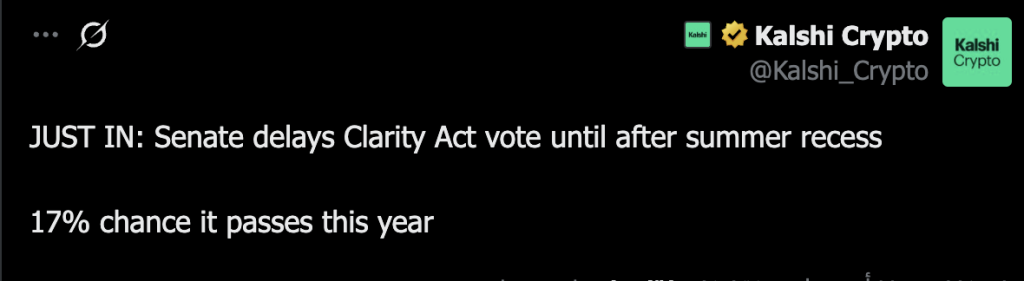
Kalshi estimated that the bill had a 17% chance of becoming law by year-end. JPMorgan said that level was below what institutional investors typically require for new mandates.
Discover: Your Market Calls Are Worth Something. Start With Free $25 on Kalshi
Clarity ACT Regulatory Split and Tokenization
The proposed legislation would split oversight of digital assets between the Commodity Futures Trading Commission and the Securities and Exchange Commission.
Tokens classified as digital commodities would fall under CFTC supervision, reducing compliance burdens that have pushed issuance and trading activity offshore.
A grandfather clause in the current draft would treat tokens tied to spot ETFs listed before January 1, 2026, including XRP, Solana, Litecoin, Hedera, Dogecoin and Chainlink, as commodities by default.
Separately, new projects could raise up to $75 million annually without full SEC registration, subject to disclosure requirements. JPMorgan said that provision could revive onshore venture activity that has migrated abroad.
JPMorgan warned that delays in Senate action could result in tokenization and blockchain applications being absorbed by traditional market infrastructure rather than benefiting public crypto networks. On July 15, the Depository Trust & Clearing Corporation announced a pilot to tokenize stocks and U.S. Treasuries involving firms including JPMorgan and Vanguard.
Citi estimates that the global market for tokenized financial assets, currently valued at $17 billion, could reach $5.5 trillion by 2030. The bank said that without a clear regulatory framework, much of that growth may remain within traditional financial systems rather than public blockchains.
Outlook for the Senate Process
Any effort to advance the CLARITY Act in the Senate still faces the 60-vote hurdle. The bill’s prospects will depend on whether lawmakers can resolve the outstanding provisions and assemble the support needed for a floor vote.
Until then, the legislation’s proposed division of regulatory authority between the CFTC and SEC remains unimplemented, leaving market participants without the clearer congressional framework envisioned by the bill.
Discover: Get Paid to Be Right, $25 to Start on Kalshi
Don’t Miss Out on Our $1,000 USDT Airdrop on ByBit