


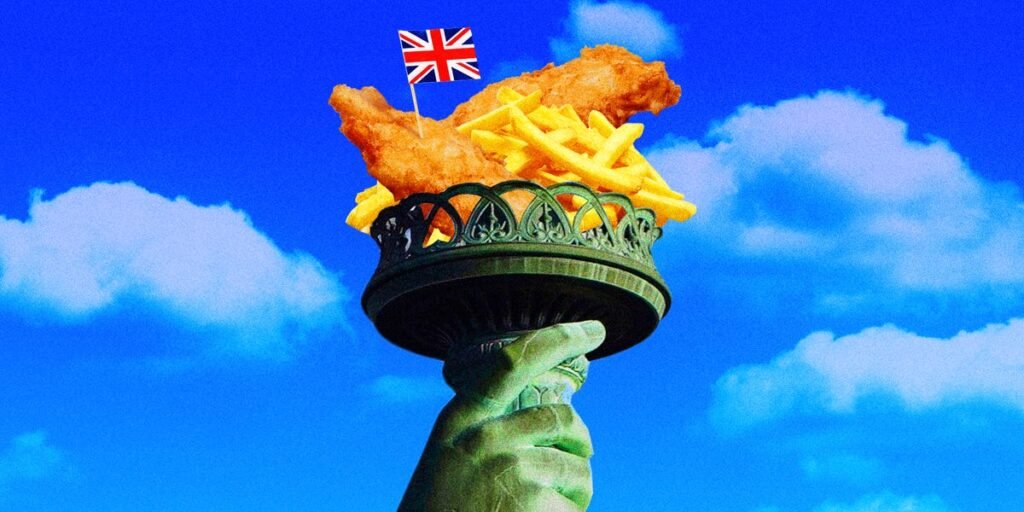
One of my strongest memories of growing up in London was coming home from school to a piping-hot filet of fried cod, fluffy chips, and sometimes a saveloy — a mildly seasoned, boiled sausage — all wrapped in newspaper.
Since moving to New York, I’ve had to accept that, beyond a couple of iconic establishments like A Salt & Battery, the neighborhood chippy simply isn’t part of the city’s dining culture.
That is beginning to change. From Sunday roasts to pub grub and British-Indian fare, chefs are tapping into the comfort and versatility of the modern British dining scene.
One Friday evening in May, I visited Dame, a British seafood restaurant tucked beneath a navy-blue awning on MacDougal Street.
I started with a Pimm’s Cup — a staple at garden parties back home — before the headliner arrived: fish and chips. The plate was simple, featuring golden battered fish, thick-cut chips, tartar sauce, and lemon, served with a bottle of malt vinegar. There was no newspaper in sight, but the straightforward presentation made it feel authentic.

Alex Lau
By dessert — a warm slab of sticky toffee pudding drenched in dark sauce and cream — Dame’s argument for a modern take on British food was clear: it isn’t being reinvented so much as reintroduced.
“There’s a lot of similarity between a meat pie and a pot pie, and fish and chips is not that alien of a concept to an American who grew up in the Midwest and has a fish fry on the weekends,” chef and co-owner Ed Szymanski told Business Insider.

Every time Erin publishes a story, you’ll get an alert straight to your inbox!
Stay connected to Erin and get more of their work as it publishes.
Szymanski, who grew up in England and trained in London before moving to New York, opened Dame in 2021 with his partner, Patricia Howard, a hospitality veteran who has worked at some of New York’s most notable restaurants. What began as a pandemic-era fish-and-chips pop-up evolved into a permanent restaurant that has become one of the leaders of New York’s new British restaurant boom, even earning Szymanski a James Beard nomination.
There seems to be a crowd in New York hungry for it. The only reservation I could get on a Friday at 5:30 p.m. was a seat at the bar.
“A common refrain we’d hear from our customers would be, ‘Oh, I wasn’t expecting it to be so good.'”Ed Szymanski, chef and co-owner of Dame
The appetite also extends beyond New York. Los Angeles recently welcomed three new British restaurants: Chicago’s Piccadilly Pub, a self-described “neighborhood chippy,” opened last December; further west, Seattle is getting a taste of meat pies at Little Beast; and Gordon Ramsay is set to open a London-inspired gastropub at Downtown Disney in California this year.
In a dining landscape shaped by economic pressure, comfort food is resonating again, albeit with a chef’s touch. In that context, British restaurateurs are thriving.
Comfort food with a glow up
Few British restaurants exemplify that trend better than Dean’s, which opened in SoHo this spring.
“There’s more appetite for flexibility, less interest in rigid formats, with people wanting to shape the experience a bit more themselves,” Annie Shi, who cofounded Dean’s with British-born chef Jess Shadbolt, told Business Insider. “That’s exactly what a pub offers: a sense of ease and community that feels especially relevant right now.”
Matt Russell
Reviews for Dean’s have largely been positive, though some note this is not an everyman’s local pub.
The New Yorker called Dean’s “a hot downtown restaurant wearing a pub’s clothing.” Restaurant guide The Infatuation rated it 8.1 out of 10, lamenting how difficult it is to snag a reservation, especially compared to the walk-in culture of a traditional pub.
The menu leans heavily into comfort food, but with more polish. Menu staples include fish and chips with triple-cooked fries and tartar sauce, Guinness bread served with butter and Marmite, and stargazey pie, a Cornish staple featuring a seafood pie with the fish heads poking up out of the pastry.
Montana Cooper
The details at Dean’s also skew distinctly British: Guinness is served in true 20-ounce pints.
“It’s less about rewriting the narrative and more about presenting British cooking in a way that feels honest to us,” said Shadbolt, whose upbringing along England’s coastline inspired much of the menu.
“We’ve always wanted to showcase its range — the dishes people know and love, but also the parts of the cuisine that are often overlooked, like preservation, baking, and roasting.”
British food culture is international
British cuisine doesn’t have the best reputation, thanks to World War II rationing that limited the kinds of food available. “British food was quite grim,” Syzmanski said.
Over the past decade, however, London’s food scene has undergone a transformation, moving past its reputation for bland or uninspired cuisine. Today, it’s a hub for regional fare, immigrant-driven concepts, and restaurants shaped by personal history and cultural identity — all things that New York diners know well.
For buzzy UK restaurant group Dishoom, expanding into New York in 2027 means focusing less on the brand’s British identity and more on cultural storytelling.
Dishoom
The group, which began in London in 2010 and now operates 15 locations across the UK, is rooted in Bombay café culture — an all-day, communal dining tradition named for the city’s former official name. Although the city is officially called Mumbai, many locals still use Bombay in everyday speech.
The menu features a variety of dishes familiar to international audiences: chicken tikka, biryani, and samosas, as well as local Bombay favorites like crispy prawn Koliwada and Pau Bhaji, which features buttery mashed vegetables and soft buns.
Dishoom
“New York is a city we have long admired,” cofounder Kavi Thakrar told Business Insider as he gears up to open their first stateside location. Like Mumbai and London, New York is defined by its diversity, and by diners willing to explore new dishes and cultures.
“It feels like a place that you could easily call home,” he said. “People are very open-minded.”
It’s not just cuisine — it’s the British way of dining
As Shadbolt sees it, diners aren’t necessarily chasing Britishness. They’re embracing restaurants where “you can have a quick drink, a full meal, or stay for hours without it needing to be one specific thing.”
Shi believes that’s what gives a great pub its staying power. “The best pubs evolve naturally over time because they’re shaped by the people inside them,” she said. “That sense of informality — where you can come in, stay a while, and feel like you belong there, whether it’s your first visit or your fiftieth — is what makes them so special.”
For UK transplants like me, this new wave of British restaurants offers a small taste of home. For New Yorkers, it offers the chance to see British food not as a punchline, but as a cuisine — and a dining culture — that is both comforting and far more varied than its reputation suggests.
In that sense, Britain’s biggest culinary export may not be fish and chips at all. It may be a way of dining that feels relaxed, generous, and increasingly suited to what Americans want from restaurants today.