


Unlock the Editor’s Digest for free
Roula Khalaf, Editor of the FT, selects her favourite stories in this weekly newsletter.
Boeing could look to redirect some of its planes destined for Chinese airlines to other customers as the US plane maker deals with the fallout from President Donald Trump’s trade war, its chief executive has said.
Kelly Ortberg said the company’s deliveries into China were already on hold due to the tariffs between the two countries. The US aerospace and defence group is America’s largest exporter and Beijing’s retaliatory tariffs on US goods have made Boeing’s jets significantly more expensive for Chinese airline customers.
The company has taken back two planes that were in China due for delivery and is in the process of bringing back a third, Ortberg said in an interview with CNBC.
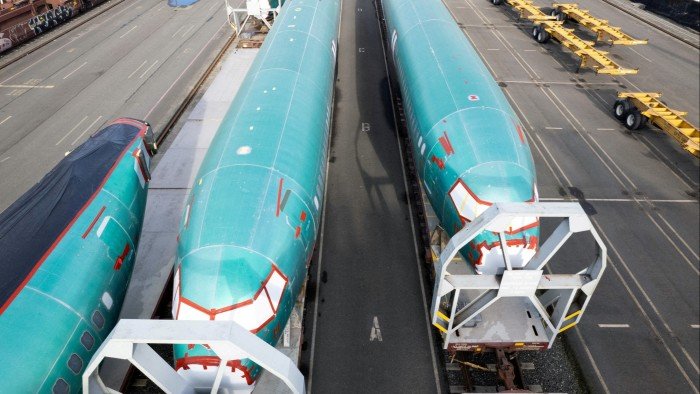
Ortberg said Boeing would be “pretty pragmatic” with the aeroplanes which had yet to be built. “There’s plenty of customers out there looking for the Max aircraft.”
Boeing had about 50 aeroplanes scheduled to be delivered to China this year. “I am not going to let this derail the recovery of our company,” said Ortberg.
The trade war is one of a number of challenges facing the US aerospace and defence group even as it delivered first-quarter results that beat Wall Street expectations.
The company reported a smaller than expected first-quarter loss after an increase in aircraft deliveries, and confirmed its forecast of positive free cash flow for the latter part of the year thanks to strong commercial aircraft deliveries.
Boeing shares jumped almost 9 per cent before trading at about $172, up 6 per cent.
For the first quarter, the company incurred a net loss of $31mn, significantly lower than the $355mn loss it reported in the same period last year. Revenues in the quarter rose 18 per cent to $19.5bn amid higher aircraft deliveries. The company had negative free cash flow of $2.3bn, compared with a negative $3.9bn in the same period last year.
On an adjusted basis, Boeing reported a loss per share in the quarter of $0.49, down from a loss of $1.13 per share a year earlier and less than the loss of $1.24 per share expected by analysts. The results only reflected tariffs enacted as of March 31, the company said.
Ortberg, who was brought in last August to turn around the group in the aftermath of a mid-air accident involving one of its planes, said the company was “moving in the right direction and making progress”.
“We’re building higher quality aeroplanes and delivering them with more predictability,” he said in a letter to staff on Wednesday, in which he described 2025 as the company’s “turnaround year”.
Boeing on Tuesday announced a plan to sell parts of its digital aviation unit to private equity group Thoma Bravo for $10.6bn to shore up its finances. Last year, it raised $24bn in equity and said it would cut 17,000 jobs.
The company on Wednesday reaffirmed plans to reach a target of producing 38 of its best-selling 737 Max planes a month this year. It is also stabilising production of its 787 jets at five a month, with plans to increase to seven a month this year.
Boeing delivered 130 planes in the first three months of the year — including 104 of the 737 Max — up from 83 deliveries in the same period of 2024.
Ortberg told employees that while the company was “closely watching the developments in global trade”, its strong start to the year, combined with strong demand for aeroplanes, gave it the “flexibility we need to navigate this environment”.
Additional reporting by Claire Bushey in Chicago