



Author
Ahmed Barakat


Author


Share


U.S. spot Bitcoin ETF products shed $635 million in a single trading session on Wednesday, the largest single-day outflow since January 29, as hawkish signals from the Bank of Japan triggered a global risk-off move that cascaded into over $500 million in crypto liquidations.
Bitcoin price dropped more than 2% in 24 hours to $79,400, stalling a rally that had carried prices from $65,000 to above $80,000 over recent weeks.

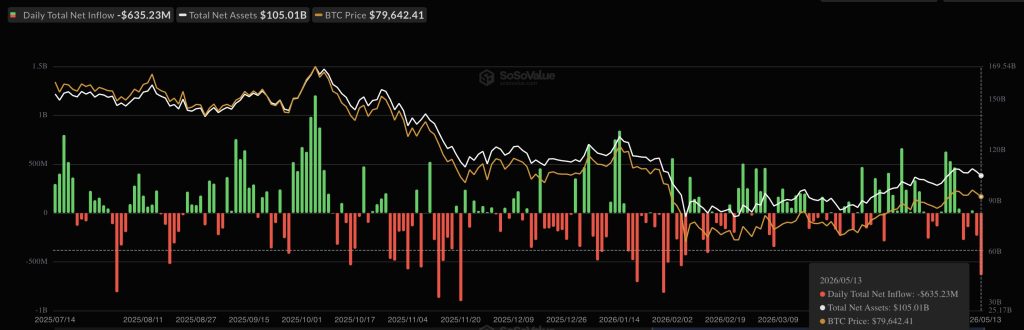
The $635 million exit brings total net outflows across the 11 U.S.-listed spot Bitcoin ETFs to $1.26 billion over five trading days, pulling cumulative net inflows since the January 2024 launch down from $59.76 billion to $58.5 billion, erasing in one week what took months to accumulate.
Discover: The best pre-launch token sales
How BOJ Hawkishness Produced a $635M Bitcoin ETF Exodus, and Why the Transmission Ran Through Leverage
The mechanism is straightforward once you trace the chain. The Bank of Japan reinforced its rate-hiking stance, strengthening the yen and forcing institutional desks holding yen-funded risk positions to reduce exposure to high-beta assets.
Crypto, sitting at the far end of the risk spectrum, absorbed a disproportionate share of that deleveraging.
Bitcoin was already technically vulnerable. The rally had run into the 200-day simple moving average positioned just above $82,000, a level that has historically acted as a momentum checkpoint.
When macro-driven selling pressure arrived at that resistance zone, leveraged long positions had nowhere to go.
Exchange data points to Binance and OKX as the primary venues for the bulk of the $500 million in long liquidations, consistent with the retail-leverage profiles of those platforms.
The ETF outflow is the institutional layer of the same story. The 11 U.S.-listed spot Bitcoin ETF products that raised $3.29 billion through March and April were driving the primary bullish flow narrative. That narrative required macro conditions to stay accommodative.
When the BOJ signaled otherwise, institutional redemptions followed, not because Bitcoin changed, but because the risk-budget calculus did.
Adam Haeems, head of asset management at Tesseract Group, framed the conditional precisely: “A persistently hot CPI, an incoming Fed under Warsh that markets read as more hawkish, or another oil shock can compress bitcoin even with positive net flows.
Discover: The best crypto to diversify your portfolio with