


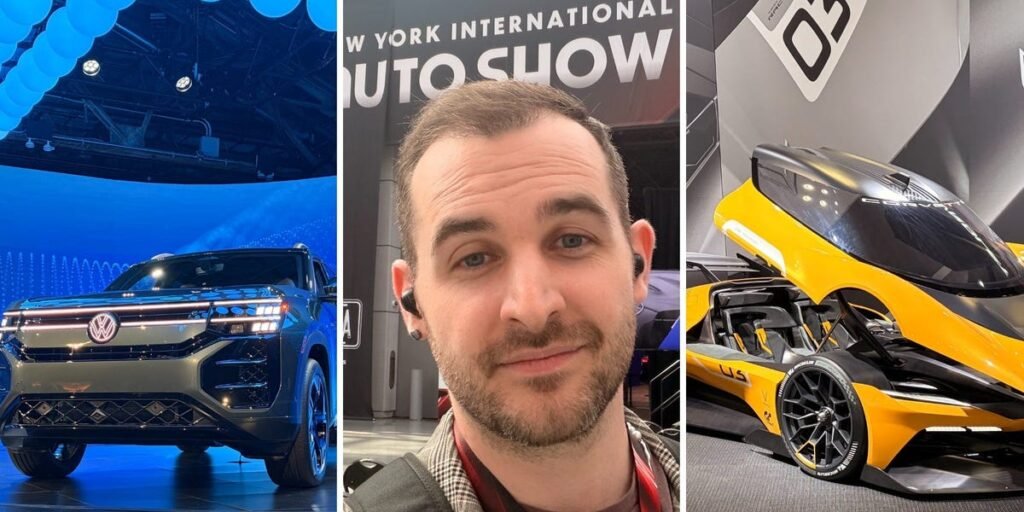
The auto industry is under siege on multiple fronts — tariffs, supply chain shocks, the associated rising costs, competition from China, and uneven demand for EVs.
So when I walked into the New York Auto Show this week — my third consecutive year at the expo — I expected executives to have a wide array of answers to the industry’s myriad challenges.
Instead, they all said the same thing: They’re responding to these pressures with a trunk full of AI.
That bet could dramatically change how automakers design, build, and sell vehicles. Most importantly, it could collapse a product’s development timeline and make companies more agile.
For decades, developing a new vehicle typically took four to six years from design to production. That timeline is now too slow as companies try to respond more quickly to fickle demand and global disruptions.
Nissan executives, for example, said they’re aiming to cut development time dramatically — targeting 36 months for a new powertrain and about 30 months for vehicles built on the same platform.
“Lead time to development time, all said and told, is a couple of years,” Eric Ledieu, the vice president of Infiniti America, Nissan’s luxury arm, told Business Insider. “Trying to get that cycle shortened is really our ambition.”
Executives from Hyundai said it’s doing the same, though it declined to share an exact timeline.
“The people that are using AI today, it will make them more efficient and effective,” Randy Parker, CEO of Hyundai Motor North America, told me. “The quicker that you lean in, the quicker you can embrace it. I think it will help you be more efficient and get to market a lot faster.”
Toyota, Ford, and GM executives are all humming a similar tune. Behind the show’s flashy product launches — a sleek Corvette concept from Chevy, a rugged new Hyundai SUV, EVs from Kia and Subaru — the executives all discussed their desire to find ways to move more efficiently.
Everything on the Javitz Center’s showroom floor, it seemed, flowed from that effort.
So many collabs
Ben Shimkus/Business Insider
One way to move faster is to work together.
It typically costs $1 billion or more to bring a new car to market. Increasingly, automakers are deciding they won’t do it alone.
Toyota and Subaru have partnered on EVs and now sell — or are preparing to launch — four closely related models. Nissan’s Rogue Plug-In Hybrid is a rebadged version of the Mitsubishi Outlander. Ram’s ProMaster City cargo van shares key components with the Fiat Scudo sold in Europe.
“The other big trend I see that’s a huge shock to this industry is a need for consolidation,” Ponz Pandikuthira, Nissan and Infiniti’s chief product and planning officer, said.
Pandikuthira said the Rogue Hybrid’s ties to Mitsubishi were partly due to the new compressed timelines.
“The costs are going up so much,” he added. “It doesn’t have to be a merger or some giant partner. We just have to do joint projects.”
He added that automakers producing fewer than 5 million to 8 million vehicles a year may struggle to survive on their own.
The return of the sedan
Ben Shimkus/Business Insider
For years, US automakers have steadily walked away from sedans, betting instead on higher-margin SUVs and trucks. Now, that calculus may be shifting.
With consumer costs still rising, several executives said they’re reconsidering smaller, more affordable vehicles — including sedans — to reach buyers who have been priced out of the market.
There are also practical reasons. Sedans tend to be more aerodynamic than SUVs, making them a better fit for EVs, for which efficiency is critical.
And there may be a cultural shift, too.
“I think the younger generation wants a little bit of differentiation,” Ledieu said, adding that SUVs and crossovers are “what mom and dad drive.”
So. Many. Light. Bars.
Ben Shimkus/Business Insider
One of the most visible design trends at the auto show was the rise of LED light bars — thin strips of light stretching across the front or rear of a vehicle.
And now, some new cars (including the Genesis G90 Winback concept and the redesigned VW Atlas) have two.
They’ve been around for a few years, but they’re no longer just a concept-car gimmick. They’re showing up across entire lineups.
Lincoln and Lucid feature them on nearly every model. Hyundai, Ford, GM, and Toyota have adopted them widely as well.
What was once a futuristic flourish is quickly becoming standard.
Showing up is expensive
Ben Shimkus/Business Insider
Presenting at the New York Auto Show doesn’t come cheap. Multiple executives told Business Insider they’re spending seven (and sometimes eight) figures to exhibit at the event.
That cost is changing how and where automakers choose to reveal their biggest vehicles.
Infiniti unveiled its coming 2027 QX65 SUV at a stand-alone event with former NFL stars Julian Edelman and Rob Gronkowski days before media previews began. Volkswagen showed off its redesigned 2027 Atlas at a warehouse a day before the Javitz Center opened to the press.
Even newcomers are opting out. Slate, the EV truck startup backed by Jeff Bezos, showed off its vehicle at a small shop about a mile from the convention center.
“Auto shows used to be the only place you reveal a car,” Ledieu said. “Now, you’re revealing them in all kinds of different places.”
Other executives said they still see a payoff from the show, even after complaining about the cost.
A clear winner
Sjoerd van der Wal/Getty Images
Amid all the talk of supply chains, geopolitical risk, and the industry’s uncertain future, I slipped in one lighter question during six of my interviews:
If you could take home any car from the show floor — and not one from your company — what would it be?
Bentley was the clear favorite. Four executives picked the luxury brand, including two who singled out the Flying Spur sedan.
All asked for anonymity when naming a rival.
A few other standouts made the cut, too: Chevy’s mid-engine Corvette and Hyundai’s body-on-frame Boulder concept each earned a nod.