


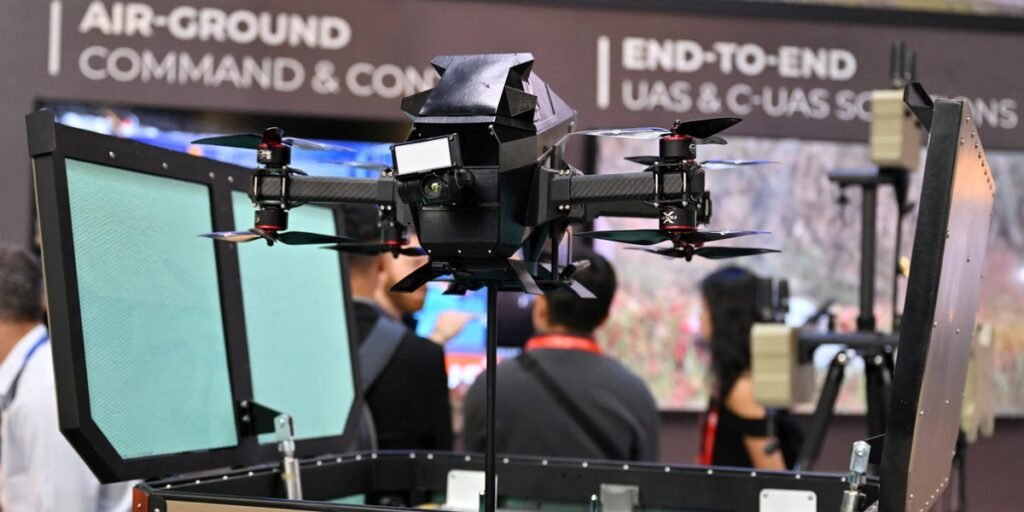
This year’s Singapore Airshow was a true display of how the world has come to both love drones and fear them.
Fighter jets danced in the sky and a slew of commercial airliners sat on the baking tarmac for military officials, students, and eager interns to gawk at.
But inside the main hall, you’d be hard-pressed to look anywhere and not see “drone” or “UAS” plastered on a placard or wall.
Roughly 550 organizations were listed as exhibitors at the event, which hosted a mix of civil aviation companies, defense contractors, and air forces. A third were in the uncrewed aerial system business.
Around every corner, it seemed as though there was a system to fight drones: Big drones, small drones, drones with bombs strapped to them, drones that spy on you from miles away, drones that spy on you from 300 feet in the sky — and increasingly, drones that fly at you in swarms.
Recent conflicts, especially the Ukraine war, has brought to the fore the fear of an unknown $600 device flying into a military base or a football stadium to deal untold damage or take lives.
The implications go beyond war. Last fall, repeated unidentified drone sightings forced European countries to disrupt hundreds of passenger flights.
The solutions on offer at the airshow covered almost everything one imaginable for preventing those scenarios. There were the usual radio frequency area jammers, designed to cut off any nearby drone from its link to the operator. These came in anything from handheld devices to boxes that you have to mount on flatbed trucks.
Skylock, an Israeli company, brought along a 13-pound, two-handed jamming gun called Skybeam, which is supposed to mess with electronics that you point the device toward.
Matthew Loh for Business Insider
There were actual guns, such as Saab’s new “Loke” system that features a truck-mounted, software-assisted machine gun to knock out drones in a “one shot, one kill” fashion. The company hopes to add airburst rounds soon.
There were, of course, drones to kill other drones, easily denoted by their aerodynamic design of a missile-like body, tear-shaped tail, and four propellers.
French manufacturing giant Thales was promoting the “ThunderShield,” a remotely operated dome-like device that targets small, Class 1 drones with an invisible electromagnetic beam that spreads out in a cone.
The company said the device has already been deployed at a major public event in France two years ago, though it wouldn’t say which (the biggest one that year was the Olympic Games.)
One standout was the CROSSBOW, a device developed by laser company IPG Photonics’ brand new defense division, IPG Defense.
Tucked away on the side of the exhibition hall, the Massachussetts-based company’s showcased an invention that fires lasers to destroy drones via thermal damage.
Matthew Loh for Business Insider
An accompanying radar helps the CROSSBOW identify drones from other flying objects, such as unsuspecting bald eagles, and an Xbox controller allows the operator to choose whether to engage the target.
Still, as one anti-drone tech salesman noted to me, many of the world’s counter-UAS inventions run on tech that isn’t necessarily novel. Like the idea of a hobbyist drone strapped with a grenade, most of these companies have simply merged older concepts that no one thought of combining before.
Some will say they merge that tech better than others, but it’s still no F-35 or F-47.
It’s another sign of how accessible air warfare is becoming, with quadcopters sitting alongside multimillion-dollar fighter jets and hulking Rolls Royce engines in the main hall.
The airshow, which is running its 11th edition of the biennial event, said that it’s seen the largest involvement so far from small and medium-sized companies this year.