


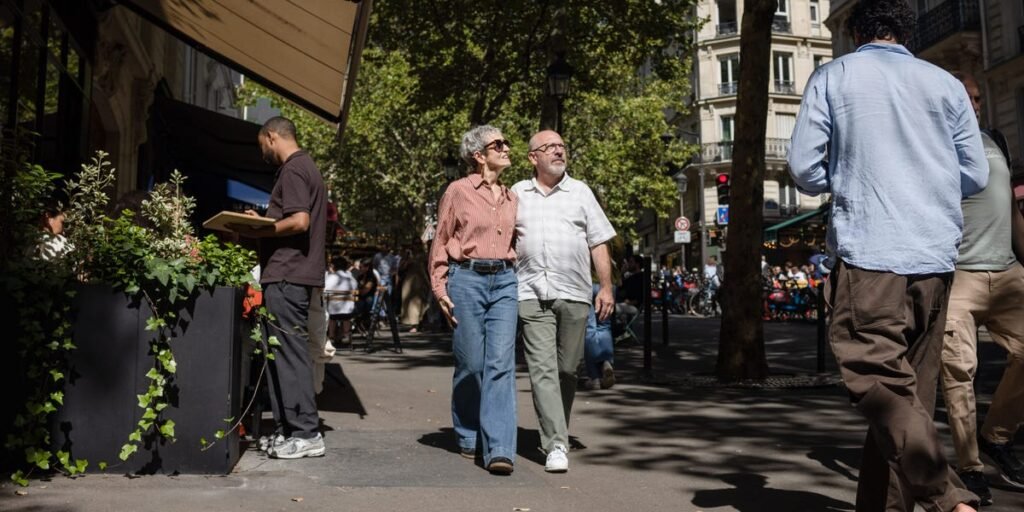
Getting fired after a reorganization at his firm wasn’t ideal, but Marty Yabrow and his wife, Angie, wanted to make the best of it, so in 2024 they booked a three-city trip to Europe. Then, one morning while Marty was filling out a planning spreadsheet with hotels and restaurants, Angie asked out of the blue, “Why don’t we just move there instead?” Marty was quick to react.
“I deleted that spreadsheet, and I started a new one,” he says.
Despite some initial misgivings from their financial advisor, Marty, 68, crunched the numbers and found that it was not only financially possible but also preferable to retire in France, since he and Angie, 73, would benefit from free healthcare. After selling their home in Atlanta, they moved to Paris in January 2025.

Camille McOuat for BI
A growing number of Americans have been flocking to the French capital, seeking a better work-life balance, a slightly cheaper cost of living, or some distance from politics back home. And unlike previous generations of uber-wealthy Americans investing in pied-à-terre properties, more people are making a permanent move. In 2025, 15,388 Americans applied for a French residency permit, a 17.3% increase from the previous year.
Parisians, meanwhile, are ambivalent about welcoming the Yanks. On the downside, the new wave of Américains is driving up housing prices for locals investing in their own high-end properties. On the upside, the rush of real estate cash is creating new financial opportunities and greasing the wheels of the housing market as many French people look to downsize.
“Americans are among the biggest foreign buyers in France,” says Maître Angélique Devaux, a notary in Paris.
They also tend to spend more: In Paris, one in four foreign buyers is American, and their average budget of 825,000 euros (roughly $950,000) exceeds the average value of both foreign and French purchases.
Camille McOuat for BI
These new expats are seduced by the historic neighborhoods: Odéon and Saint-Germain-des-Prés on one side of the river, Le Marais and the Triangle d’Or on the other. They’re interested in postcard Paris, says Guillaume de Blaÿ, managing partner at Barnes Bac-Varenne, a brokerage that has long served those looking for luxurious properties.
“Have you heard of ‘Emily in Paris’? That’s the sort of imagery I’m talking about,” he says.
Like the titular Emily, American buyers are also up for an adventure. They’re slowly looking further from the epicenter, venturing into neighborhoods where real (wealthy) Parisians live, such as Nouvelle Athènes and Montparnasse, close to bilingual schools and major parks. Some are even exploring the (chicer) suburbs. Regardless of where they settle, Americans are changing what is being sold and how.
Camille McOuat for BI
The morning after the 2024 election, Margo woke up and quoted Freud to her husband: “If one of us dies, I shall move to Paris.” They were both retired and already owned a vacation property in the south of France. Now it was time to make the definitive transatlantic move. By mid-November, Margo and her husband submitted a 700,000-euro offer for their new two-bedroom apartment near the Canal Saint-Martin, a neighborhood gentrified in the 2000s where, she says, the real Parisians live.
“The politics in the United States has got them crazy,” says buyer’s agent Adrian Leeds, who’s been operating an all-inclusive, let’s-move-you-to-France business for 30 years. “They literally say that: Get me out of here.”

Camille McOuat for BI
Beyond politics, a Parisian pad can also be a way for Americans to diversify their portfolio. Buying property in Paris isn’t a lucrative investment, but it is a safe one. Values have increased by 1.1% over the past year, and 31% since 2016, with a 2 to 4% projected annual increase in the next decade. The return on investment, especially in the short- to mid-term, isn’t great, since the transaction cost is around 8 to 9%, including taxes, disbursements, and notary fees. However, the two nearby airports make for a great European base, the city limits ensure constrained supply, and the historical preservation is attractive to long-term investors. It also allows American investors to hold assets not in US dollars, which can be a plus in times of volatility.
Far from being a luxury play, Paris can make more financial sense for some people. Compared with the French capital, cost-of-living measures show that major American cities like New York City and Los Angeles are more expensive to live in. Furthermore, education and healthcare are free, while Paris’ walkability allows residents to save up on car payments. Finally, the bilateral tax treaty protects against double taxation, and since French salaries are significantly lower, Paris is even more attractive to Americans living on a US salary or retirees.
Michelle Trinh still lives in New York, but thanks to her newly purchased apartment in the Marais, she’s ready to get on a plane at any time. She’s renovating the studio and is hoping to rent it out until she makes the leap. Whenever she visits Paris, “there’s just like a weight that gets lifted off.”
Want more Business Insider in your news feed?
Add BI in Google so our reporting is easier to find when you’re searching for what matters.
Camille McOuat for BI
Trinh gained a following through her YouTube channel, where she documented her rocky apartment-hunting journey. She described to me what she saw as an attempt from a French agent to squeeze a little more money out of her Big Apple purse. During her search, she found a place that she liked and made an offer. It was 5,000 euros below another buyer’s, but hers was all-cash. However, she learned that the seller’s agent hadn’t told their client about it, which she took as a tactic to pressure her into sweetening the deal.
“It’s very well known within the industry that you can get a higher price from an American buyer,” says Leeds.
Part of the reason Americans end up paying more is their unfamiliarity with the incredibly fragmented French real estate market. Instead of a single repository, listings are spread across dozens of mini-Zillows, which requires buyers to scour different sites to find what’s available. French buyers also typically do not employ their own agents to avoid paying extra fees and usually deal directly with the seller’s agent, whose commission is often factored into the listing price. This leads to dramatic information asymmetry. Americans tend to be naïve, Leeds says, and defer to the knowledgeable professional on the other side of the table.
“They trust the agent, and they shouldn’t trust the agent,” Leeds says. “They represent the seller. They don’t care what the buyer buys as long as they buy from them.”
Camille McOuat for BI
The cardinal sin of the American buyer, according to French agents, is failing to negotiate. The typical transatlantic buyer wants features that few Parisian apartments possess — the holy trinity is air conditioning, an elevator, and two toilets — and they are typically on a tight timeline. This combination makes star-spangled buyers less price sensitive. Andrea Boström Mouls, director of a well-established brokerage called Varenne, notes that many of her American clients go apartment hunting in 10-day chunks between April and June, often extending their stay around the French Open tennis tournament at Roland Garros. The window of opportunity is short: Should the stars align within that timeframe, they’re willing to act fast.
A big reason for this price blindness is that Americans work with an overall budget and a wish list rather than being sensitive to the number their French counterparts consider most important: price per square meter. French law requires floor-space measurements for all sales, and the Council of Notaries releases that data along with transaction prices and the number of rooms, making it easier to value properties and compare. The average price per square meter in the capital is 9 ,520 euros, but it jumps to more than 15,000 euros in the most expensive arrondissements.
“US buyers are disconnected from the market,” said an agent based in the bourgeois part of the city. She recently sold an apartment listed at 7,900,000 euros for 7,700,000 euros. Great deal, right? Not really. The price per square meter ended up at 20,000 euros, whereas she had valued it at 17,000 euros.
Camille McOuat for BI
The French opinion of the American takeover is varied. Leeds, who is an American transplant herself, has sensed some anger, but it’s not necessarily Yank-specific.
“They’re pissed off, and they have to blame somebody,” says Leeds. “And if it weren’t Americans, it would be the Saudis, the Russians, or whoever.”
But some French agents disagree. They believe French and American clients aren’t interested in the same apartments. Rather than directly affecting property value, foreign buyers’ influence ricochets through the market as they create new opportunities.
Americans have also played a part in developing another strand of France’s new real estate web: property flippers. French agents refer to them as “merchants” for marchands de biens. Americans want everything a traditional Parisian apartment lacks: renovated kitchens, en-suite bathrooms, and AC. So flippers step in to transform apartments into beige, two-toilet wonders with fashionable architectural renovations that look like five-star hotels. Frédérique Verrier-Pytel, associate director at Barnes Passy-la-Muette, a luxury international brokerage, tells me it’s very clear who these fresh-faced places are targeting.
“French buyers, even the wealthiest, don’t want to live around Trocadéro and aren’t interested in apartments that feel like hotel suites,” she says.
This new market, however, is having a trickle-down effect. Blaÿ recalls a property he listed on the rue de Varenne in the 7th arrondissement. Its floor plan mirrored that of an apartment on the same floor, which had been bought for 14,000 euros per square meter, renovated, and flipped at 25,000 euros per square meter. Using it as a benchmark, Blaÿ advertised his unrenovated listing at 17,000 euros per meter rather than 15,000.
Camille McOuat for BI
Americans are also introducing some other new real estate features to their French counterparts. One is the buyer’s agent — or property hunter. There are structural reasons for their rarity. For one, listing mandates are not exclusive, and agencies don’t typically co-list. The buyer’s agent is paid by the buyer as an added fee that makes little sense to the French, since they can comb through listings themselves. Second, much of the legal legwork that Americans would delegate to their agent is already handled by a notaire. French notaires are an essential and obligatory part of the process. They’re an independent and neutral entity that takes time (a lot of it) to check land titles, look for mortgages, draft deeds, collect taxes, and register the new deed.
“The notary is not there to defend [the buyer]. They’re there to defend the legality of the transaction,” says Justyna Simmons, cofounder and director of Your Friend in Paris, a relocation agency.
Margo was aware of her vulnerability as a foreign buyer and found an answer to her prayers in the shape of Susan Lu, the silk-haired “marvel” who ferreted out her apartment. Lu is a buyer’s agent at Parlez-moi de Paris. Besides finding listings and securing appointments, her job is to ask the right questions. Without her, Margo said, she would never have negotiated the listed price and would’ve spent 50,000 euros more as a result.
“I’m too old, and I don’t want to pretend,” says Margo. “I don’t want to spend the next 10 years becoming a real estate expert about Paris.”
While exact numbers are hard to come by, almost everyone in the Parisian real estate market says the number of buyer’s agents has exploded over the past few years. To Leeds, who was among the first to occupy this niche 30 years ago, many of these newcomers are shockingly unqualified.
“People are just coming out of the woodwork, and they’re doing podcasts and videos on YouTube and putting out a website and offering advice,” she says. “It’s unbelievable.”
There’s little sign that American buying will cool off anytime soon. Demand soared after the election and continues to rise, says Boström Mouls. Clients are even turning to co-ownership to share the costs of premium hotel-style apartments.
Camille McOuat for BI
“It’s nice, but I feel like Paris needs to remain a city for Parisians as well,” says Boström Mouls. The Swedish-born, Paris-adopted agent wants to make sure the capital doesn’t turn into more of a museum than a livable city.
From Atlanta to the 10th arrondissement, Angie and Marty are basking in their new lives. Despite the paperwork, their shipping container taking an unexpected six-week detour through Panama, and her French social security application requiring 12 document resubmissions via the Poste, their main regret is not moving earlier. I asked on a scale of 1 to 10, how would they rate their decision? Marty is quick to reply: “Eleven, twelve!”
Business Insider’s Discourse stories provide perspectives on the day’s most pressing issues, informed by analysis, reporting, and expertise.