


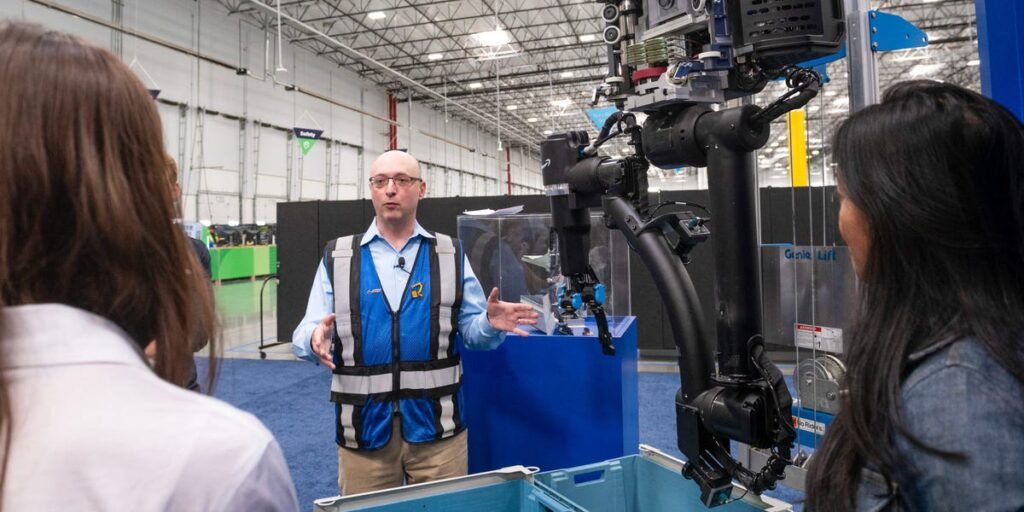
Amazon has pulled the plug on one of its newest warehouse robots, a few months after unveiling it.
Blue Jay, a multi-armed robotic system Amazon launched in October for its same-day delivery warehouses, quietly shut down in January, according to people familiar with the matter.
Many employees who worked on the project were reassigned to other robotics initiatives, the people added, while asking not to be identified discussing private matters.
The move shows how hard it is to develop AI robotics technology that’s useful and cost-effective. Generative AI has made huge gains in the digital world, thanks to free training data on the web. In the physical realm, useful training data is harder to come by, and the challenges of operating robots in real-world settings are much greater.
Terrence Clark, an Amazon spokesperson, told Business Insider that Blue Jay’s core technology will be carried over to other initiatives across the company’s network of warehouses. He added that Blue Jay was one of several warehouse robotics bets Amazon has made, alongside efforts such as Vulcan, Sparrow, and Proteus.

Every time Eugene publishes a story, you’ll get an alert straight to your inbox!
Stay connected to Eugene and get more of their work as it publishes.
“We’re always experimenting with new ways to improve the customer experience and make work safer, more efficient, and more engaging for our employees,” Clark said in a statement.
Blue Jay headwinds
Blue Jay was one of Amazon Robotics’ biggest announcements last year.
Developed in just over a year, far faster than earlier robots like Robin or Sparrow, it leveraged advances in AI to accelerate training and deployment. The machine featured multiple robotic arms capable of reaching and lifting several items at once, a design intended to boost productivity while creating a safer environment for frontline workers.
When Amazon unveiled Blue Jay in October, the company said it was being piloted at a fulfillment center in South Carolina and described it as a “core technology” for powering same-day delivery while lowering costs.
Internally, though, the project ran into headwinds. People familiar with the effort cited Blue Jay’s high cost, manufacturing complexity, and implementation challenges as reasons it was ultimately put on pause.
While the Blue Jay system itself is being shelved, Amazon plans to incorporate parts of its technology into future systems, including a new one called “Flex Cell” that will be more floor-mounted, the people said. (Blue Jay was mounted to the ceiling).
“Local Vending Machine” to “Orbital”
The shift is part of a move by Amazon away from an older same-day warehouse system known internally as “Local Vending Machine,” or LVM, the people said. LVM facilities were built as largely monolithic systems, with automation tightly integrated into a single, massive structure. Blue Jay was designed to operate within that framework.
Now, Amazon is pivoting to a new same-day warehouse system called “Orbital.” Unlike LVM, Orbital is designed to be modular, consisting of many components that can be assembled in different configurations, according to the people who spoke to Business Insider. The more flexible structure is intended to make the system easier to deploy and scale.
Orbital is better suited to smaller same-day delivery warehouses, rather than the sprawling fulfillment centers Amazon has historically operated.
The system could also potentially be installed as a micro-fulfillment solution in the back of Whole Foods stores, an area Amazon is prioritizing, the people said. Orbital is also expected to handle chilled products, such as groceries. Amazon is revamping its same-day delivery efforts to close the gap with Walmart in groceries and other perishable goods.
An Orbital rollout remains some time away. The first same-day warehouse built around the Orbital system is not expected to open until 2027, according to people familiar with the project.
Have a tip? Contact this reporter via email at ekim@businessinsider.com or Signal, Telegram, or WhatsApp at 650-942-3061. Use a personal email address, a nonwork WiFi network, and a nonwork device; here’s our guide to sharing information securely.