


Fact Checked by
CryptoNews Editorial Team
Author



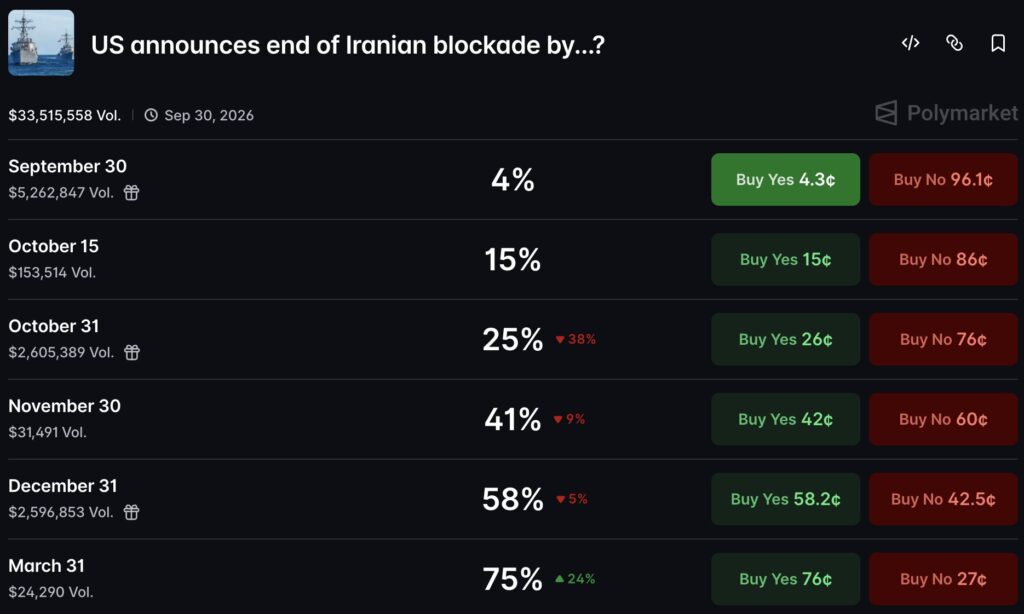
Iran War Polymarket odds price a US announcement ending the naval blockade of Iran no earlier than March 31, 2027, with the contract trading at 74.5% Yes to 25.5% No as of mid-morning on Tuesday, 29 September, according to live pricing on the platform.
The event has logged over $33M in cumulative volume since launch, and the highest-priced outcome sitting nine months out raises an obvious question: if US-Iran talks are genuinely progressing, why is the smart money betting on delay rather than a near-term resolution?

Got a Gut Feeling? It Could Pay Out Big on Polymarket
Iran War Polymarket Odds: What is the Diplomatic Backdrop Traders Are Watching?
Pricing is influenced by ongoing negotiations, as Reuters reported on September 24. U.S. and Iranian negotiators are considering a phased deal where Tehran would reopen the Strait of Hormuz in exchange for lifting the U.S. economic blockade. Both sides are hesitant to yield leverage; the U.S. maintains economic pressure, while Iran controls a key shipping artery for global oil.
However, current conditions do not trigger resolution under market rules. Polymarket specifies that only official announcements from the U.S. government can count for contract resolution, excluding speculation or conditional statements.
This discrepancy between market sentiment and strict legal requirements is causing outcome expectations to shift later in the timeline. Observers can also see how the Iran-U.S. ceasefire proposal is affecting Bitcoin price expectations, reflecting broader risk sentiment.
What the Full Ladder of Contracts Actually Shows
Polymarket’s blockade market features multiple deadline contracts that gauge the odds of a qualifying announcement on specific dates. These contracts can’t be combined into a single event probability, as each one represents a distinct bet.
Together, they suggest traders expect the diplomatic process to extend beyond the current news cycle. Once a qualifying announcement is made, it resolves as “Yes,” even if the blockade later continues or if a partial concession is made; such concessions do not qualify.
This distinction is important, as past U.S.-Iran ceasefire agreements have quickly unraveled, reflecting a tendency for narrower resolutions, similar to market bets on the Bab-el-Mandeb Strait, which require specific triggers for resolution.
Got a Gut Feeling? It Could Pay Out Big on Polymarket
Total volume across the event stands at $33,486,973, with liquidity of $519,322 as of the last update at 09:07:57 UTC Tuesday. The March 31, 2027 contract – the current price leader – carries relatively thin volume of just $24,290, meaning its 74.5% Yes print reflects a smaller pool of capital than the headline number suggests.
The heaviest trading has run through nearer-dated contracts already priced for near-certain No outcomes: the September 30 deadline alone has drawn $5,238,179 in volume against a mere 3.3% Yes price, and October 31 has seen $2,604,557 change hands at 24.5% Yes.
December 31 sits between the two extremes at $2,596,836 in volume and 57.9%. Yes. That distribution suggests most capital has already been deployed betting against a quick resolution, leaving the March contract as a comparatively low-conviction, low-liquidity outlier at the top of the ladder, a dynamic worth weighing against how Polymarket’s NATO-related contracts have similarly shown thin markets producing headline-grabbing but fragile probability prints.