



Crypto Journalist
Anas Hassan


Crypto Journalist


Share



A massive generational wealth transfer could reshape crypto markets over the next two decades as younger investors inherit trillions in assets and redirect capital toward digital assets at unprecedented rates.
Nansen founder Alex Svanevik predicts the impending shift will fundamentally alter crypto market dynamics, while recent data shows younger generations already allocating significantly more portfolio exposure to digital assets than their predecessors.
The transfer involves roughly $100 trillion changing hands globally within 20 years, with younger heirs demonstrating markedly different investment preferences than current asset holders.
“It’s like a tidal wave, you know, a tsunami that’s coming,” Svanevik told Magazine, explaining that even modest allocation shifts could double crypto’s current $3.05 trillion market cap. “There are all these kinds of forces that I think just drive crypto upwards.“
Younger Generations Demonstrate Radically Different Asset Preferences
A recent Coinbase research found 45% of younger U.S. investors currently own crypto, compared to just 18% of older generations, with younger cohorts allocating 25% of portfolios to non-traditional assets, triple the 8% allocation among older investors.
Four in five younger adults believe crypto will play a larger role in future financial systems.
The preference gap extends globally. Asia Pacific’s high net worth people now see nearly half allocating over 10% of portfolios to digital assets, with 87% already holding crypto and 60% planning to increase allocations.
In fact, a very recent Bitget Research found 20% of Gen Z and Alpha respondents expressing openness to receiving retirement funds in cryptocurrencies, while 78% showed more confidence in alternative savings methods than traditional pension funds.
Similar to Svanevik, Galaxy Digital’s Zac Prince also emphasized the demographic inevitability earlier this month, noting younger investors prefer “an app first” platform approach over traditional brokerage relationships.
“The older people are going to pass away and pass the money down to younger people,” Prince explained.
He added that younger investors are “much more familiar with platforms like the one that we have at GalaxyOne, where it’s kind of an app first. Multiple kinds of products in one place, really intuitive user interface versus the traditional, you have to pick up a phone and call your broker.“
2025 UBS data reveals $83 trillion will transfer between generations over the next 20-25 years, with $29 trillion in the United States alone.
Prince noted that wealth transfer patterns don’t strictly correlate with population size or GDP, pointing to Italy, which, despite having half Japan’s population and 60% of its GDP, is projected to see higher inter-generational wealth transfers due to higher savings rates and home ownership among elderly citizens.
Infrastructure Maturation Allows Sophisticated Product Development
The crypto industry has reached a level of key infrastructure maturity, allowing institutional-grade products that were previously impossible to build.
“The product we have built could not have been built two or three years ago because the infrastructure wasn’t there,” Svanevik explained, pointing to improved wallet technology and execution capabilities. “The wallet technology wasn’t good enough.“
Institutional adoption has accelerated alongside infrastructure improvements.
Morgan Stanley launched Bitcoin ETFs while traditional financial platforms expanded crypto access, even as retail sentiment remains cautious.
Last month, FINRA Foundation data shows crypto consideration among U.S. investors dropped from 33% to 26% between 2021 and 2024, with 66% viewing digital assets as extremely or very risky, up from 58%.
However, institutional products continue proliferating.
Prince noted distribution channels remain partially closed but expects continued expansion throughout 2025.
“The ETFs just came around last year. Some warehouses and other firms have a one-year lockdown on new ETFs being able to be made available to their clients.“
Gulf-region families show the wealth-transfer pattern already unfolding.
Bahrain’s Kanoo family backed Bitcoin in 2020 despite initial skepticism, later selling at a profit before continuing digital asset investments through hedge fund structures.
Banks, including Citigroup, Barclays, and Deutsche Bank, are scaling Gulf wealth divisions to capture an estimated $1 trillion in regional wealth transfers.
Svanevik believes passage of the CLARITY Act will usher in “a new era for crypto in the US,” with global implications. “The rest of the world is going to follow.“
Bitcoin Struggles Despite Wealth Transfer Optimism
Despite long-term adoption trends, Bitcoin has lost roughly 25,000 millionaire addresses in the year since President Donald Trump returned to the White House, falling from 157,563 addresses at his January 2025 inauguration to 132,383 by Jan. 20, 2026.

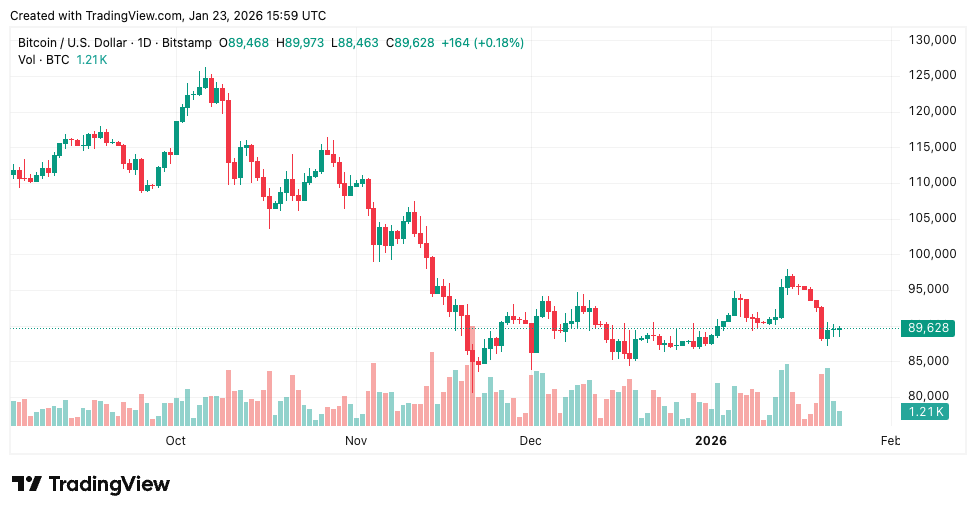
The crypto dipped below $90,000 today amid broader market volatility, even as institutional products continue proliferating and younger generations position themselves to inherit trillions in assets over the coming decades.